Labour’s plan to charge VAT on private school fees was a headline pledge in its 2024 general election manifesto. The move ends the long-standing VAT exemption enjoyed by UK private schools and independent schools.
The government’s objective is to raise between £1.5 billion and £1.8 billion annually. This revenue is earmarked to improve the state school system, including recruiting around 6,500 new teachers. Ministers argue that the policy promotes fairness and helps address educational inequality.
Legal Challenge Against the VAT Policy
Opponents of the government’s decision to impose VAT on private school fees argued that the policy unfairly targets vulnerable groups. The legal challenge came from families, faith schools, and organisations that support children with special educational needs.
The claimants said that adding VAT would restrict access to private education for many children. They raised concerns that families seeking faith-based schooling, single-sex education, or specialist provision would be hit hardest. Some argued that the policy breaches human rights by limiting choice and access to suitable schooling.
Despite these arguments, the High Court found no legal fault. Judges agreed that while there may be an impact on certain pupils, the government had acted within its powers. They ruled that the policy balanced individual rights against the wider public interest.
High Court Decision
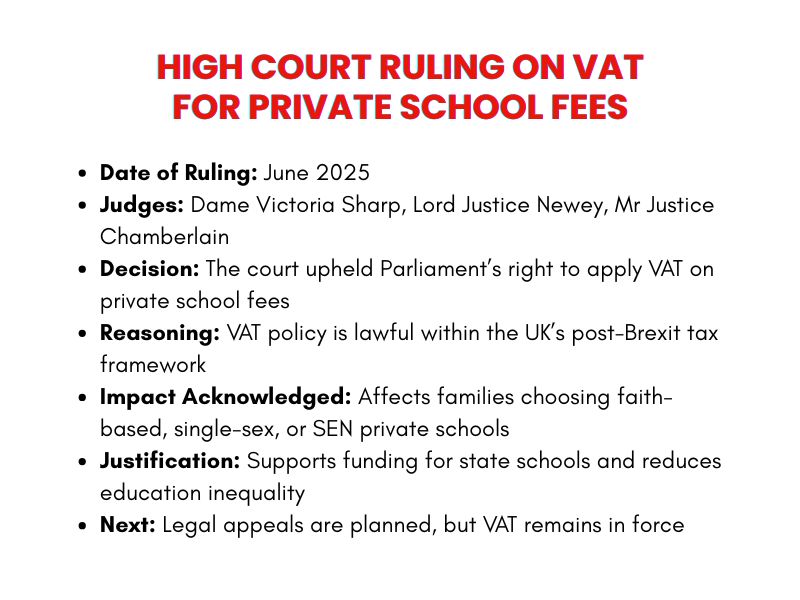
In June 2025, the High Court delivered its verdict on the legal battle over VAT on private school fees. The panel of judges Dame Victoria Sharp, Lord Justice Newey, and Mr Justice Chamberlain upheld the government’s policy. They confirmed that the move to apply VAT was within Parliament’s right to set tax laws, especially in the post-Brexit legal framework.
The ruling acknowledged that the tax might affect access to private education, particularly for families seeking specific types of schools. However, the judges noted that human rights law does not require the government to ensure access to independent schools. They found that any limitations imposed by the VAT were justified by the aim of improving education funding and equality through stronger support for state schools.
This decision has set a firm legal foundation for the continuation of the VAT policy, despite ongoing criticism from campaigners and independent school leaders.
Reactions to the VAT Ruling
The High Court’s decision to uphold VAT on private school fees sparked strong reactions across the education sector. The Independent Schools Council (ISC) expressed deep disappointment, calling the judgment a setback for parents who rely on independent schools for their children’s education. The ISC has announced plans to pursue an appeal, arguing that the policy harms educational diversity and freedom of choice.
Campaign groups, including those representing faith schools and special educational needs charities, warned of a damaging effect on vulnerable pupils. They claimed that families who choose private education out of necessity, not luxury, will suffer the most. For these groups, the VAT represents not just a tax increase but a barrier to suitable schooling.
On the other hand, the Labour government welcomed the ruling. Ministers defended the policy as a fair way to boost funding for state schools and reduce inequalities in the education system. They highlighted that revenue generated through VAT will directly support teacher recruitment and classroom resources.
Impact on UK Private Schools
Many UK families now feel the financial strain linked to VAT on private school fees. The policy has triggered fee increases, enrolment shifts, and concerns about the future of independent education.
Rising Fees and Changing Choices
Many parents are now reconsidering their options as fees surge following the 20% VAT charge. The financial impact is leading families to make difficult decisions about their children’s schooling.
- Parents could pay an additional £75,000 to £111,000 per child across their school career.
- Early signs show falling enrolment numbers in independent schools.
- More families are exploring grammar school places or switching to state schools to manage costs.
- Some private schools report that parents are delaying admissions or seeking bursaries.
Closures and Uncertain Futures
Smaller UK private schools are struggling to absorb the effects of the tax, especially those serving niche communities.
- Several schools have already announced closures, citing VAT as a key reason.
- Faith-based and special educational needs (SEN) schools appear most vulnerable.
- Closures reduce educational choice for families and communities.
- Local state schools may face added strain as displaced pupils seek new places.
Future Outlook for VAT on Private School Fees
Looking ahead, the debate over VAT on private school fees is far from over. The Independent Schools Council and other campaigners have confirmed plans to appeal the High Court’s decision. Their focus will be on arguing that the tax unfairly limits access to essential educational options for certain groups of pupils.
Meanwhile, the government remains firm. Ministers continue to promote the policy as a vital tool for funding improvements in the state school sector. The money raised is set to help recruit thousands of new teachers and upgrade school facilities, supporting the goal of reducing educational inequality.
Families and schools are watching closely for signs of further policy changes. There are concerns that the long-term impact could see more independent schools struggle to survive, while fee increases may continue to price some families out of private education entirely.
As the appeal process begins and the effects of the tax become clearer, the future of UK private schools will depend on how both the legal system and the education market respond.
FAQs
VAT was introduced to raise funds for state school improvements.
The 20% VAT took effect from January 2025.
Families using UK private schools, especially for faith or SEN needs, are impacted.
Some independent schools have already reported closures linked to the VAT policy.
Yes, campaigners plan to appeal the High Court’s decision.
Related Posts

Previous Post
Next Post





- Business
 5
5 - Cricket5
- Department for Education49
- Departments3
- Driving and Transport
 53
53 - Education45
- Finance6
- Football13
- Golf3
- Government
 108
108 - Guides1
- Health4
- Health
 5
5 - International Politics9
- Law and Justice31
- Money and Tax23
- National Politics4
- News68
- Politics6
- Sports38
- Technology5
- Tennis3
- Transportation4
- Uncategorized4
- Visa
 17
17 - Visas and Immigration
 24
24 - Weather1