UN response to the recent terrorist attack in Pahalgam, Jammu and Kashmir, has heightened tensions between India and Pakistan. The attack occurred in the Baisaran forest area of Anantnag district, a popular tourist destination in the region.
Pahalgam Attack Sparks Regional Tensions
The attackers targeted a group of tourists, leaving 26 people dead and many others injured. The event is considered one of the most horrific and violent acts in recent years. It has further intensified the already frail security situation in the region.
This tragedy has been universally condemned as brutal, cowardly, inhumane, and dastardly.It has drawn attention to the growing terrorist activities in Jammu and Kashmir. This has raised concerns about the safety of civilians. The areas frequently targeted by insurgents are particularly at risk.
While the attack primarily targeted tourists, the wider implications for peace and stability in the region are significant. The frequency of terrorist attacks in Kashmir is increasing. These attacks are often linked to extremist groups operating across the border. This further destabilizes an already volatile situation.
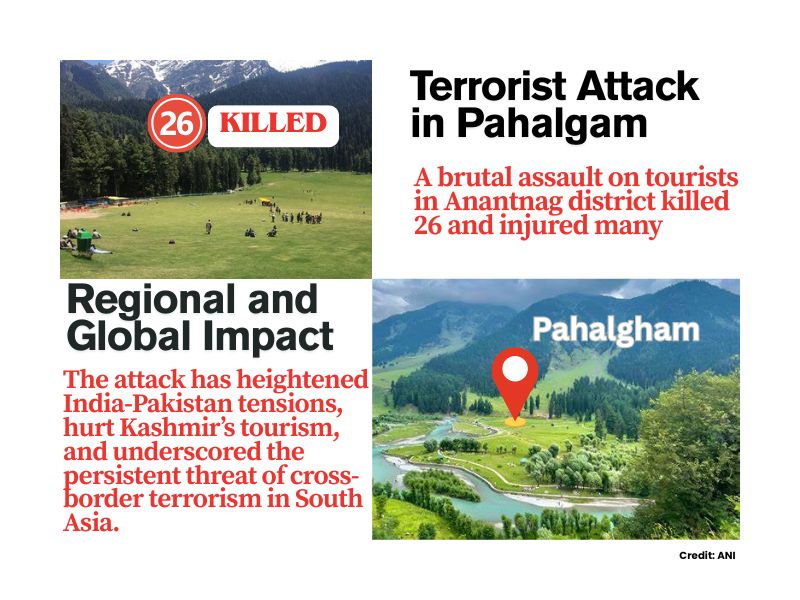
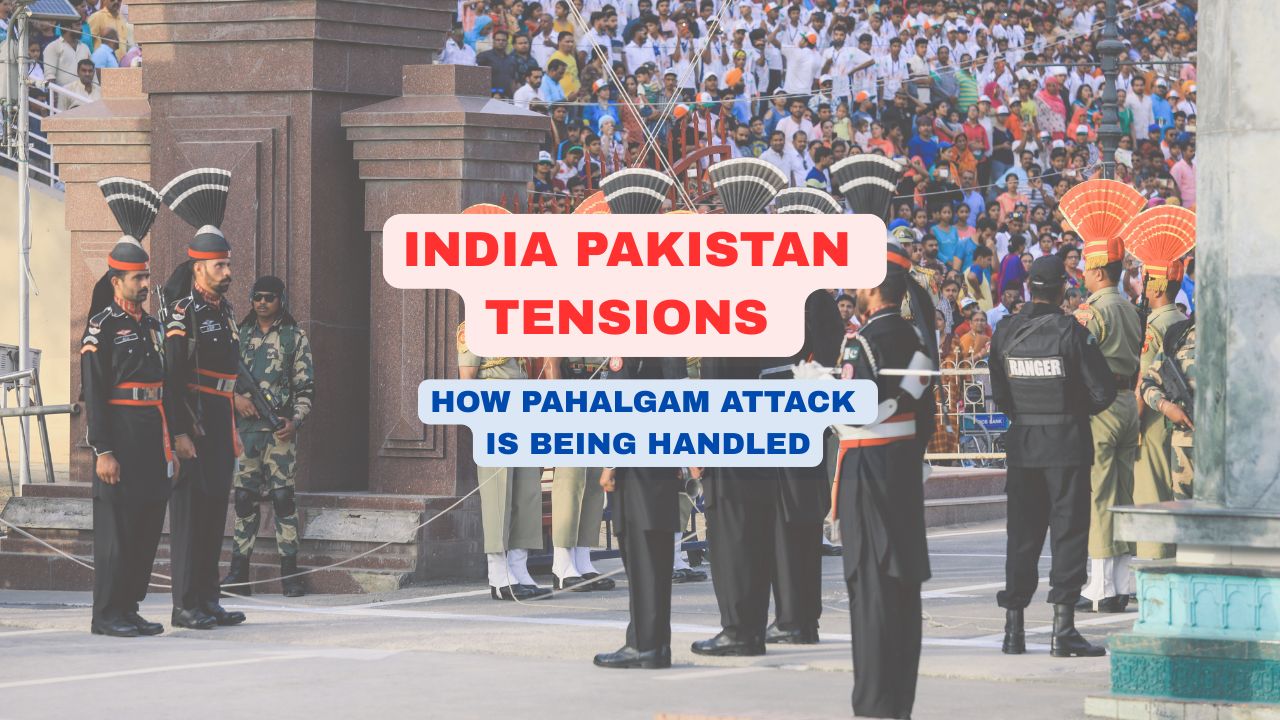
Source: ANI
Moreover, the impact on tourism in the region has been profound, with many countries issuing travel advisories for their citizens. The loss of innocent lives has had a significant emotional and psychological effect. The fear of future attacks has added to this impact. Both local residents and visitors have been affected.
The attack also highlights the broader issue of terrorism in South Asia, where cross-border violence remains a persistent threat.
UN Response to Pahalgam Terror Attack
Following the attack in Pahalgam, the United Nations was quick to issue a statement condemning the violence. UN Secretary-General Antonio Guterres expressed his firm disapproval of the attack. He reiterated that attacks on civilians are completely unacceptable. This stands true under any circumstances.
This condemnation was not only a message to the perpetrators of the attack. It was also a reminder of the UN’s commitment to human rights and the protection of innocent lives.
In his statement, Guterres offered his heartfelt condolences to the families of the victims. He acknowledged the immense grief and loss caused by such a senseless act of violence.
He emphasized that the international community must remain united in the fight against terrorism. The focus must be on protecting civilians, particularly in conflict zones like Jammu and Kashmir.
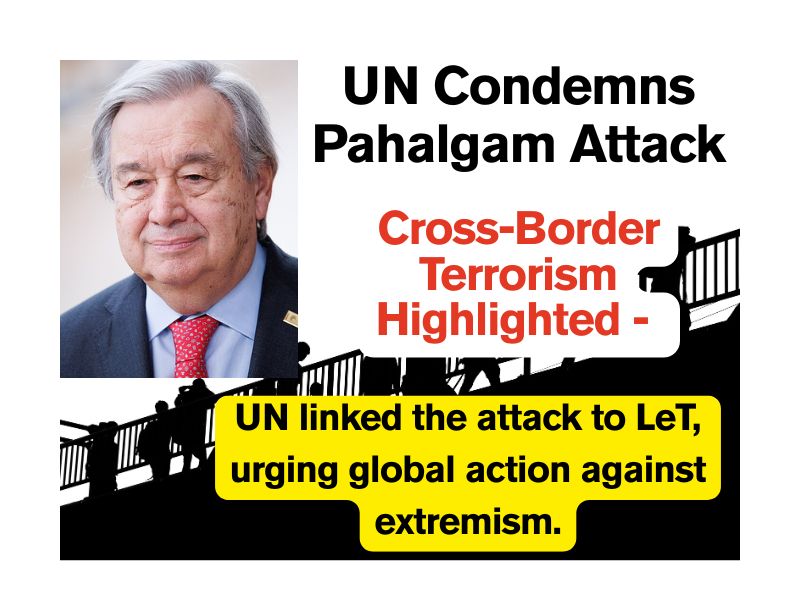
Source: Wikipedia
Stephane Dujarric, the UN Secretary-General’s spokesperson, provided further details. He confirmed that the terrorist group responsible for the attack was linked to Lashkar-e-Tayyiba (LeT), a Pakistan-based militant group.
This revelation added to the growing concerns about the cross-border links between terrorism and insurgency in the region. It also brought attention to the continued threat posed by such groups and the need for greater international cooperation to combat extremism in South Asia.
The UN’s response underscored the importance of addressing terrorism in all its forms. It stressed the need for countries to cooperate in curbing the activities of terrorist organizations.
While the UN’s statement was a strong condemnation of the attack, it also served as a reminder. The root causes of violence, such as political instability and territorial disputes, must be addressed. Only then can lasting peace be achieved in the region.
UN Response to Rising India-Pakistan Border Tensions
In the aftermath of the Pahalgam attack, tensions along the India-Pakistan border escalated, leading to a series of ceasefire violations. The Pakistan Army was reported to have fired small arms at Indian positions across multiple points along the Line of Control (LoC). This particularly occurred in the Nowgam area of Kupwara district in North Kashmir. Similar violations were reported in the Rajouri and Poonch regions of Jammu.
These violations came shortly after the terrorist attack, raising concerns. They were seen as part of a deliberate strategy to destabilize the region and provoke further conflict. The exchange of gunfire remained relatively limited, with no casualties reported on the Indian side.
However, the situation raised alarms about the potential for the conflict to escalate further. Both countries maintain a significant military presence along the LoC, which heightened these concerns.
The Indian military responded swiftly to the unprovoked violations, engaging in controlled counterfire. This response was in line with India’s policy of maintaining the security and integrity of its borders. The The Indian government made it clear that it would not tolerate any violation of its sovereignty. It would respond firmly to any acts of aggression along the border.
General Upendra Dwivedi, the Indian Army Chief, conducted a thorough review of the security situation in Kashmir. This was done in light of the increased cross-border tensions. The review focused on the ongoing efforts to combat terrorism and the need to address the increasing frequency of ceasefire violations.
The Indian Army also took additional measures to enhance the security of civilian areas near the LoC. These steps ensured that the population remained safe despite the rising tensions.
UN Response to the Role of International Mediation
The UN has condemned the terrorist attack and the subsequent ceasefire violations. However, the international community has an important role to play in reducing tensions between India and Pakistan.
The long-standing dispute over Kashmir remains a flashpoint for conflict. Any escalation along the border has the potential to trigger a larger regional conflict.
In such circumstances, international mediation could prove crucial in de-escalating the situation and encouraging dialogue between the two nations.
Historically, the UN has played a role in mediating conflicts between India and Pakistan. However, its effectiveness has been limited due to the complex nature of the Kashmir dispute.
Nevertheless, the international community has consistently called for dialogue and negotiations. These efforts aim to resolve the issues that fuel tensions between the two countries.
A peaceful resolution to the Kashmir conflict could pave the way for long-term stability in the region. This would reduce the likelihood of future violence.
While both countries have often resisted external involvement in the dispute, the growing threat of terrorism presents a challenge. The possibility of conflict spilling over into a broader regional war could necessitate greater international involvement. Diplomatic efforts, possibly through the UN or other international organizations, could help facilitate dialogue and prevent further escalation.
UN Response to Implications for Regional Security
The ongoing tensions between India and Pakistan have far-reaching implications for regional security in South Asia. Both countries possess nuclear weapons, and any military conflict between them could have catastrophic consequences. This reality makes it all the more urgent for both sides to find peaceful solutions to their disputes and avoid military escalation at all costs.
The recent attacks and border skirmishes highlight the fragility of peace in the region. The rise in terrorist activities, the use of proxy groups by both states, and the frequent violations of ceasefires along the LoC contribute to an environment of perpetual instability.
Without meaningful diplomatic engagement and conflict resolution, the situation could continue to deteriorate, with devastating consequences for the people of Kashmir and the broader South Asian region.
Regional organizations, such as the South Asian Association for Regional Cooperation (SAARC), must also take a more active role in promoting peace and security in South Asia.
While the organization has struggled to facilitate meaningful dialogue due to political differences, a renewed focus on peacebuilding and conflict resolution could help mitigate the risks posed by escalating tensions.
The Future of Indo-Pakistani Relations
The future of Indo-Pakistani relations remains uncertain, as both countries face complex challenges that hinder the path to peace. The ongoing conflict in Kashmir, combined with the rise of extremist groups operating across the border, makes reconciliation difficult.
However, it is crucial for both nations to engage in meaningful dialogue and address the root causes of their disputes.
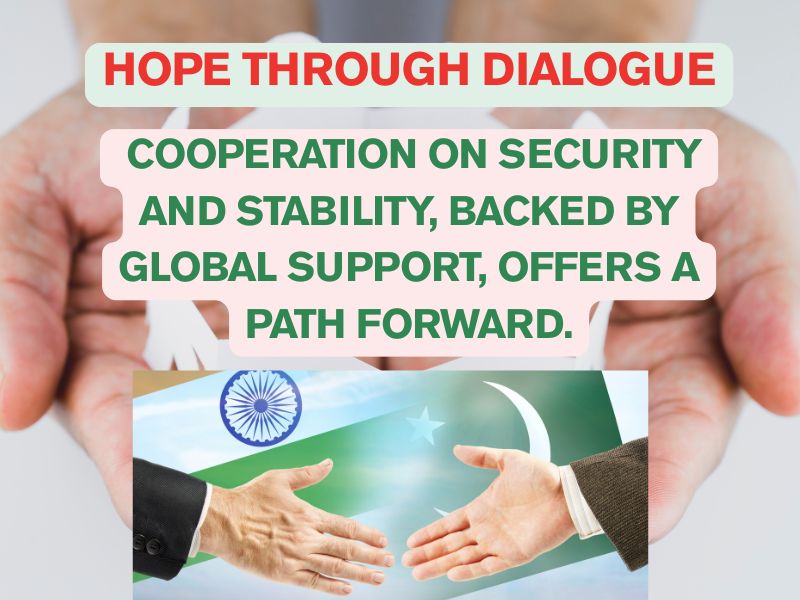
Despite the many challenges, there are opportunities for cooperation between India and Pakistan. Both nations share common interests in ensuring regional stability, fighting terrorism, and fostering economic growth.
A concerted effort by both governments, with support from the international community, could help pave the way for a more peaceful future.
Important Clarification: No Call for “Restraint”
While the UN response strongly condemned the Pahalgam terror attack and reiterated the importance of civilian protection, it is important to clarify that the UN did not specifically call for “restraint” after the border gunfire incidents.
The sources available indicate that the UN’s statements were primarily focused on condemning the terrorist attack and emphasizing the general principle that attacks against civilians are unacceptable.
At no point did the UN issue a direct call for restraint following the ceasefire violations along the Line of Control. The UN response remained centered on the humanitarian aspect of the attack, without addressing the military exchanges directly.
This distinction is important to understand the scope of the UN’s involvement and its focus on protecting civilians from violence.
Conclusion
The Pahalgam terror attack and the subsequent border violations highlight the persistent volatility in the India-Pakistan region. While the UN’s condemnation of the attack underscores the need for international solidarity against terrorism, it is clear that the path to lasting peace requires more than just statements of condemnation.
The UN response emphasizes that the international community must work towards fostering dialogue between India and Pakistan, addressing the root causes of conflict, and preventing further violence.
As tensions along the border continue, the UN response highlights the crucial role of international mediation and cooperation. Only through diplomatic engagement and mutual understanding can both nations hope to achieve peace and stability in the region.
The future of Indo-Pakistani relations will depend on the willingness of both governments to prioritize diplomacy over conflict and work towards a more peaceful South Asia.
Written by [Ketan Borada / British Portal Team] – Founder of British Portal, dedicated to providing accurate and up-to-date information on UK public services and benefits.Related Posts
Previous Post
Next Post






- Business
 5
5 - Cricket5
- Department for Education49
- Departments3
- Driving and Transport
 53
53 - Education45
- Finance6
- Football13
- Golf3
- Government
 108
108 - Guides1
- Health4
- Health
 5
5 - International Politics9
- Law and Justice31
- Money and Tax23
- National Politics4
- News68
- Politics6
- Sports38
- Technology5
- Tennis3
- Transportation4
- Uncategorized4
- Visa
 17
17 - Visas and Immigration
 24
24 - Weather1