Recent developments in UK charity regulation news have seen the nation’s charity watchdog step in to address concerns surrounding a community organisation. The Charity Commission UK has confirmed it has opened a formal investigation, known as a statutory inquiry, into The Muslim Community Centre and Mosque 1977.
This action, officially launched on April 3, 2025, follows worries about how the charity is being run, specifically concerning its management, governance, and a significant property dispute.
Understanding the Charity Commission’s Role
Before diving into the specifics, it’s helpful to understand who the Charity Commission is. They are the independent, official body responsible for regulating charities in England and Wales. Their job is crucial:
- Ensuring charities are genuine: They check that organisations claiming charitable status meet the legal requirements.
- Maintaining public trust: They work to ensure charities operate properly and use their resources for the public benefit, helping build confidence among donors and the public.
- Providing guidance: They advise charities on how to follow the law and run effectively.
- Taking action when needed: If serious problems arise within a charity, the Commission has the power to investigate and intervene to protect the charity’s assets and beneficiaries.
Their overall goal is to create an environment where well-run charities can thrive and make a positive impact on society.
What is a ‘Statutory Inquiry’?
The term “statutory inquiry” might sound quite formal, and it is. It represents the Charity Commission’s statutory inquiry process, which is one of the most serious tools the regulator uses. Here’s what it means in simple terms:
- Formal Investigation: It’s an official, legally backed investigation into matters of significant concern within a charity.
- Triggered by Serious Concerns: The Commission doesn’t launch these lightly. It indicates they have identified potential risks or problems that need a thorough examination. These could relate to misconduct (deliberate wrongdoing) or mismanagement (running the charity poorly).
- Fact-Finding Mission: The main goal is to carefully investigate and establish the facts of the situation.
- Protective Powers: The inquiry allows the Commission to use specific legal powers if necessary to protect the charity’s funds, property, or reputation.
- Important Note: Crucially, the Charity Commission always emphasises that opening an inquiry is It simply means some issues warrant a formal, in-depth look. Guilt or fault is not assumed at this stage.
The Muslim Community Centre and Mosque 1977
The subject of this specific investigation is the Muslim Community Centre and Mosque of 1977. An important detail highlighted by the Commission is that this organisation is currently an unregistered charity.
- What ‘Unregistered’ Means: Generally, charities in England and Wales with an annual income over £5,000 must register with the Charity Commission. Smaller charities, or certain types like some religious organisations, might not be registered.
- Still Subject to Regulation: However, being unregistered does not mean a charity is outside the law or the Commission’s oversight. All organisations operating as charities, registered or not, must comply with charity law. This unregistered charity investigation UK shows the Commission takes concerns seriously regardless of registration status. The Commission confirmed that its initial checks concluded that this organisation is legally a charity.
Why Has This Investigation Been Launched?
The Charity Commission has outlined several key areas of concern that prompted The Muslim Community Centre and Mosque 1977:
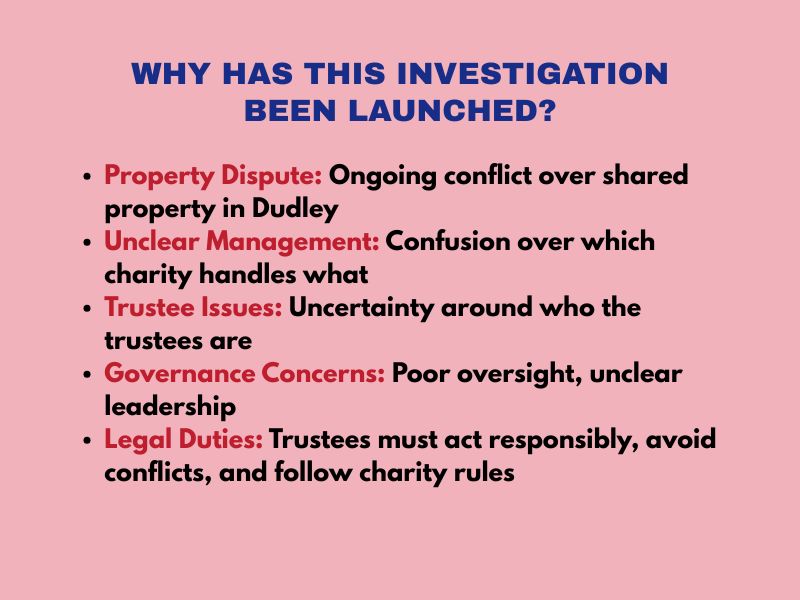
The Property Dispute:
- A major concern revolves around a property dispute. Specifically, there is an ongoing disagreement between the Muslim Community Centre and Mosque 1977 and another charity, the Dudley Central Mosque and Muslim Community Centre (which is a registered charity).
- This dispute has created uncertainty and potential risk regarding shared property located in Birmingham Street, Dudley.
- There appears to be a lack of clarity about which charity is responsible for what aspects of managing this shared property.
- Concerns also exist about how related charitable funds (money intended for charitable purposes) are being banked amidst this dispute.
- The Commission notes that those involved have, so far, been unable or unwilling to resolve these issues themselves, necessitating regulatory intervention. Charities must protect their assets and use them correctly to avoid serious property disputes.
Governance and Management Concerns:
- Beyond the property issue, there are broader governance issues. The charity’s leaders manage its operations, make decisions, and ensure it follows its own rules and charity law.
- The Commission is worried about the overall management and administration by the charity’s trustees.
- A significant point raised is a lack of clarity over who the current trustees of The Muslim Community Centre and Mosque 1977 are. Identifying the responsible individuals is fundamental to charity oversight.
Trustee Duties:
Central to these concerns are the duties expected of charity trustees. The Charity Commission highlights that all trustees have legal obligations. Understanding charity trustee responsibilities UK is vital. Trustees must:
- Always act in the best interests of their charity.
- Manage the charity’s resources responsibly (including property and finances).
- Act with reasonable care and skill.
- Ensure the charity is carrying out its purposes for the public benefit.
- Properly manage any conflicts of interest.
- Comply with the charity’s governing document (its rulebook) and the law.
- Provide accurate information annually to the Commission (even if unregistered, certain information may be required).
The inquiry will examine whether the individuals acting as trustees for The Muslim Community Centre and Mosque 1977 have been meeting these important duties.
What Will the Inquiry Look At?
The statutory inquiry will delve deep into the charity’s operations. The Commission has stated it will examine the extent to which:
- Following the Rules: Is the charity being managed according to its governing document (its constitution or rulebook)? Is that document still suitable?
- Sufficient Trustees: Does the charity have enough people properly appointed as trustees to manage it effectively?
- Protecting Property: Is the charity’s property being looked after correctly and kept safe? This links directly back to the property dispute mentioned earlier.
- Trustee Performance: Have the trustees fulfilled all their legal duties and responsibilities?
- Misconduct or Mismanagement: If failings are found, were they due to deliberate misconduct or poor management (mismanagement) by the trustees?
The Commission also notes that the scope of the inquiry might widen if other regulatory issues come to light during the investigation.
The Importance of Charity Governance and Regulation
This Charity Commission Muslim Community Centre 1977 investigation highlights why good governance and regulation are so essential for the thousands of charities operating across the UK.
- Public Trust: Charities rely heavily on public trust and goodwill. When people donate money or time, they expect the charity to be run properly and effectively. Issues like property disputes or unclear governance can damage this trust, not just for one charity but potentially impact the wider sector.
- Protecting Assets: Charities must use their funds and property for specific charitable purposes. Robust governance helps ensure these assets aren’t wasted or put at risk.
- Effective Delivery: Charities that run well are more likely to achieve their goals and make a real difference for their beneficiaries and communities. Clear roles, responsibilities, and adherence to rules (like those outlined in the Charity Governance Code UK, which sets out principles of good practice) are key.
- Accountability: Regulation ensures that charities are accountable for their actions to the public, to their beneficiaries, and the law. Investigations like this one are part of that accountability framework.
What Happens Next?
Statutory inquiries are thorough processes and can take time to complete.
- Ongoing Investigation: The Charity Commission will now gather evidence and examine the issues in detail.
- Report Publication: Once the inquiry concludes, the Commission usually publishes a report detailing its findings, conclusions, and any actions taken. This ensures transparency.
- Separate Inquiry: It’s worth noting the Commission also has a separate, ongoing statutory inquiry into the other charity involved in the property dispute, Dudley Central Mosque and Muslim Community Centre, focusing on its own governance and financial controls.
This story is currently developing, and the focus now is on the investigative process. The inquiry aims to bring clarity and resolution to the concerns, protecting the charity’s assets for the community’s benefit. It serves as a reminder of the vital role the Charity Commission UK plays in overseeing the sector and the importance of sound management and governance for all charities.
Read more about NHS England’s Big Update: More Local Health Services Explained
Frequently Asked Questions
The UK’s Charity Commission is formally investigating The Muslim Community Centre and Mosque 1977. Concerns involve its management, governance (how it’s run), and a specific property dispute with Dudley Central Mosque.
It’s the Charity Commission’s most serious type of formal investigation, started because of significant concerns. Its main purpose is to establish the facts of the situation, not to assign blame initially.
No. The Charity Commission emphasises that opening an inquiry does not mean anyone has been found guilty of wrongdoing. It is strictly an investigation phase to gather facts.
The key reasons cited are concerns about its overall management and governance, issues related to a property dispute with another charity, and uncertainty about who its current trustees are.
The Charity Commission will conduct a thorough investigation, which can take some time. Once complete, they typically publish a report explaining their findings and any actions taken.
Source / Ref.: Gov.uk Contains public sector information licensed under Open Government Licence v3.0.
Written by [Ketan Borada / British Portal Team] – Founder of British Portal, dedicated to providing accurate and up-to-date information on UK public services and benefits.Related Posts

Previous Post
Next Post




- Business
 5
5 - Cricket5
- Department for Education49
- Departments3
- Driving and Transport
 53
53 - Education45
- Finance6
- Football13
- Golf3
- Government
 108
108 - Guides1
- Health4
- Health
 5
5 - International Politics9
- Law and Justice31
- Money and Tax23
- National Politics4
- News68
- Politics6
- Sports38
- Technology5
- Tennis3
- Transportation4
- Uncategorized4
- Visa
 17
17 - Visas and Immigration
 24
24 - Weather1