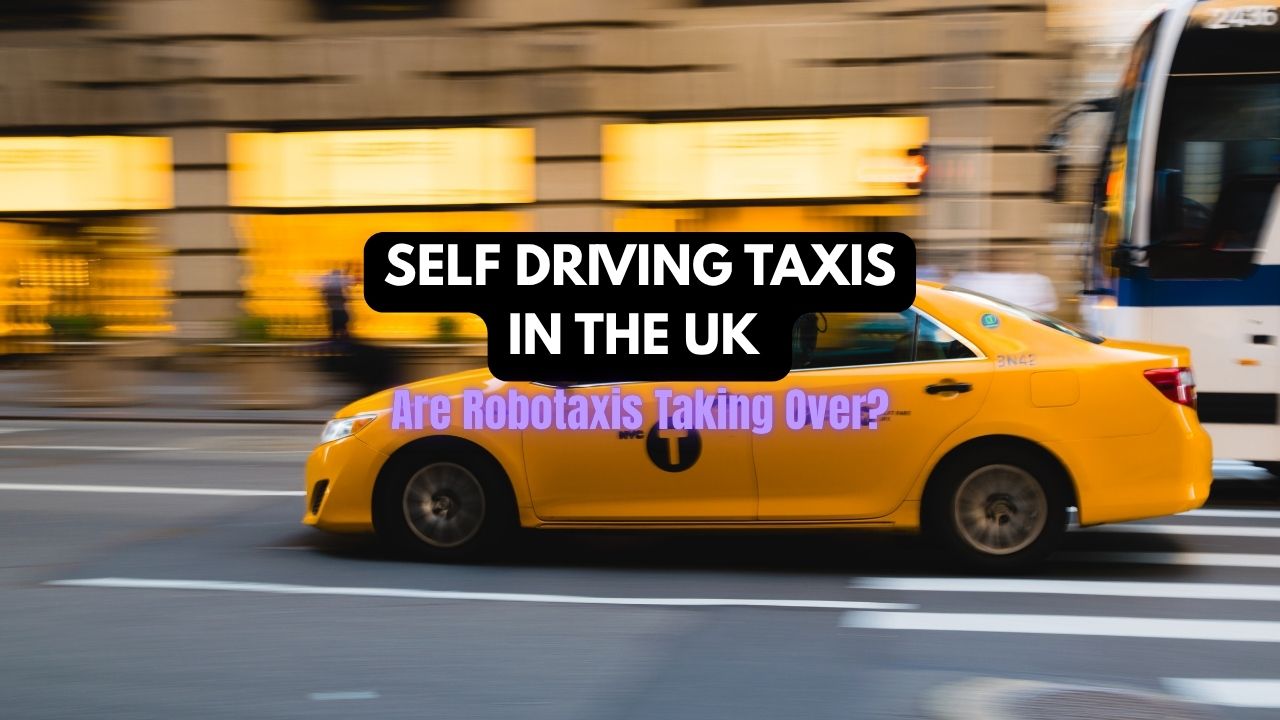
Self driving taxis in the UK are set to reshape how people travel. As technology advances, traditional cabs may soon be replaced by driverless robotaxis cruising through busy city streets. Trials are already underway in major areas, signalling a bold shift in public transport. Backed by tech firms and government funding, these autonomous vehicles promise to reduce accidents, cut emissions, and offer smoother journeys.
Still, this new chapter in UK transport raises important questions.
Will these autonomous taxis be safe? How will they affect jobs? And when will you be able to hail one?
In this blog, we explore everything from upcoming trials and technology to, furthermore, the real-world benefits and public concerns.
What Are Self Driving Taxis?
Vehicles like self driving taxis in the UK, also known as driverless taxis or robotaxis, operate without a human driver by using sensors, cameras, GPS, and AI to navigate roads.
These vehicles rely on:
- Cameras to read road signs and traffic lights.
- Radar and LiDAR sensors to detect nearby cars, cyclists, and pedestrians.
- AI-powered software that makes split-second driving choices.
Unlike normal cars, robotaxis don’t need a person behind the wheel. Some may still have steering wheels and pedals as a backup, but many are being tested without them.
In the UK, this idea is gradually moving from theory to practice. Moreover, thanks to real-world trials and strong government support, driverless technology is becoming more reliable and road-ready.
Self driving taxis aim to:
- Reduce human error, which causes 88% of traffic accidents in the UK.
- Offer convenient, on-demand rides without needing a driver.
- Improve transport access for people with mobility issues.
These taxis will likely be electric, making them cleaner than petrol cars. They’re not just a new way to ride they’re a possible solution to urban congestion and safety challenges.
When Are Driverless Taxis Coming to the UK?
According to government plans and industry updates, self driving taxis in the UK are expected on public roads by 2026, with major rollouts following initial trials.
Key milestones include:
- 2024–2025: Testing and limited public trials in selected areas.
- 2026: Launch of commercial autonomous taxi services.
- 2030 goal: Widespread integration into urban transport systems.
Cities like London, Manchester, and Cambridge are leading the way, with trials already underway or in planning. These early programs help test safety, collect data, and build public trust.
The UK government is playing a major role in speeding things up. A £100 million investment is backing self driving technology, while new laws such as the Automated Vehicles Bill are being drafted to legalise the use of fully driverless vehicles on public roads by 2026.
Who’s Behind These Smart Cars?
Self driving taxis in the UK are backed by major tech firms, transport companies, and UK innovators. These groups are leading trials and preparing for commercial launches.
Key players:
- Uber is teaming up with Motional and Waymo to launch self driving Ubers by 2026.
- Oxa (Oxbotica) is a UK firm creating software for local road and weather conditions.
- Waymo, Google’s self driving unit, plans UK expansion after US success.
- Cruise, supported by GM and Microsoft, is eyeing UK trials next.
Public transport giants like Stagecoach, First Bus, and National Express are trialling driverless buses with government backing.
The UK Department for Transport (DfT) is:
- Funding trials
- Updating laws
- Setting safety standards
As a result, combined public and private efforts are placing the UK at the forefront of autonomous taxi development.
Where Will You First See Them?
Selected UK cities and regions, chosen for their road readiness and infrastructure, will host early trials of self driving taxis in the UK to test robotaxi safety before wider rollout.
UK cities and areas leading the way:
- London
The capital is at the heart of the driverless movement. Trials supported by Uber and UK tech firms are already underway. With its complex traffic and dense population, London provides the perfect testing lab for autonomous vehicle behaviour. - Manchester
Manchester has been chosen for future pilot programs, especially involving self-driving Ubers. The city’s diverse road layouts from motorways to residential streets help companies train their vehicles under real conditions. - Milton Keynes
A long-time testbed for smart mobility, Milton Keynes is part of multiple government-backed projects. It was one of the first cities to host autonomous pod trials and will now see robotaxis join the streets. - Cambridge
Known for its innovation, Cambridge is also trialling autonomous vehicles, particularly for academic and medical transport within the city. - Oxfordshire and Northumberland
Meanwhile, these areas are seeing rural driverless testing, which is crucial for expanding services beyond major urban centres. In particular, testing focuses on how autonomous taxis perform on country roads and in unpredictable weather.
These early deployments will shape how the rest of the UK adopts driverless taxis. If successful, more cities including Birmingham, Glasgow, and Bristol could see similar programs within a few years.
Why Is the UK Pushing Driverless Cars?
Support for self driving taxis in the UK is growing as they promise safer, cleaner, and more efficient transport.
Key benefits:
- Fewer Accidents: Robotaxis cut crashes caused by human error, responsible for 88% of road incidents.
- Less Congestion: Autonomous cars can ease traffic with smarter, faster responses.
- Greener Travel: Most will be electric, helping the UK hit net-zero by 2050.
- Inclusive Mobility: Great for those who can’t drive, offering door-to-door service.
- Economic Growth: New jobs, tech leadership, and billions in potential revenue.
- Smarter Roads: Fewer cars, less parking stress, and more space for cyclists.
Simply put, self driving taxis in the UK are more than innovation, they’re a practical solution for modern transport challenges.
What Worries People About Driverless Cars?
Self driving taxis in the UK raise concerns, despite their benefits. Many people remain cautious about handing over full control to machines.
Main concerns include:
- Safety: Can robotaxis handle emergencies or unpredictable road users without human help?
- Hacking risks: Being software-driven, these vehicles could be vulnerable to cyberattacks.
- Job loss: Drivers fear automation may replace their livelihoods.
- Legal issues: Who’s at fault in an accident – the manufacturer, the owner, or the system?
- Road readiness: UK roads are narrow, complex, and weather-challenging. Can AI cope?
Trials aim to prove both safety and build public trust, but these questions must be addressed before wide acceptance.
How Will They Work with Buses and Trains?
As self driving taxis in the UK become more common, they won’t replace public transport, they’ll enhance it. These driverless vehicles are expected to work alongside buses and trains to create a more flexible, connected transport network.
Integration goals:
- First and last mile support
Robotaxis can fill the gap between your home and the nearest bus or train station, making public transport more accessible. - Reduced traffic pressure
Fewer private cars on the road means less congestion, allowing buses to run more smoothly and on time. - Data-driven coordination
Autonomous taxis can be programmed to avoid busy routes during peak bus or train times, supporting better traffic flow. - Smart hubs
Transport hubs in cities may combine self driving taxi bays with bus stops and train platforms for easy transfers.
Therefore, by working together, traditional transport and driverless services can create a cleaner, faster, and more reliable travel experience for everyone.
What’s Next for Self Driving Taxis in the UK?
The future of self driving taxis in the UK is approaching fast. With pilot programmes expanding and full rollouts planned by 2026, the next two years will be critical for testing, regulation, and public adoption.
What to expect:
- More trials in new cities: Expect pilot schemes in places like Birmingham, Glasgow, and Bristol.
- Updated laws: The government is working on new legislation to define insurance, accident liability, and safety standards.
- Public engagement: Demonstrations, media campaigns, and hands-on trials aim to build trust.
- Private sector investment: Tech and transport companies are pouring millions into research and infrastructure.
While challenges remain like public confidence and weather-based performance self-driving taxis in the UK are no longer a distant vision. They’re a near-future reality that could reshape how the country moves.
Conclusion
As the UK prepares for a future with self driving taxis in the UK, it’s clear that these vehicles are more than just a tech upgrade. They represent a shift toward safer, greener, and more connected transport.
From early trials in cities like London and Manchester to full-scale rollouts expected by 2026, robotaxis are set to transform daily travel. While public concerns around safety and trust still exist, strong government backing, tech innovation, and thoughtful planning are helping ease the transition.
In the years ahead, self driving taxis in the UK could reduce congestion, cut emissions, and expand mobility for all creating a smarter, more inclusive transport system for the future.
FAQs
They are expected to launch commercially by 2026 after ongoing trials.
Cities like London, Manchester, and Cambridge are leading early trials.
They may reduce some roles, but new tech jobs are expected to grow.
They’re being tested for UK-specific road and weather conditions.
New laws are being developed to address legal responsibility.
Companies like Uber, Waymo, and UK firms like Oxa are leading the charge.
Related Posts

Previous Post
Next Post







- Business
 5
5 - Cricket5
- Department for Education49
- Departments3
- Driving and Transport
 53
53 - Education45
- Finance6
- Football13
- Golf3
- Government
 108
108 - Guides1
- Health4
- Health
 5
5 - International Politics9
- Law and Justice31
- Money and Tax23
- National Politics4
- News68
- Politics6
- Sports38
- Technology5
- Tennis3
- Transportation4
- Uncategorized4
- Visa
 17
17 - Visas and Immigration
 24
24 - Weather1