Self driving cars are no longer science fiction. They’re real and already on our roads.
In 2025, the world of autonomous cars is changing fast. From driverless cars in cities to trials of autonomous vehicles in public transport, we’re living through a driving revolution.
But what do these terms mean? How do self driving vehicles work? And can we trust them?
This blog breaks it all down in plain language, what autonomous driving cars are, how they work, where they’re used, and the benefits of driverless cars.
What Are Self-Driving Cars?
Self driving cars, also known as autonomous cars or driverless cars, are vehicles that can move without a human driver. These cars use advanced technology to navigate roads, avoid obstacles, and follow traffic rules all on their own.
Instead of a person controlling the steering wheel, brakes, and accelerator, the car’s computer system takes over these tasks. This allows the vehicle to drive safely and efficiently, even in complex traffic situations.
They use a mix of smart technologies to “see,” “think,” and “drive” safely.
Key features include:
- Cameras to watch the road and traffic
- Radar and lidar to detect objects around the car
- GPS and maps to know where they are
- Computer brains to make driving decisions in real time
There are different levels of autonomous driving, from basic assistance to full control:
- Level 0: No automation, human does everything.
- Level 1–2: Some help like steering or braking, but you stay alert.
- Level 3: Car can handle driving in some cases, but may ask for help.
- Level 4: No help needed in certain areas, like city zones.
- Level 5: Fully autonomous vehicles, no steering wheel needed.
In short, these cars don’t just follow commands, they understand the road and act on their own.
How Do They Work?
Self driving cars rely on smart tech to drive safely without a person in control. They use a combination of cameras, sensors, radar, and lidar to “see” the world around them in real time. These devices gather detailed information about nearby vehicles, pedestrians, road signs, and obstacles.
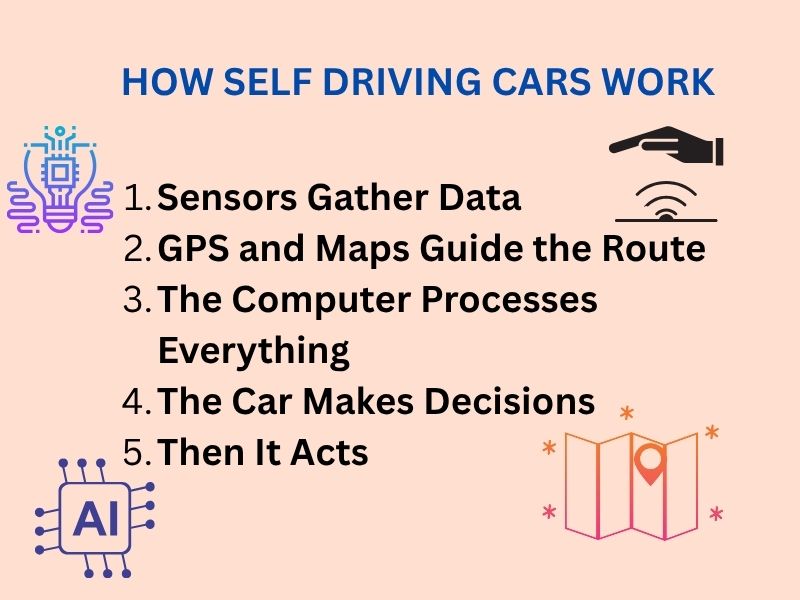
Then, the car’s computer system processes all this data using artificial intelligence to make quick decisions about steering, braking, and accelerating. This allows the vehicle to navigate roads smoothly while reacting to changing conditions without any human input.
Here’s how it works, step by step:
- Sensors gather data
Cameras, radar, lidar, and other tools scan the surroundings such as cars, people, signs, and more. - GPS and maps guide the route
Like your phone’s map app, but way more detailed, down to lanes and traffic lights. - The computer processes everything
The car’s brain uses AI to understand the road, traffic, and conditions. - The car makes decisions
It decides when to turn, slow down, stop, or overtake, just like a human driver would. - Then it acts
Using steering, brakes, and acceleration, the car moves itself.
This is how autonomous driving cars stay on track, avoid danger, and follow rules, all without a driver touching the wheel.
Current Status in 2025
In 2025, self driving cars are no longer just prototypes, they’re being tested and even used in some places. While many autonomous vehicles are still in the trial phase, some companies have started offering limited services to the public.
However, most of these cars are not yet fully driverless and usually operate in controlled environments or along fixed routes. This cautious approach helps ensure safety as the technology continues to improve and regulations catch up with the rapid progress.
Examples in action:
- Waymo runs driverless cars in Phoenix and Los Angeles. No safety driver inside.
- Tesla has “Full Self-Driving” features, but a human must still watch the road.
- WeRide and Renault are testing electric minibuses in Barcelona on fixed paths.
Many of these self driving vehicles are used in ridesharing, public transport, or business fleets.
We’re not at Level 5 yet, the kind where you can nap while your car drives you anywhere. But autonomous driving is improving every year.
Benefits of Self-Driving Cars
Self driving cars offer big advantages for people, cities, and the environment. They can greatly reduce accidents caused by human error, making roads safer for everyone. These cars help improve traffic flow by communicating with each other to avoid jams and delays.
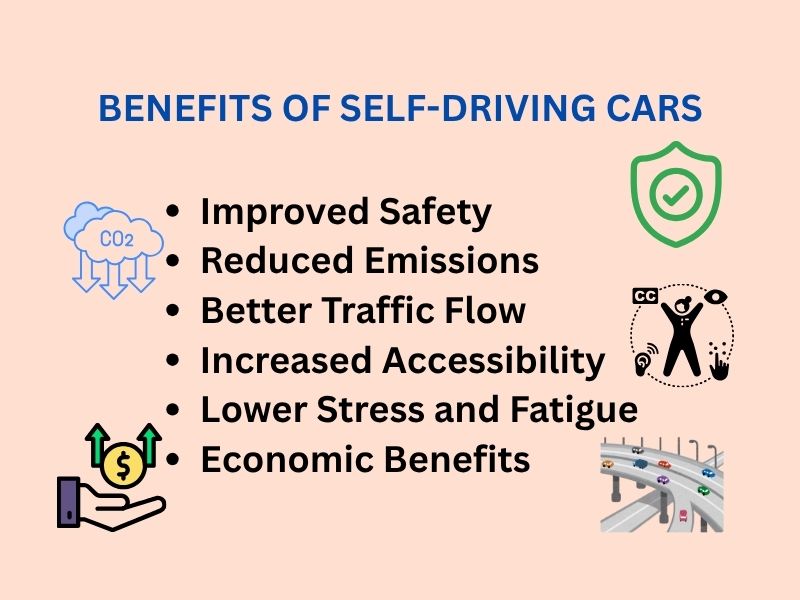
Additionally, many self-driving vehicles run on electric power, which lowers pollution and helps fight climate change. Beyond that, they provide greater independence for people who cannot drive, such as older adults or those with disabilities, making travel easier and more accessible for all.
Let’s look at the main benefits of driverless cars in 2025:
Safer Roads
- 90% of road crashes are due to human error.
- Autonomous vehicles don’t get tired, distracted, or drunk.
- They follow traffic rules every time.
Better Traffic Flow
- Autonomous driving systems keep safe distances.
- They avoid sudden stops and reduce traffic jams.
- Smart cars can even “talk” to each other to prevent pile-ups.
Easier Mobility
- Older adults and disabled people gain greater freedom.
- No need for someone else to drive them.
- Self-driving taxis and shuttles help people get around.
Greener Travel
- Many self driving vehicles are electric.
- Less pollution and fewer emissions.
- Smarter routes mean less fuel use.
Saves Time and Stress
- Passengers can relax, read, or work while the car drives.
- No more dealing with parking, directions, or traffic stress.
As autonomous cars grow smarter, these benefits will only increase.
Should You Own or Rent a Self-Driving Car?
In 2025, buying your own self driving car is possible but not always practical. The technology is still evolving, and owning one can be expensive due to high upfront costs and maintenance.
Many people are choosing to rent autonomous vehicles instead of owning them, as renting offers flexibility without long-term commitments. Renting allows users to try out the latest models and benefits without worrying about updates or repairs.
Here’s why:
Buying a Self-Driving Car
- Pros:
- Full control over the vehicle
- Can use it anytime, anywhere
- Great for daily commuters
- Cons:
- Very expensive upfront
- Costly to maintain and update
- Tech is still evolving, today’s model may be outdated soon
Renting a Driverless Car
- Pros:
- Cheaper short-term option
- No maintenance worries
- Use only when needed like holidays, errands, or work trips
- Great for trying out autonomous driving without long-term risk
- Cons:
- Limited availability in smaller cities
- May not always be nearby when needed
In short, owning is for tech lovers and frequent users. Renting suits casual drivers or those testing autonomous cars for the first time.
Key Takeaways
Self driving cars are changing the future of travel, and 2025 marks a major step forward. These autonomous cars use advanced sensors, AI, and high-definition maps to operate without human drivers. While we’re not yet at full automation, many autonomous vehicles are already on roads in select cities, helping reduce traffic and increase safety.
The benefits of driverless cars are clear, fewer accidents, easier travel for people with limited mobility, and more efficient traffic systems. These vehicles are also helping lower emissions, especially when they run on electric power. Whether you choose to buy or rent self driving vehicles, each option comes with its own set of pros and cons, depending on your budget and lifestyle.
As autonomous driving cars continue to evolve, they’ll become more affordable and widespread. Although full self-driving in all conditions isn’t here yet, we’re quickly heading in that direction, one smart vehicle at a time.
FAQs
Self driving cars are autonomous vehicles that drive without human input using AI and sensors.
They use cameras, lidar, radar, and AI to sense surroundings and make driving decisions.
Yes, when properly tested, autonomous cars aim to reduce accidents caused by human error.
Most current autonomous vehicles still require human oversight, but fully driverless versions exist in limited areas.
Some models are available, but many people prefer renting autonomous vehicles.
Related Posts
Previous Post
Next Post







- Business
 5
5 - Cricket5
- Department for Education49
- Departments3
- Driving and Transport
 53
53 - Education45
- Finance6
- Football13
- Golf3
- Government
 108
108 - Guides1
- Health
 5
5 - Health4
- International Politics9
- Law and Justice31
- Money and Tax23
- National Politics4
- News68
- Politics6
- Sports38
- Technology5
- Tennis3
- Transportation4
- Uncategorized4
- Visa
 17
17 - Visas and Immigration
 24
24 - Weather1