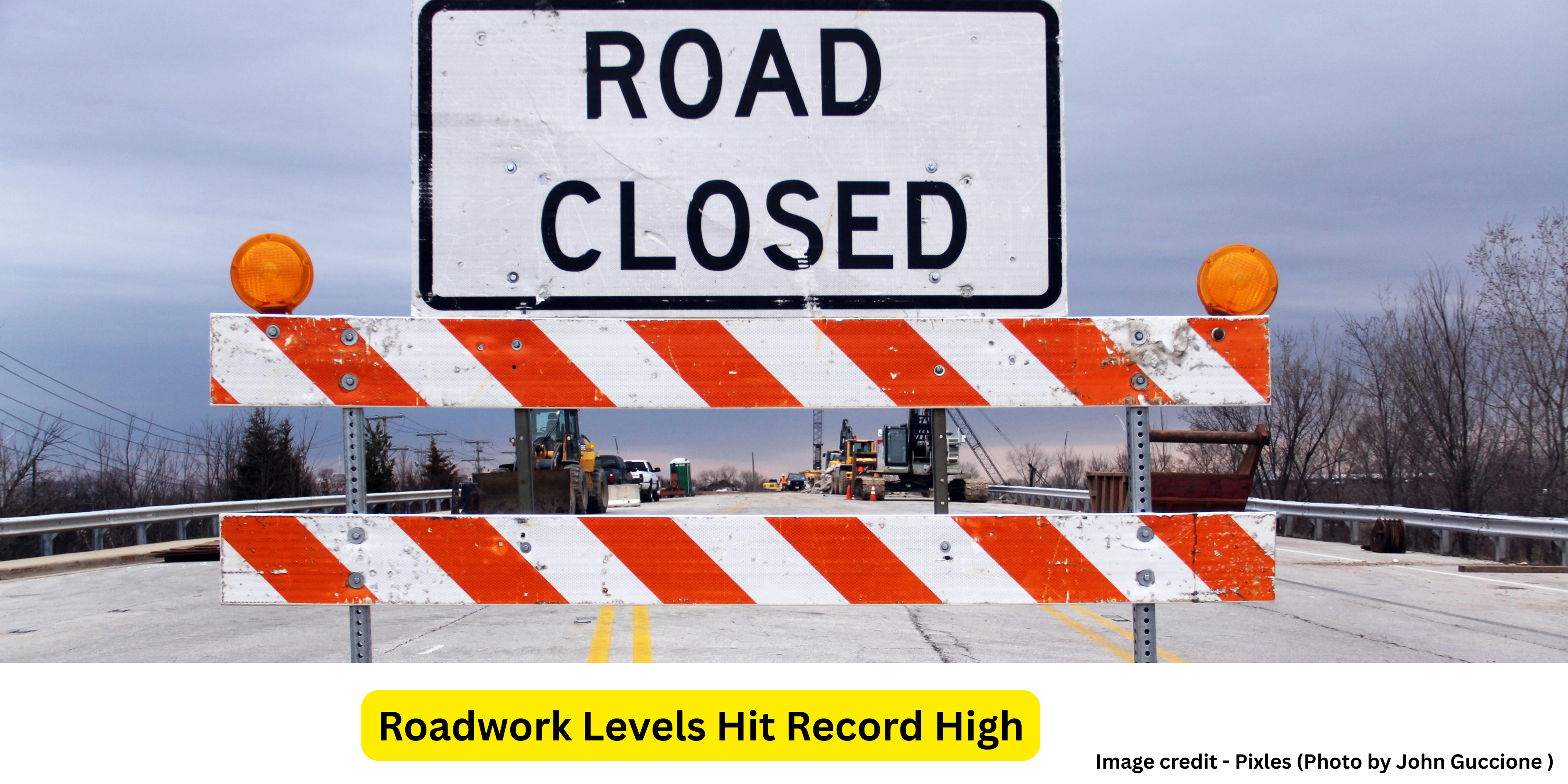
You’re definitely not imagining it if you’ve been stuck behind temporary traffic lights more frequently than normal. In the last year alone, 425,524 miles of roadwork were completed throughout the United Kingdom, according to data. To put that into perspective, that is equivalent to 17 Earth orbits. The shocking fact is that in just two years, the quantity of roadworks has more than doubled. Lane closures amounted to roughly 203,000 miles back in 2023. Now, that’s a huge 110% increase. It makes sense why drivers are irritated. Roadwork Levels Hit Record High leading to nationwide traffic chaos.
Why So Many Roadworks?
One major reason is the big push to roll out super-fast fibre broadband across the country. The original plan was to deliver full-fibre internet nationwide by 2024, but the deadline has now been pushed back to 2032. Infrastructure experts admit the demand for high-speed internet is driving the spike in roadworks. As one explained:
“It’s absolutely true that the rollout of super-fast fibre has caused a huge increase because we all want those facilities. The problem is, you can’t do it without digging up the roads.”
And since the project is far from complete, drivers may have to deal with disruptions for at least another six years.
It’s More Than Just Broadband
By the end of the decade, the government also hopes to have 100,000 new EV charging stations installed. Although that’s fantastic for the environment , it also means that more roads will need to be dug for infrastructure and cables. Victorian water pipes that burst and require repairs are another ongoing problem. The same streets are excavated several times in a matter of weeks in certain towns. The outcome? In addition to daily delays, potholes are becoming worse for drivers.
The Worst Roadwork Hotspots
Some areas are more severely affected than others. With 490,893 roadworks in 2024 an average of over 1,300 sites per day London tops the list. Kent came next with 134,430 projects, followed by Surrey at 132,291. Essex and Hampshire also landed in the top five.
What’s the Government Doing?

Authorities announced a crackdown on disruptive street works earlier this year. This plan will continue, according to the current government, which has also proposed a new rule that will penalize businesses that needlessly close roads on weekends. That wasn’t possible before. The reality is that roadworks and traffic jams will likely persist for years to come, even though there is hope for fewer disruptions.
Conclusion
Roadworks can be annoying, but they also show that the UK is working to create a more connected and environmentally friendly future with better charging stations, faster internet, and more up-to-date infrastructure. Although drivers will currently have to endure longer delays and interminable detours, it is hoped that these temporary inconveniences will eventually result in long-term benefits.
FAQ
Projects like the installation of new electric vehicle charging stations, the rollout of super-fast fiber broadband, and continuous maintenance on outdated infrastructure like Victorian water pipes are primarily to blame for the surge.
The amount of roadwork has more than doubled, increasing by 110% from about 203,000 miles of lane closures in 2023 to over 425,000 miles in 2024.
With an average of over 1,300 roadworks per day in 2024, London has the most roadworks. Hampshire, Essex, Surrey, and Kent are additional hotspots.
Previous Post
Next Post






- Business
 5
5 - Cricket5
- Department for Education49
- Departments3
- Driving and Transport
 53
53 - Education45
- Finance6
- Football13
- Golf3
- Government
 108
108 - Guides1
- Health
 5
5 - Health4
- International Politics9
- Law and Justice31
- Money and Tax23
- National Politics4
- News68
- Politics6
- Sports38
- Technology5
- Tennis3
- Transportation4
- Uncategorized4
- Visa
 17
17 - Visas and Immigration
 24
24 - Weather1