In recent Sentencing Council news, a significant reappointment has been confirmed for the body responsible for shaping how sentences are decided in courts across England and Wales. The Lord Chancellor, the government minister responsible for the justice system, has approved Richard Wright KC’s reappointment to the Sentencing Council.
This confirmation means Mr. Wright will continue to serve as a Sentencing Council non-judicial member, bringing his specialist expertise in criminal defence to the Council’s vital work. His new three-year term is set to run from 1 August 2025 through to 31 July 2028.
But what does this mean for the justice system and the public? Let’s explore the details.
Who is Richard Wright KC?
Understanding the individual is key to appreciating the significance of this appointment. So, who is Richard Wright KC?
- Highly Experienced Barrister: Richard Wright became a barrister (was “called to the Bar”) in 1998. His talent and expertise were recognised in 2013 when he “took silk” – this means he was appointed King’s Counsel (KC), a title awarded to senior and highly accomplished barristers.
- Leadership Roles: He has been Head of Chambers at his base in Leeds (6 Park Square) since 2013 and notably served as Leader of the North Eastern Circuit (a professional body for barristers in the region) from 2020. This leadership role involved navigating the significant challenges posed by the COVID-19 pandemic for the legal profession.
- Specialist in Serious Crime: Mr. Wright has extensive experience in complex criminal cases, particularly specialising in murder and manslaughter. He has acted as both prosecution and defence counsel in major trials across the North of England. This deep, practical understanding of the criminal justice system from the front lines is invaluable.
- Judicial Experience: Alongside his practice, he has held part-time judicial roles, being appointed a Recorder (a part-time Crown Court judge) in 2012 and a Deputy High Court Judge in 2023.
- Existing Council Member: Importantly, this is a reappointment. Mr. Wright has already been serving as a non-judicial member of the Sentencing Council since August 2022, specifically valued for his experience in criminal defence.
This blend of high-level legal practice, leadership, judicial insight, and existing familiarity with the Council makes him a significant figure within the legal community.
What Does the Sentencing Council Do UK?
Established in April 2010, the Sentencing Council for England and Wales plays a crucial role in our justice system. Its primary goals are to:
- Promote Consistency: Ensure that sentences handed down by courts across the country are more consistent for similar offences committed in similar circumstances. This helps build public trust that the system is fair.
- Increase Transparency: Make the sentencing process clearer and more understandable to the public, victims, and offenders.
- Maintain Judicial Independence: While providing guidelines, the Council respects the independence of judges to make decisions based on the specific facts of each case. Courts must follow the guidelines unless it’s not in the interests of justice to do so in a particular case.
How do they achieve this?
The Council’s main task is to develop and issue sentencing guidelines for a wide range of criminal offences. These guidelines cover everything from theft and assault to complex fraud and driving offences. They help judges decide on the appropriate sentence by considering the seriousness of the crime and the offender’s circumstances.
The Council consists of a mix of judicial members (judges) and non-judicial members, ensuring a range of expertise. These Sentencing Council England and Wales members bring diverse knowledge from different corners of the criminal justice system.
The Importance of the Non-Judicial Member Role on the Sentencing Council
It might seem counterintuitive to have ‘non-judges’ helping to create sentencing guidelines, but the non-judicial member role in sentencing Council positions is vital.
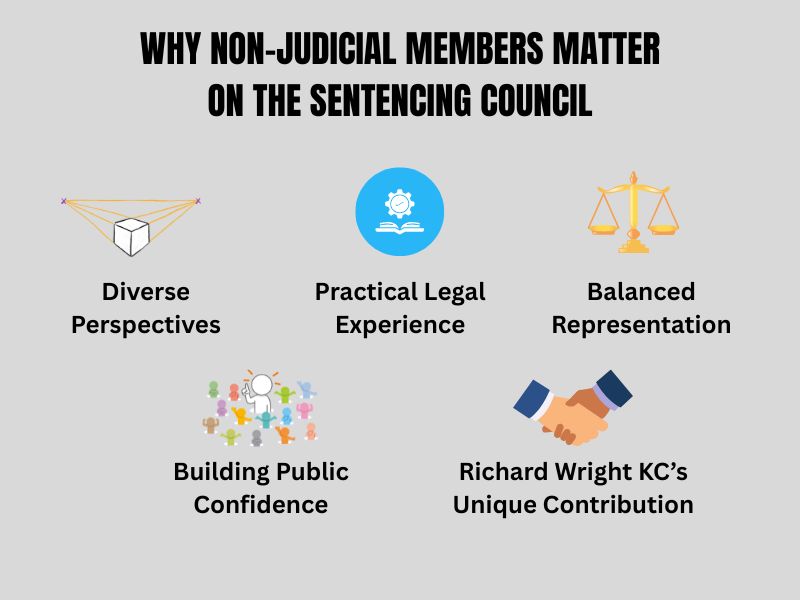
Here’s why:
- Diverse Perspectives: Including members who aren’t judges ensures that the Council benefits from a wider range of viewpoints and expertise. This can include lawyers (like Richard Wright KC), police professionals, probation officers, academics, and those with experience in victim support.
- Practical Experience: Non-judicial members often bring deep, practical experience from specific areas. Richard Wright KC’s extensive background as a defence barrister means he understands the realities of trials, the factors presented in mitigation, and how sentencing decisions impact defendants – insights crucial for crafting workable and fair guidelines.
- Representing Different Aspects: Their presence ensures that the guidelines consider the perspectives of various participants in the justice system, not just the judiciary. This helps create guidelines that are balanced and grounded in real-world application.
- Building Confidence: Having a mix of members can enhance public confidence, showing that sentencing isn’t decided in an isolated bubble but considers broader societal and practical implications.
Richard Wright KC’s specific contribution, drawing on decades of experience defending in serious criminal cases, provides an essential counterpoint and complement to the judicial members and those with other specialisms on the Council.
Details of the Reappointment and the Process
The reappointment, approved by the Lord Chancellor Sentencing Council interface (meaning the Lord Chancellor, currently the Secretary of State for Justice, gives the final go-ahead), secures Mr. Wright’s expertise for another three years (1 August 2025 – 31 July 2028).
It’s worth noting that UK Sentencing Council appointments like these are not casual arrangements. They are formally regulated processes:
- Oversight: The Commissioner for Public Appointments oversees the process.
- Code Compliance: Recruitment follows the strict Cabinet Office Governance Code on Public Appointments. This ensures appointments are made on merit following fair and open procedures.
- Consultation: While the Lord Chancellor approves, appointments often involve consultation with senior judiciary figures like the Lord Chief Justice.
This rigorous process underscores the importance placed on selecting suitably qualified and experienced individuals for the Sentencing Council.
Why This Reappointment Matters for the UK Justice System
The reappointment of Richard Wright KC is more than just a procedural step. It signifies:
- Continuity: Retaining experienced members like Mr. Wright provides stability and continuity for the Council’s ongoing work programme, which involves reviewing existing guidelines and developing new ones.
- Valued Expertise: It reaffirms the value placed on his specific expertise in criminal defence and his contributions to the Council’s discussions and decisions over the past few years.
- Maintaining Balance: It keeps a strong defence voice in the Council, helping create balanced and effective sentencing guidelines.
- Supporting Public Confidence: A strong Sentencing Council with trusted experts boosts public trust in fair and transparent sentencing in England and Wales. The work carried out by Richard Wright KC, the Sentencing Council connection, alongside his colleagues, directly impacts this.
Reappointing experts like Richard Wright KC helps the Sentencing Council keep the system strong, fair, and clear.
Read more about SFO Reveals Clearer Path for UK Businesses to Avoid Prosecution
Frequently Asked Questions
It’s an independent body that promotes consistent and transparent sentencing in England and Wales. It does this mainly by issuing guidelines that courts must follow.
Senior barrister Richard Wright (KC) uses his criminal defence expertise to help create fair, realistic guidelines.
It means he isn’t a serving judge. Non-judicial members bring expertise from areas like legal practice to offer diverse views alongside judges on the Council.
Courts in England and Wales are legally required to follow the Council’s guidelines when sentencing, ensuring consistency. They can only deviate if it’s clearly in the interests of justice for that specific case.
The Lord Chancellor approved the reappointment through a fair, merit-based process.
Source / Ref.: Gov.uk Contains public sector information licensed under Open Government Licence v3.0.
Written by [Ketan Borada / British Portal Team] – Founder of British Portal, dedicated to providing accurate and up-to-date information on UK public services and benefits.Related Posts



Previous Post
Next Post







- Business
 5
5 - Cricket5
- Department for Education49
- Departments3
- Driving and Transport
 53
53 - Education45
- Finance6
- Football13
- Golf3
- Government
 108
108 - Guides1
- Health
 5
5 - Health4
- International Politics9
- Law and Justice31
- Money and Tax23
- National Politics4
- News68
- Politics6
- Sports38
- Technology5
- Tennis3
- Transportation4
- Uncategorized4
- Visa
 17
17 - Visas and Immigration
 24
24 - Weather1