Register SORN immediately if your vehicle is not being driven or parked on public roads. A Statutory Off-Road Notification (SORN) tells the DVLA that your car is off the road and not in use. If you don’t register it properly, you could face fines for unpaid vehicle tax or insurance lapses.
This guide will walk you through everything—when to make a SORN, how to apply, what information you need, and what it means for your vehicle’s tax, insurance, and future use.
What is the Purpose of a SORN
A Statutory Off Road Notification (SORN) is an official declaration to the DVLA that a vehicle is not being used on public roads. When you register SORN, you’re confirming that the car is kept off-road—such as on a driveway, in a garage, or on private land—and that it won’t be driven until it’s taxed again.
The main purpose of a SORN is to pause your legal obligations for vehicle tax and insurance while the car remains unused. It prevents you from being fined for not taxing or insuring a vehicle that isn’t on the road.
Why SORN Exists
The UK government introduced the SORN system to help vehicle owners avoid unnecessary expenses while keeping the DVLA informed. This system ensures that all cars used on roads are properly taxed and insured, while exempting off-road vehicles from these duties.
Key points to remember:
- A SORN is mandatory if your car is untaxed and off-road
- It helps you avoid fines for unpaid tax or uninsured status
- It allows you to keep a vehicle legally, even without a tax disc
By declaring a SORN, you are taking responsibility for your vehicle’s off-road status and fulfilling legal obligations without incurring tax or penalty charges.
Making a Statutory Off Road Notification (SORN)
Declaring your vehicle as off the road is a legal requirement in the UK if it’s not in use. The Statutory Off Road Notification (SORN) formally tells the Driver and Vehicle Licensing Agency (DVLA) that your car will not be driven or parked on public roads.
You may choose to register SORN for various reasons:
- You’re keeping a car in a garage or on private property
- Your vehicle has been damaged and is awaiting repair
- You no longer drive but want to keep your car
- You’re restoring a classic car that isn’t road-ready
By making a SORN, you won’t need to pay vehicle tax, but you also can’t drive the vehicle unless you re-tax it first.
It’s important to note:
- SORN is free to apply
- You must register your vehicle under SORN before using or keeping it off-road
- Once declared, SORN stays in place until you either tax the vehicle again or sell/scrap it
When Do You Need to Register SORN for Your Vehicle?
You must register SORN in specific situations where your vehicle is not being used or kept on a public road. Making a SORN is not optional—it’s a legal duty in these cases, and failure to comply may lead to fines or prosecution.
Situations That Require a SORN:
- Your vehicle is untaxed and not being driven or parked on public roads.
- You’ve cancelled your vehicle tax (for example, to get a refund).
- You’ve bought a car but don’t plan to use it immediately.
- You’re keeping a car off-road during repairs, restoration, or storage.
- You’ve taken your vehicle off the road due to high fuel or insurance costs.
- You’re waiting to scrap or sell the car, but it’s off-road in the meantime.
If your tax expires and the vehicle is not in use, you must make a SORN immediately to avoid enforcement. DVLA checks vehicle tax and insurance status regularly using number plate recognition systems.
Also, note that once your vehicle is declared SORN, it must not be used or parked on a public road, even briefly.
Why You Can’t Transfer a SORN to Another Vehicle
When you register SORN, it’s important to understand that it only applies to the current registered keeper of the vehicle. If ownership changes, the SORN becomes invalid—even if the vehicle remains off the road.
What happens when you sell or buy a SORN vehicle?
- If you sell a vehicle that has a SORN, the new owner must re-register SORN in their name if they intend to keep it off-road.
- If you buy a car with an existing SORN, you still need to make a new SORN declaration after the ownership transfer is complete.
The DVLA does not carry over the SORN status between owners. This is to ensure that the vehicle registration details, including keeper address and off-road status, are accurate and up to date.
What you need to do as a new keeper:
- Use the V5C vehicle log book or V62 form (if you don’t have a log book)
- Declare a new SORN either online, by phone, or by post
- Ensure the vehicle is not parked or used on public roads until taxed again
Not making a new SORN after buying an off-road vehicle may lead to fines or enforcement action, as the DVLA will assume the car is now back on the road.
How Long Does a SORN Last and Do You Need to Renew It?
When you register SORN, it remains valid indefinitely—as long as the vehicle stays off the road and under the same ownership. Unlike vehicle tax, there’s no need to renew your SORN annually.
How long does a SORN last?
- It lasts until:
- The vehicle is sold
- The vehicle is scrapped
- You tax the vehicle again
- Ownership details change
You won’t receive a vehicle tax reminder (V11) while a SORN is in place. This is because you’re no longer required to pay vehicle tax until you return the vehicle to the road.
Can you renew a SORN?
You only need to make a new SORN if:
- You become the new registered keeper
- You’ve previously taxed the vehicle and want to declare it off-road again
There’s no penalty for keeping a car SORN long-term, but you must ensure the car remains off all public roads. It can’t be moved, driven, or parked on the street—even temporarily.
If your car is stored in a garage or private driveway, your SORN will continue without issue.
How to Register Your Vehicle as Off the Road (SORN)
To register SORN, the DVLA offers several easy and accessible ways to apply. Whether you prefer using a computer, phone, or post, the process is straightforward—as long as you have the correct documents ready.
Before you start, make sure:
- The vehicle is not being used or parked on public roads
- You have your log book (V5C) or V11 vehicle tax reminder
- Your details are correct and up to date
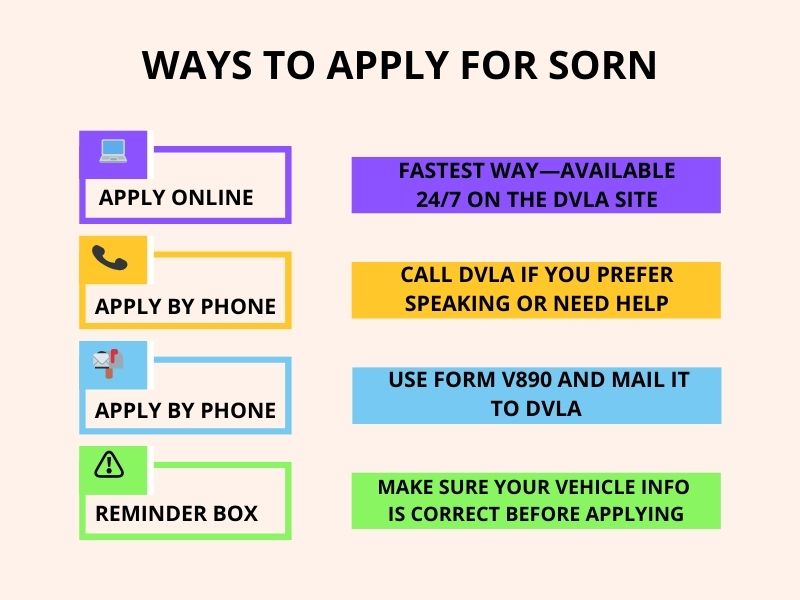
Ways to Apply for SORN: Online, By Phone, or By Post
To register SORN, the DVLA provides three application methods, designed to suit various needs. Each one allows you to legally declare your vehicle off-road and avoid tax obligations while it’s not in use.
1. Online
The quickest and easiest method is to apply online via the official DVLA SORN page. You can make an immediate SORN or schedule one for the next month.
Once submitted, you’ll get instant confirmation on the screen and a follow-up by post. This method is available 24/7 and is completely free.
2. By Phone
If you prefer, you can register SORN by phone. Call the DVLA on 0300 123 4321. Lines are open Monday to Friday, and you’ll need the same V5C or V11 reference.
This is a useful option if:
- You don’t have internet access
- You have questions about your vehicle’s status
- You’re not confident completing forms online
3. By Post
If your logbook is outdated or you’re unable to use the other methods, you can apply by post. You’ll need to fill out a V890 form, available to download or order from GOV.UK.
Send the completed form to: DVLA, Swansea, SA99 1AR
This method takes longer but is still reliable and free. Ensure the details on your vehicle registration are current before submitting.
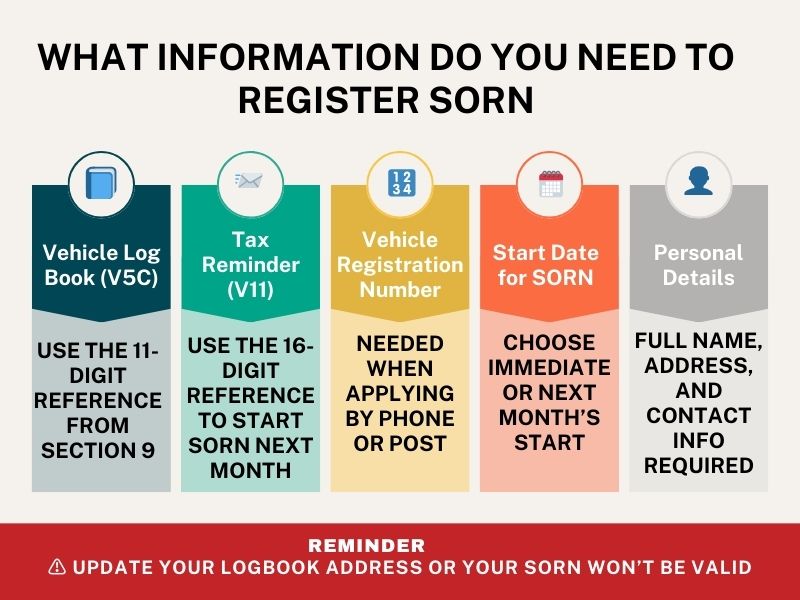
What Information Do You Need to Register SORN for Your Vehicle?
When you register SORN, having the right information ready makes the process smooth and ensures your application is accepted without delays. The specific details you need will depend on the method you choose.
Key documents and details required:
- Vehicle log book (V5C)
- Use the 11-digit reference number from section 9
- Ensure the address is current—if not, update it before applying
- Vehicle tax reminder (V11)
- Includes a 16-digit reference that allows you to SORN the vehicle from the first day of the next month
- Vehicle registration number
- You must provide this when applying by post or phone
- Date when you want the SORN to start
- Immediately (if untaxed) or from the beginning of the next month
- Personal details
- Full name, current address, and contact information
If you don’t have a logbook, you’ll need to apply for a new one using a V62 form before making a SORN declaration. Without it, you can’t proceed.
Always double-check the address in your logbook. If it’s wrong, your confirmation may go to the wrong place, and your SORN may not be valid.
What Happens After You Register?
When you register SORN, you’re legally declaring that your vehicle will not be used on public roads. While this removes the need to pay vehicle tax, it also comes with important restrictions.
Penalties for Driving a SORN Vehicle Illegally
If caught driving a vehicle with an active SORN:
- You could face a fine of up to £2,500
- The vehicle may be clamped, impounded, or crushed
- It may also invalidate your insurance policy
The DVLA uses automatic number plate recognition (ANPR) to catch untaxed and SORN vehicles in use, so enforcement is strict.
Registering SORN helps save money and avoids tax penalties, but only if you follow the conditions.
What Are the Tax and Insurance Rules After Registering?
When you register SORN, you are no longer required to pay vehicle tax or keep your car insured—but only under certain conditions.
Vehicle Tax
- Once the SORN is in place, your vehicle tax is automatically cancelled.
- Any full months of unused tax will be refunded to the registered keeper.
- This refund is sent via cheque, so it’s crucial that the logbook (V5C) has your correct name and address.
Insurance
- While insurance is not legally required for a SORN vehicle, it’s highly recommended.
- Your car may still be at risk of theft, fire, or damage while stored on private land.
- Many insurers offer laid-up cover or SORN insurance, which is cheaper than standard policies but still provides protection.
Note: If your car isn’t insured or SORN, you may receive a penalty notice under Continuous Insurance Enforcement (CIE) rules.
In summary:
- SORN removes your duty to tax the vehicle
- Insurance becomes optional, but going without is risky
- Always keep your V5C updated for smooth refunds and communication
How to Get a Tax Refund on Vehicle Tax After SORN
One of the key benefits of registering SORN is that you can receive a refund for any full months of unused vehicle tax. This can help save money while your vehicle remains off the road.
How do you get a tax refund?
- Automatic refund: Once your SORN is processed, the DVLA will automatically cancel your vehicle tax. If you’ve paid for the full year, you’ll receive a refund for any remaining months.
- Refund method: The refund will be issued by cheque to the registered keeper’s address, as shown on the log book (V5C). It can take up to 6 weeks for the refund to be processed and sent.
How much will you be refunded?
The amount you receive depends on how many full months are left on your tax period. For example, if you’ve paid for 12 months and declare a SORN halfway through, you’ll be refunded for the remaining 6 months.
Note: No refunds are issued for part-month periods, so you must wait until the full month of tax has been unused to qualify for a refund.
Important considerations:
- Make sure your logbook (V5C) is up to date so the refund is sent to the right address.
- If your car is insured or sold before the SORN is processed, the refund may be delayed.
While receiving a tax refund after registering SORN is a clear benefit, it’s essential to ensure your SORN status is in place before the end of a tax period to maximise your refund.
How to Put Your Vehicle Back on the Road After SORN
Once you’ve registered SORN, it’s important to know that your vehicle cannot be used on public roads until it’s officially taxed and insured again. When you’re ready to return your vehicle to the road, the process is straightforward but requires a few important steps.
Steps to re-tax your SORN vehicle:
- Reapply for Vehicle Tax
You must tax your vehicle again using the DVLA’s online tax service, by phone, or by post. If you’re applying by post, you’ll need the V11 tax reminder or V5C registration certificate. - Insurance
Before driving your vehicle again, ensure it’s insured. A valid insurance policy is required for your vehicle to be legally used on public roads. - MOT Requirements
If your vehicle is more than 3 years old, you’ll need a valid MOT certificate. Make sure the vehicle passes the test before you return it to the road.
What to do if the vehicle isn’t being taxed right away:
- If you don’t immediately re-tax your vehicle, it must remain off the road, still under SORN status, until you decide to tax it.
- Ensure that the vehicle remains on private land to avoid penalties from the DVLA.
Can you drive a SORN vehicle before re-taxing?
No, unless:
- You’re driving the vehicle to a pre-booked MOT test
- Your vehicle is fully insured and has a valid MOT
Once the vehicle is taxed, insured, and MOT, you can legally drive it again.
If you’ve encountered any of these problems with your SORN application, read our article on how to update your log book (V5C) for more help
Registering SORN Made Easy
In conclusion, registering your vehicle as SORN is a simple and effective way to save on road tax while keeping your vehicle off the road. It’s easy to apply online, by phone, or by post, as long as you have your log book (V5C) ready.
Be mindful that driving a SORN vehicle is illegal and could lead to fines. When you’re ready to get your vehicle back on the road, re-taxing it is just as simple.
For more details on the process and related topics like vehicle tax, check out our other guides. Register your SORN today and enjoy peace of mind.
Source / Ref.: Gov.uk Contains public sector information licensed under Open Government Licence v3.0.
Written by [Ketan Borada / British Portal Team] – Founder of British Portal, dedicated to providing accurate and up-to-date information on UK public services and benefits.Related Posts
Previous Post
Next Post






- Business
 5
5 - Cricket5
- Department for Education49
- Departments3
- Driving and Transport
 53
53 - Education45
- Finance6
- Football13
- Golf3
- Government
 108
108 - Guides1
- Health4
- Health
 5
5 - International Politics9
- Law and Justice31
- Money and Tax23
- National Politics4
- News68
- Politics6
- Sports38
- Technology5
- Tennis3
- Transportation4
- Uncategorized4
- Visa
 17
17 - Visas and Immigration
 24
24 - Weather1