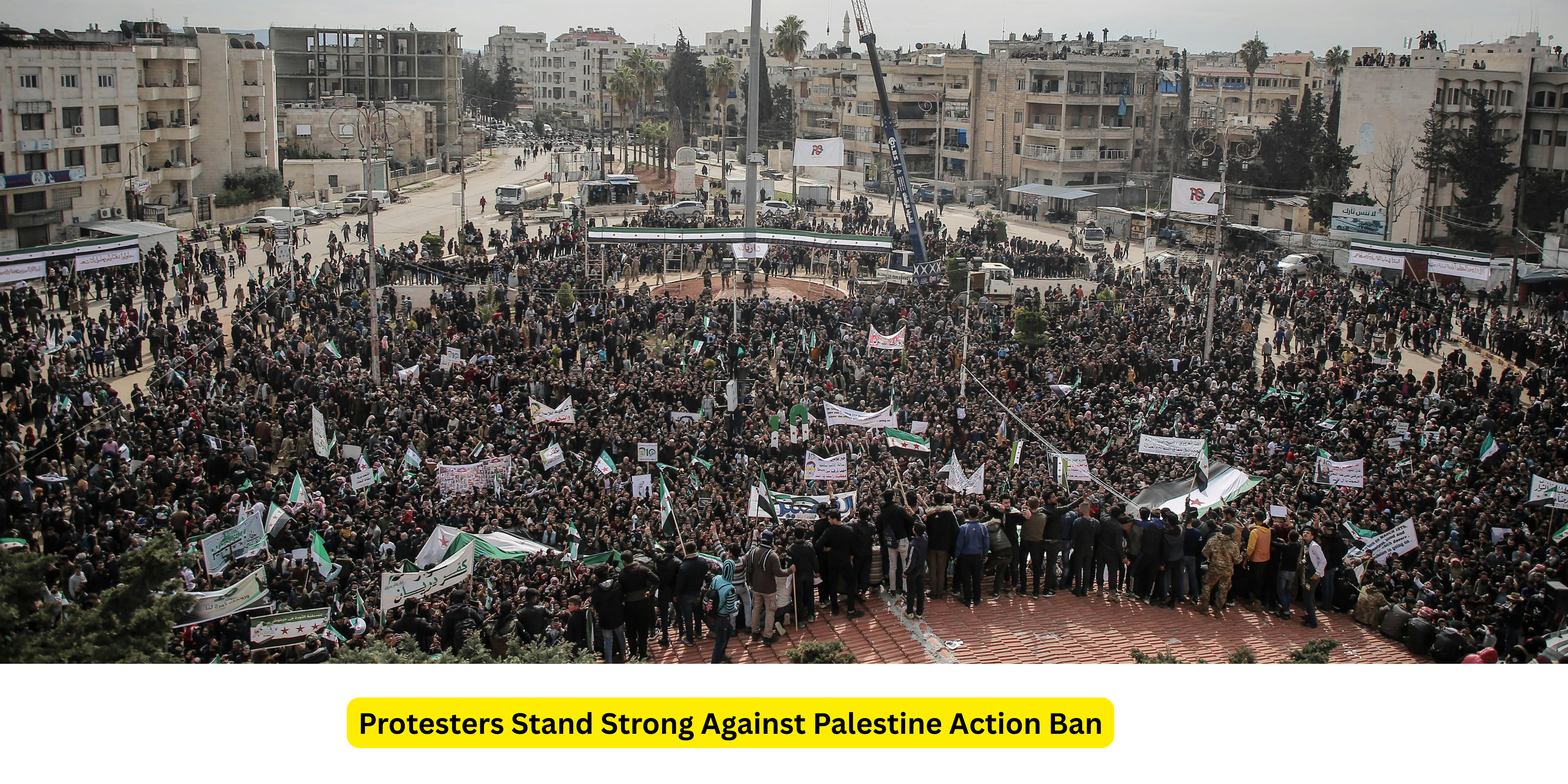
Let me tell you something that there is going to be something significant in London on 6th September 2025. Defend Our Juries is demanding a mass protest against the government’s ban on Palestine Action. However, protesters are altering their tactics this time round; they will not give out their details to police in the streets. Instead, they will insist on being taken to a police station, and this would bring thousands at a time to strain the system. The thinking is straightforward, making it nearly impossible for the police to arrest all the people. Protesters Stand Strong Against Palestine Action Ban, Showing Unity and Determination in Their Fight for Justice.
What had happened previously?
During the previous mass action, the police arrested more than 500. Out of the same, 212 were detained at police centers, as they failed to provide details or were even on bail. The rest, some 320 others, were processed quickly in the street and granted what was termed street bail, where they handed over their details and were released. Activists are now saying that was the ruse that police used to have so many people arrested in such a short time. The number of arrests would have been lower if more people had insisted on being taken to a proper station, given the space and other available means.
The New Protest Scheme
This time, Defend Our Juries expects 1,000 people to sign a pledge promising to attend the demonstration and not to cooperate with “street bail.” Already over 2,500 people have expressed interest, but the group has said that it will not go ahead until at least 1,000 have signed the formal pledge.

When signing, you are asked to do so under your agreement that you:
1. Will go to train on the protest against the ban, carrying banners
2. Know the threat of arrest
3. Provide details to on-street officers
The demonstration will not only be within an hour. Defend Our juries have no plans to go away, and people not willing to break unity by leaving stay until they are arrested.
Why This is Important?
In explaining it, Tim Crosland, the spokesperson of the group, said that the police resorted to the stunt of street bail as a way of denying protesters their right to immediate free legal representation. However, when hundreds of them do not give details and insist that they must be handled according to the rules at the stations, the police just do not cope with it. As the history shows to us, when a law is so unpopular and is met with mass opposition, then it cannot be implemented. Same as the poll tax is dismantled in the 1990s, campaigners think this ban is also likely to crumble due to the pressure on the consumers.
The Political Side
The outrage is not only on the streets but also within politics. A recent Survation poll reveals that 70 percent of Labour members believe that the government was incorrect to label Palestine Action as a terror organization. Even relatively senior members are speaking out, with Peter Hain and Stella Creasy expressing concern, concluding that the ban does not offer any protection of protest but rather makes it harder to police.
Final Thought
Friends, this is not only about one group or one protest. It is about the right to protest itself. The warning is loud and clear when thousands of people come out in the streets and refuse to be intimidated by unjust laws and demand their rights.
FAQ
The government has trouble labelling Palestine Action as a prohibited group citing security concerns. Activists say that the ban limits their freedom of peaceful demonstrations.
The demonstration is organizied by the group Defend Our Juries, which wants mass action against the ban on Palestine Action.
This time the protesters will not share information with the police on the streets and will demand to be taken to the police stations. This is supposed to inundate the system to stop large-scale arrests by means of a street bail.
Related Posts


Previous Post
Next Post





- Business
 5
5 - Cricket5
- Department for Education49
- Departments3
- Driving and Transport
 53
53 - Education45
- Finance6
- Football13
- Golf3
- Government
 108
108 - Guides1
- Health4
- Health
 5
5 - International Politics9
- Law and Justice31
- Money and Tax23
- National Politics4
- News68
- Politics6
- Sports38
- Technology5
- Tennis3
- Transportation4
- Uncategorized4
- Visa
 17
17 - Visas and Immigration
 24
24 - Weather1