When someone breaks the law in the UK, the courts decide the consequences. Prison is one possibility, but often, individuals serve their sentences within the community under supervision. This is where probation frequently comes into play. Knowing what probation is is crucial for many people, whether they encounter it themselves or through family, or simply want to understand the justice system better.
Essentially, the meaning relates to a specific period where an individual who has committed an offense is monitored while living in the community. The core aims of the probation service managing this process are:
- Protecting the public from harm.
- Reducing the likelihood of future offending.
- Supporting the rehabilitation of individuals.
- Considering the needs and safety of victims.
Think of it as a structured opportunity for someone to demonstrate they can adhere to rules and live responsibly while still being accountable for their actions.
Is it Probation or Parole? Clearing Up Confusion
Many people find the terms probation and parole confusing. Understanding the difference between parole and probation is important.
- Probation: This often forms part of a sentence given directly by a court, such as a Community Order or a Suspended Sentence Order, meaning the person avoids immediate custody. It involves supervision from the start.
- Parole: This applies specifically to individuals released from a prison sentence to serve the remainder of that sentence back in the community. Their release and subsequent supervision are subject to strict conditions, often called a ‘license’. In England and Wales, The Parole Board, an independent body, makes decisions about whether an offender is safe to be released on license.
So, while both involve supervision outside prison walls, probation can be a sentence in its own right, whereas parole follows a period of imprisonment. The specific meaning in law differs from the meaning of parole in law. Although you might hear informal terms like jail parole, the official UK terminology usually refers to release on the license, managed by professionals often titled probation officers. While the term parole officer is understood, probation officer is the more common title for the supervising role in the UK. Grasping the parole vs probation or the specific difference between probation and parole helps clarify how the system works.
Who Manages Probation Across the UK?
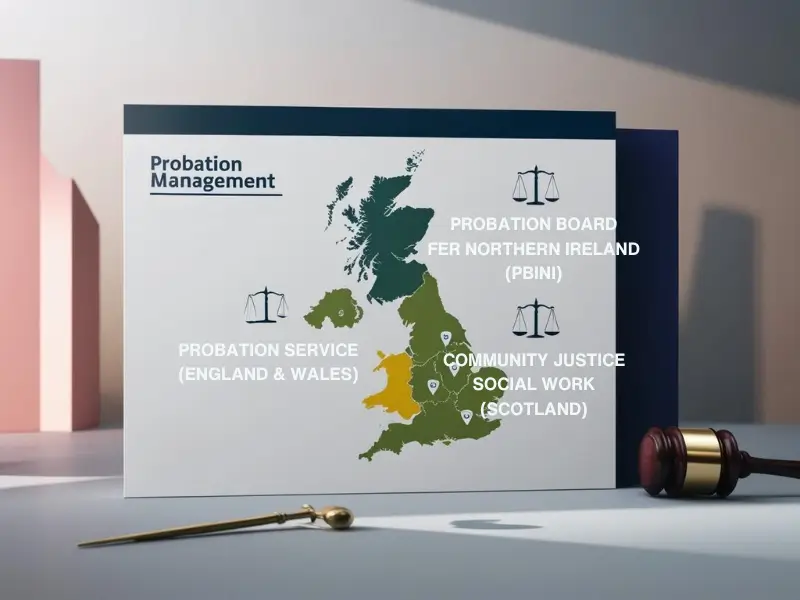
The United Kingdom comprises different nations, each with its justice system. This means probation operates slightly differently depending on your location:
- England and Wales: Here, services are delivered by the Probation Service. This single, unified organization is part of the wider His Majesty’s Prison and Probation Service (HMPPS). You will often hear it called the National Probation Service or simply the Probation Service. It manages individuals on community sentences and those released from prison on license.
- Northern Ireland: The Probation Board for Northern Ireland (PBNI) is responsible for probation services. They utilize slightly different sentencing options and structures.
- Scotland: Community justice social work services, often managed by local authorities, handle supervision in the community.
Therefore, when seeking information, always verify which part of the UK the details apply to. The prison and probation service structure described here mainly relates to England and Wales. Any general reference to a probation agency or a specific team, like a probation delivery unit in England and Wales, falls under this national HMPPS umbrella.
Community Sentences and Probation (England & Wales)
When a court imposes a sentence that doesn’t involve immediate custody, or when someone is released on licence, supervision by the Probation Service is typically required. Common situations include:
- Community Orders: These are sentences served entirely in the community. They always come with specific requirements that must be followed.
- Suspended Sentence Orders: An individual receives a prison sentence, but it is ‘suspended’ for a set period. They don’t go to prison unless they breach the order’s requirements (which include probation supervision) or commit another offense during the suspension period.
- Release on Licence: This applies after serving part of a prison sentence. The person serves the remaining time in the community but must adhere to strict licence conditions, monitored by the Probation Service.
The requirements attached to these orders vary but commonly include:
- Attending regular appointments with a probation officer.
- Completing unpaid work, often known as community service for probation.
- Participating in specific programs or activities designed to address offending behavior (e.g., courses on substance misuse or thinking skills).
- Adhering to curfews or staying away from certain areas or people.
- Living at an approved address.
Being on probation signifies a commitment to following all rules set by the court or included in the license conditions for the entire designated period of probation.
The Important Role of a Probation Officer
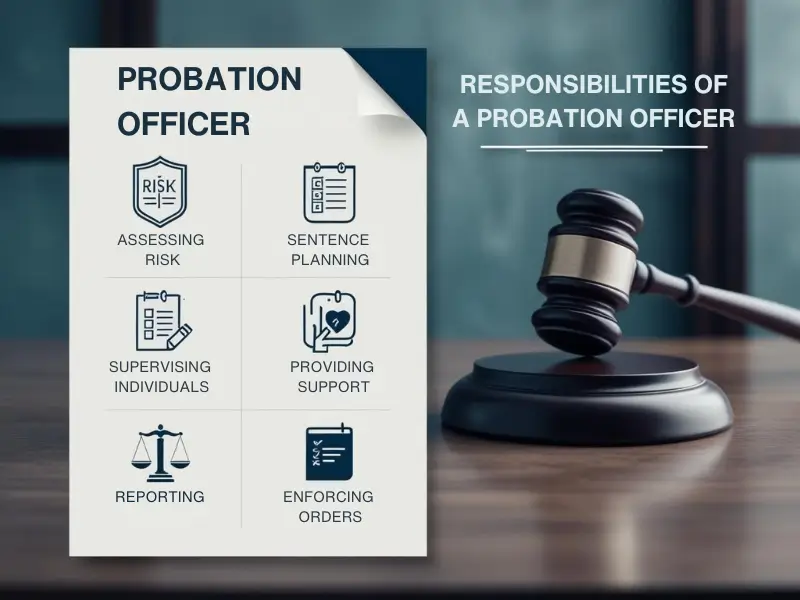
The probation officer is a key professional in this system. It’s important to note they are distinct from police officers, although they work closely with them and other agencies. Their core duties involve:
- Assessing Risk: Evaluating the likelihood of an individual causing harm to others or themselves and identifying factors linked to their offending.
- Sentence Planning: Develop a plan outlining how the individual will be managed and supervised, detailing the requirements they need to meet.
- Supervising Individuals: Hold regular meetings, monitor compliance with all requirements, and assess progress.
- Providing Support: Helping individuals access necessary support services related to housing, employment, education, or health issues to aid their rehabilitation.
- Reporting: Preparing reports for courts or the Parole Board detailing an individual’s progress, compliance, and risk level. The specific probation officer’s list of duties is extensive.
- Enforcing Orders: Taking necessary action if an individual fails to comply with their requirements (initiating breach proceedings).
Within the service structure, you might encounter roles like a district probation officer overseeing specific teams, but the fundamental purpose remains to manage individuals safely and effectively in the community.
What’s Daily Life Like on Probation?
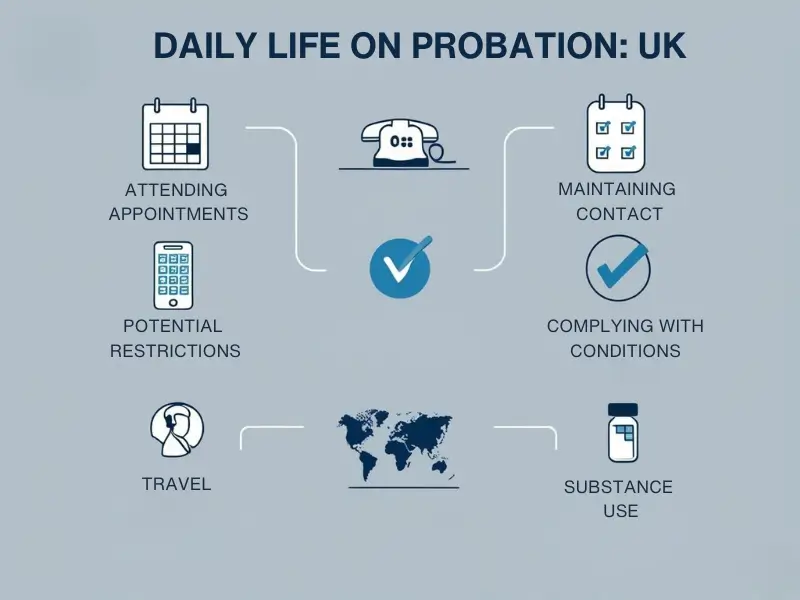
Being under probation supervision means adhering strictly to set rules and maintaining contact. Typically, this involves:
- Attending Appointments: You must attend all scheduled meetings with your probation officer. These usually take place at the local probation office but could be elsewhere. Missing appointments without a valid reason can have serious consequences.
- Maintaining Contact: You are required to inform your probation officer about significant changes, such as a new address or employment status. You will be provided with ways to get in touch, often a probation contact number or perhaps a probation email address.
- Complying with Conditions: You must follow all requirements specified in your court order or license conditions. This could involve attending programs, doing unpaid work, or respecting curfews.
- Potential Restrictions: Depending on the specifics of your case and sentence, certain restrictions might apply:
- Travel: A common question is, can you leave the country on probation? Usually, any international travel requires prior permission from your probation officer. Restrictions might also apply to travel within the UK. Some might ask, can you leave the state on probation? This phrasing is more common in the US, but the principle of needing permission for significant travel often applies within the UK, too. Always seek clarification first.
- Substance Use: Another frequent query is, Can you drink on probation? While alcohol isn’t automatically banned for everyone, its use might be restricted or monitored if it’s linked to your offending behavior. Drug testing might also be required.
Knowing how to contact your local service is vital. While online searches like “probation offices near me” or “probation near me” might yield results, the official gov.uk website provides definitive contact details for England and Wales.
Consequences of Breaking Probation Rules
Failure to comply with the rules of a probation order or license conditions is known as a ‘breach’ and is treated very seriously.
- Initial Response: Often starts with a warning from the probation officer.
- Formal Action: If non-compliance persists without good reason, the probation officer can initiate formal breach proceedings, which involves bringing the case back before the court.
- Court Decision: The court reviews the circumstances of the breach. Potential outcomes include:
- Allowing the order to continue, perhaps with a warning.
- Making the requirements more stringent.
- Adding extra requirements, like more unpaid work hours, or extending the supervision (probation extended as a consequence).
- In cases involving a Suspended Sentence Order or release on the license, the court could activate the prison sentence.
A probation failure, in the context of a court order, typically refers to situations where breach action leads to the order being revoked or a custodial sentence being imposed.
Considering Victims of Crime
The Probation Service has responsibilities towards victims of crime, particularly those affected by serious offenses. In England and Wales, the Victim Contact Scheme (VCS) allows eligible victims to:
- Receive information about the offender’s sentence progression.
- Be informed about key events, such as release dates.
- Be notified of any license conditions relevant to their safety (e.g., exclusion zones).
If someone has concerns about how their case (as an offender or victim) has been handled by HMPPS, the independent Prison and Probation Ombudsman investigates probation complaints.
Careers in the Probation Service
Working on probation offers a chance to contribute to public safety and help individuals make positive changes. Many people explore roles like becoming a probation officer.
- Qualifications: Entry typically requires a specific qualification, often the PQiP Probation (Professional Qualification in Probation). This usually involves university study, although sometimes a probation apprenticeship route is available. Check the official HMPPS recruitment site for current requirements.
- Finding Vacancies: Look for probation jobs or probation officer jobs on the HMPPS careers website or other major job platforms. Using terms like “probation officer jobs near me” might help find local opportunities. Many roles exist across both prison and community settings (probation and prison jobs).
- Salary Information: The probation officer’s salary is determined by national pay scales, influenced by experience and location.
- Training and Development: Relevant probation courses and ongoing professional development are integral to the career.
Probation at Work: A Completely Different Concept
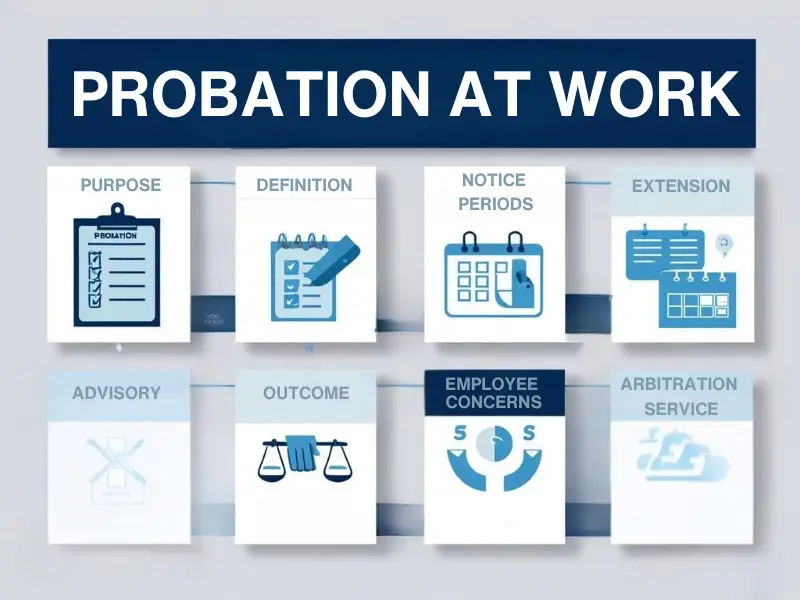
It is vital to understand that the word ‘probation’ is also commonly used in a completely different context: probation at work. This refers to the initial probation period when starting a new job in the UK.
- Purpose: This is essentially a trial phase, often lasting three or 6-month probation, allowing both the employer and the new employee to assess suitability for the role.
- Definition: Probation at work means simply this introductory phase of employment.
- Characteristics: During this employee probation period, notice periods may be shorter than standard contractual ones. Performance and fit within the team are evaluated.
- Extension: An employer might opt for a probation extension, perhaps communicating this via a probation extension letter, if they feel more time is needed for assessment. This might lead to probation being extended by 3 months, for instance.
- Employee Concerns: If your probation is extended, should you be worried? It signals that performance expectations might not have been fully met yet, warranting a discussion with your manager. Guidance specific to the probation extended should I be worried uk situation often involves understanding the reasons clearly.
- Outcome: At the end of the period, employment is either confirmed or, if suitability isn’t established, it might lead to probation dismissal (sometimes termed probation failure in the workplace context). Employers should follow fair procedures. Review meetings often use a probation form or probation form template to document progress and probation feedback.
- Support: For workplace issues, ACAS (Advisory, Conciliation and Arbitration Service) provides free, impartial advice. Many seek probation ACAS guidance on rights during this period.
Crucially, remember: Workplace probation relates purely to job performance and suitability, entirely separate from the criminal justice system.
Probate: Another Similar-Sounding but Different Term
You might also encounter the term probate. Although it sounds like probation, it is completely distinct from both criminal justice supervision and employment trial periods.
- What is probate? Probate refers to the formal legal process required to manage the estate (money, property, possessions) of someone who has died.
- Key Steps: It often involves obtaining official permission, known as a grant of probate (if the person left a valid will), to deal with the deceased’s assets. You may need to apply for probate through the relevant authority. The probate registry handles applications.
- Context: This falls under wills and probate law. Understanding how long probate takes or the intricacies of the probate process requires legal or administrative knowledge. To define probate simply: it’s estate administration after death.
Always keep probate law mentally separate from probation matters.
Finding Local Services and Making Complaints
To find contact details for specific probation offices or services in England and Wales, the official gov.uk website is the most reliable source. The Probation Service operates nationwide.
If you are unsatisfied with the service received from the Probation Service in England and Wales, a formal probation complaints procedure exists. If the internal process doesn’t resolve your issue, you can escalate it to the independent Prison and Probation Ombudsman.
Takeaway
Probation is a significant element of the UK justice system, particularly in England and Wales where the Probation Service manages individuals serving community sentences or released from prison on licence. It focuses on public protection and rehabilitation, involving supervision by a probation officer and adherence to specific conditions. It’s crucial to distinguish this from parole (post-prison release), the unrelated concept of employment probation periods, and the entirely separate legal process of probate. Understanding these differences and the specific system operating in your part of the UK provides valuable clarity.
Read more Victim of Crime in the UK: Understanding Your Rights
Probation is a period of supervision in the community for individuals who have committed an offense. The main goals are to protect the public, reduce future offending, support rehabilitation, and consider victims’ needs.
Probation is a sentence given by a court, often as part of a Community Order or Suspended Sentence Order, where the person avoids immediate custody and is supervised from the start. Parole, on the other hand, applies to individuals released from prison to serve the remainder of their sentence in the community under strict conditions.
Probation services are managed differently depending on the region: in England and Wales, it’s the Probation Service (part of HMPPS); in Northern Ireland, it’s the Probation Board for Northern Ireland (PBNI); and in Scotland, it’s community justice social work services managed by local authorities.
Source / Ref.: Nidirect.gov.uk Prisonandprobationjobs.gov.uk Gov.uk Contains public sector information licensed under Open Government Licence v3.0.
Written by [Ketan Borada / British Portal Team] – Founder of British Portal, dedicated to providing accurate and up-to-date information on UK public services and benefits.Related Posts
Previous Post
Next Post




- Business
 5
5 - Cricket5
- Department for Education49
- Departments3
- Driving and Transport
 53
53 - Education45
- Finance6
- Football13
- Golf3
- Government
 108
108 - Guides1
- Health
 5
5 - Health4
- International Politics9
- Law and Justice31
- Money and Tax23
- National Politics4
- News68
- Politics6
- Sports38
- Technology5
- Tennis3
- Transportation4
- Uncategorized4
- Visa
 17
17 - Visas and Immigration
 24
24 - Weather1