There’s exciting news emerging within the UK’s healthcare landscape this week. The government has highlighted the promising results of trials using artificial intelligence (AI) to assist doctors, potentially transforming how NHS appointments work and freeing up valuable clinician time. Labelled a potential “gamechanger,” this technology aims to tackle one of the most significant pressures facing our health service today.
The Challenge: Mountains of Paperwork, Less Time for Patients
Anyone who has visited a GP recently understands that doctors are incredibly busy. Beyond the crucial task of diagnosis and treatment, NHS clinicians often face a mountain of administrative work.
- Consultations involve detailed note-taking, often meaning the doctor spends significant time typing rather than maintaining eye contact and focusing fully on the patient.
- After appointments, summaries need to be written, referral letters drafted, and records updated – all time-consuming but essential tasks.
This heavy admin burden doesn’t just affect doctors; it impacts patients too. It can mean less direct interaction time during appointments and contributes to the pressures that can lead to longer waiting times for everyone. The government’s Plan for Change initiative aims to modernise the NHS, moving away from older, analogue methods towards more efficient digital solutions, and this AI technology is a key part of that vision.
Introducing the AI Doctor’s Assistant: How Does it Help?
So, what exactly is this revolutionary tech? Trials have been testing tools, including ambient voice technologies (AVTs). Think of it like a highly sophisticated digital assistant specifically designed for the medical environment. Here’s a simple breakdown of what it does:
- Listens Intelligently: During a patient consultation, the AI doctor assistant can listen securely in the background.
- Transcribes Conversations: It automatically converts the spoken conversation between the doctor and patient into text.
- Structures Notes: Crucially, it doesn’t just type words; it can understand the context and help organise the information into structured medical notes.
- Drafts Documents: It can even assist in drafting follow-up documents, like patient letters or referral requests, based on the consultation.
The goal is clear: let the technology handle the time-consuming documentation, allowing the clinician to focus entirely on the patient in front of them.
Positive Signs from NHS Trials
The recent buzz comes from interim trial data announced by the government. While “interim” means results are preliminary and more evaluation will follow, the initial findings are highly encouraging.
The NHS England funded work, led by London’s renowned Great Ormond Street Hospital for Children (GOSH), evaluated these AI capabilities across various settings – from GP surgeries (AI general practitioner practices) and adult outpatient clinics to mental health services, community care, A&E departments, and even the London Ambulance Service. Over 7,000 patients were involved in this wide-ranging evaluation.
Key findings highlighted in the interim data include:
- Significant Admin Reduction: Clinicians reported a “dramatic reduction” in the time spent on administrative tasks. This is perhaps the most significant finding.
- More Time with Patients: With less need to type during consultations, doctors could spend more time directly interacting with patients, looking at them, and engaging in conversation.
- Increased Productivity: In busy A&E settings, the technology helped support staff by taking on admin tasks, which contributed to seeing more patients efficiently.
- Positive Clinician Feedback: Doctors involved, like Dr Maaike Kusters at GOSH, noted they could offer more attention to patients and families without compromising the quality of the medical notes. She emphasised being able to sit closer and focus on what patients were sharing.
- Maintaining Quality: Importantly, the quality of the clinic notes and letters drafted by the AI (and then checked and authorised by the clinician) was found to be unaffected.
These early results point towards significant benefits of medical AI for assisting doctors, particularly in reducing doctor admin load.
Government Backing and NHS Integration
This isn’t just a theoretical experiment; it’s part of a concerted effort by the UK government’s AI healthcare strategy to modernise the NHS. The Health and Social Care Secretary, Wes Streeting, explicitly stated his determination to embrace this technology, seeing AI as a “catalyst that will revolutionise healthcare.” He emphasised the goal: clinicians spending less time “pushing pens” and more time focusing on patients.
The government has backed this vision with funding, including investment announced at the Budget to roll out more pioneering tech across the NHS. The publication of new guidance aims to encourage the wider adoption of these AI tools across hospitals and GP surgeries, marking a potentially seismic shift towards digital care.
Crucially, this is being developed with the specific needs and structures of the NHS in mind. The Jean Bishop Integrated Care Centre in East Hull, for example, has also introduced an “ambient scribing” product, freeing up time for GPs, consultants, nurses, and physiotherapists, receiving positive feedback from both staff and patients. Dr Andrew Noble, working there, highlighted how it optimised resources and empowered the team.
This focus ensures the AI doctor assistant UK rollout considers the unique environment of British healthcare.
How Do These AI Assistants Work?
While the technology is complex behind the scenes, the core concept relies on advanced artificial intelligence, particularly in areas like:
- Speech Recognition: Accurately converting spoken words into digital text.
- Natural Language Processing (NLP): Enabling the AI to understand the meaning, context, and structure of the conversation, not just the individual words.
- Generative AI: Using AI to help create (generate) structured notes and draft letters based on the understood conversation.
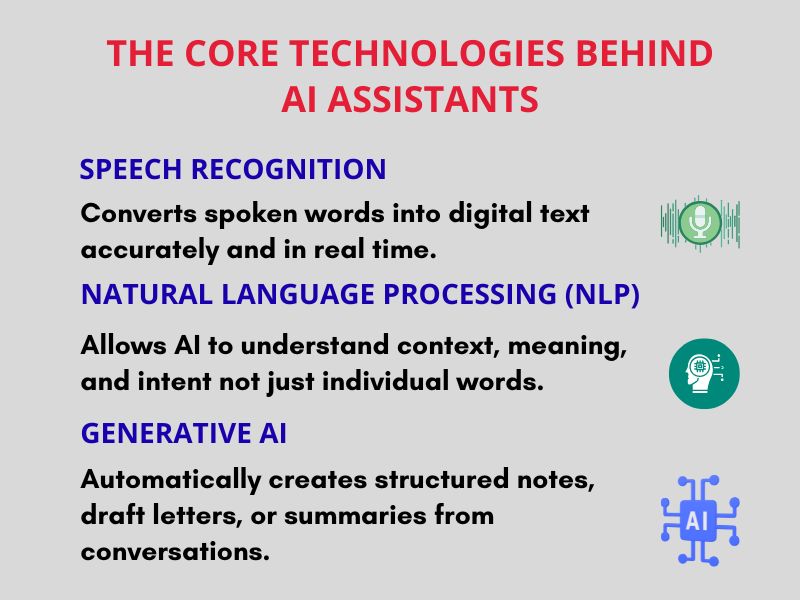
Think of it as software trained to understand medical conversations and perform specific documentation tasks, acting as a highly efficient AI assistant for doctors.
Ensuring Patient Safety and Data Security
Whenever new technology is introduced into healthcare, especially AI, questions about safety and privacy are paramount. The government guidance accompanying this initiative strongly emphasises these points:
- Data Compliance: Any tool used must adhere to strict NHS data protection regulations (like GDPR).
- Security: Robust security measures are essential to protect sensitive patient information.
- Risk Assessment: Potential risks must be identified and managed appropriately.
- Staff Training: Clinicians need proper training to use the technology effectively and safely.
- Human Oversight: It’s vital to remember that the AI assists; the clinician remains in control, reviewing and authorising all notes and documents before they are finalised and added to the patient’s record.
The NHS has designed safeguards to ensure AI is used responsibly and to protect patient trust.
The Future of AI in Healthcare UK
This AI doctor’s assistant is just one example of how doctors use AI, and healthcare systems are starting to evolve. The government sees this as part of a broader push, already using AI in other areas like:
- Speeding up cancer diagnosis (e.g., analysing scans).
- Assessing pain levels for non-verbal patients.
- Helping manage patient flow and discharge from hospitals.
The success of these transcription tools could pave the way for wider adoption and integration with other AI systems. AI in UK healthcare will likely automate routine tasks, letting experts focus on complex decisions and patient care.
While it’s still early days, the promise is significant. If AI can genuinely reduce the administrative burden, it could lead to:
- More focused and potentially longer consultations.
- GPs feeling less burnt out and better able to manage their workload.
- Potentially contributing to AI speeding up GP appointment availability over the long term by increasing overall efficiency.
A Step Towards a More Efficient NHS?
The recent news about AI doctors’ assistants in the NHS trials marks a potentially significant step forward. This technology helps free up clinicians’ time by handling time-consuming admin tasks. Positive early data and government support hint at a major shift in UK healthcare.
With proper checks, AI could be a game-changer for the NHS, helping doctors focus on patients and easing appointment pressures.
Read more about NHS England’s Big Update: More Local Health Services Explained
Frequently Asked Questions
It listens during appointments, automatically types notes, and helps draft letters. It reduces the doctor’s paperwork, saving them time.
Your doctor can give you more focused attention instead of typing. Longer-term, it might help speed up appointment availability by making the NHS more efficient.
Yes. It must follow strict NHS data protection rules. Your doctor checks and approves all notes before they are saved to your secure record.
No. It’s only an assistant for administrative tasks like notes. Your doctor still makes all decisions about your diagnosis and treatment.
It’s still in trial stages. While promising, a full NHS rollout will take time and depends on further tests and local decisions. It won’t be everywhere immediately.
Source / Ref.: Gov.uk Contains public sector information licensed under Open Government Licence v3.0.
Written by [Ketan Borada / British Portal Team] – Founder of British Portal, dedicated to providing accurate and up-to-date information on UK public services and benefits.Related Posts


Previous Post
Next Post







- Business
 5
5 - Cricket5
- Department for Education49
- Departments3
- Driving and Transport
 53
53 - Education45
- Finance6
- Football13
- Golf3
- Government
 108
108 - Guides1
- Health4
- Health
 5
5 - International Politics9
- Law and Justice31
- Money and Tax23
- National Politics4
- News68
- Politics6
- Sports38
- Technology5
- Tennis3
- Transportation4
- Uncategorized4
- Visa
 17
17 - Visas and Immigration
 24
24 - Weather1