McMurdock Reform resignation has ignited a firestorm in British politics just days after the general election. James McMurdock, one of Reform UK’s freshly elected MPs, resigned the party whip following allegations of business impropriety. His swift exit casts doubt not only on his own credibility but also on Reform UK’s internal candidate screening process.
As a party still finding its footing on the national stage, Reform UK is facing growing scrutiny. The resignation of a newly minted MP puts its momentum and its public trust at risk. McMurdock had positioned himself as a bold new face of change, but the controversy suggests deeper issues within the party’s infrastructure.
The incident is more than a political hiccup; it’s a wake-up call about transparency and integrity. And as media attention grows, the story of the McMurdock Reform resignation is far from over.
Who is James McMurdock?
Before the McMurdock Reform resignation dominated headlines, James McMurdock was largely unknown in national politics. A newcomer to Parliament, McMurdock won his seat under the Reform UK banner during the 2025 general election, part of the party’s wider success that saw it disrupt traditional political alignments. Backed by the populist momentum fueled by Nigel Farage, McMurdock was presented as a fresh voice an alternative to the status quo.
Professionally, McMurdock had built a career in business, particularly in the property and consultancy sectors. His entrepreneurial background was seen by Reform UK as an asset, portraying him as someone who understood economic frustrations from the ground up. However, his limited public service record and absence of political experience raised some eyebrows even before his campaign gained traction.
His candidacy reflected Reform UK’s broader strategy: selecting candidates who could appeal to disenfranchised voters with anti-establishment views. While this approach helped boost votes, it also led to criticism over the party’s apparent lack of due diligence.
Following his victory, McMurdock was expected to champion Reform UK’s economic reform agenda. Instead, just weeks later, his resignation would thrust him into the spotlight for all the wrong reasons marking the beginning of the McMurdock Reform resignation controversy.
The Allegations Behind the McMurdock Reform Resignation
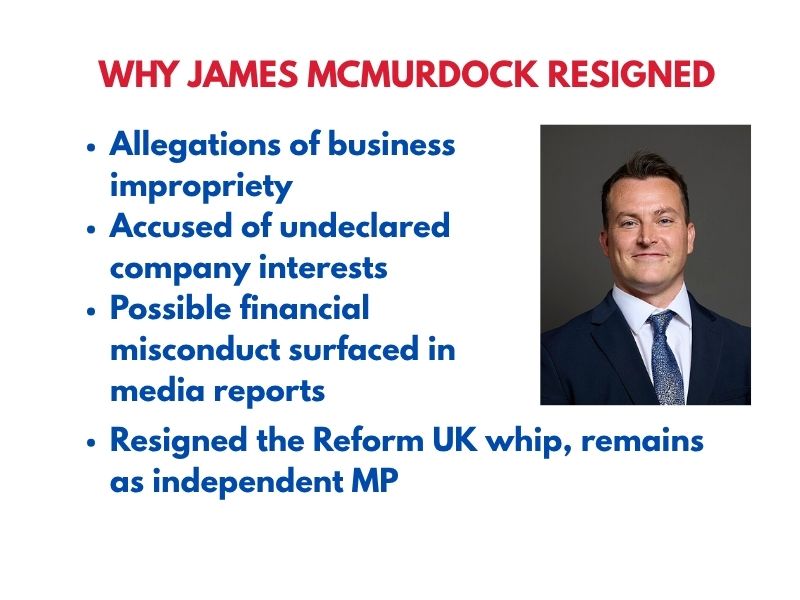
At the heart of the McMurdock Reform resignation lie troubling allegations that question both personal integrity and political accountability. James McMurdock faced claims of business impropriety stemming from his previous ventures, including possible financial mismanagement and failure to disclose relevant interests prior to his candidacy.
Reports first emerged suggesting that McMurdock had not declared directorial roles in a number of private firms some of which had reportedly faced financial or legal challenges. While details remain under investigation, media sources such as The Telegraph, BBC, and The Independent revealed discrepancies in official records and accusations of conflicts of interest. These revelations cast doubt over whether McMurdock fully complied with MPs’ financial declaration rules, a basic standard of parliamentary transparency.
More concerning were allegations of possible misuse of company funds and misleading investors, though these remain unproven. Critics argue that McMurdock’s quick resignation signals potential credibility to the claims, while supporters insist the response was taken to protect the party from media distraction.
Reform UK leadership initially remained tight-lipped, but mounting pressure forced the party to address the situation. McMurdock ultimately stepped down from the party whip, distancing himself from the Reform UK brand but retaining his seat as an MP for now.
The unfolding scandal has left many asking: How did these issues escape pre-election vetting? And could other Reform UK candidates face similar scrutiny? Whatever the outcome, the McMurdock Reform resignation has become a test case for the risks of rapid political expansion without robust internal oversight.
McMurdock’s Resignation from Reform UK
The moment the McMurdock Reform resignation was confirmed, it triggered a flurry of political reactions. On July 4, barely days after taking office, James McMurdock resigned the party whip a move that stunned both supporters and critics alike. While he did not resign as an MP, stepping away from Reform UK’s parliamentary identity was a significant admission of the weight of the allegations.
In a brief statement, McMurdock claimed his decision was intended to prevent distraction from Reform UK’s wider goals. He insisted that stepping aside was not an admission of guilt but a gesture of accountability, stating he would cooperate fully with any inquiries related to his business affairs. However, the lack of detail in his resignation raised further questions about transparency.
Reform UK, still riding the momentum of its election success, moved quickly to contain the fallout. Party officials emphasized that McMurdock acted independently, suggesting the party had not pressured him to resign. Nevertheless, critics pointed to this incident as a symptom of rushed candidate selection an issue Reform UK can no longer ignore.
For now, McMurdock will sit as an independent MP. But the shadow cast by the McMurdock Reform resignation continues to grow, placing added pressure on party leadership to restore credibility and tighten internal checks.
Party and Political Reaction
The McMurdock Reform resignation prompted swift and varied reactions from across the political spectrum. Within Reform UK, party leader Richard Tice downplayed the incident, stating that the party would remain focused on delivering real change for the British people. However, his measured tone could not mask the internal concern over the damage to the party’s newly earned credibility.
Nigel Farage, who had taken a front-facing role during the election campaign, remained relatively quiet about the resignation. Some political commentators interpreted this as strategic distancing himself from a controversy that could overshadow his own resurgence. Meanwhile, Reform UK members privately expressed frustration, with some MPs demanding stronger vetting procedures moving forward.
Opposition parties were quick to seize the moment. Labour and Liberal Democrat MPs called the resignation a sign of deeper problems within Reform UK, accusing it of prioritising electoral gains over candidate integrity. Even some Conservative figures joined the chorus, warning that the rise of alternative parties could pose risks if they failed to uphold parliamentary standards.
The press, unsurprisingly, amplified the fallout. Headlines across major outlets framed the McMurdock Reform resignation as both a scandal and a cautionary tale. As pressure mounts, Reform UK finds itself not only defending its image but also its future direction.
Impact on Reform UK’s Public Image
The McMurdock Reform resignation has done more than spark internal tension it has also dealt a blow to Reform UK’s fragile public image. As a party founded on promises of accountability, transparency, and political reform, this incident undermines the very principles that attracted disillusioned voters in the first place.
For many who supported Reform UK, especially first-time voters, the scandal represents a betrayal of trust. The perception that the party failed to properly vet its candidates reinforces criticisms that it is more populist than professional. Media outlets have painted the party as reckless, while some political analysts warn that such controversies could limit Reform UK’s ability to expand beyond protest-vote territory.
Social media platforms have amplified this backlash, with trending hashtags calling the resignation “predictable” and “avoidable.” The situation has given mainstream parties fresh ammunition to question Reform UK’s legitimacy in parliamentary politics.
In response, party officials have pledged to review their internal procedures. Whether this response will restore public confidence remains to be seen. What is clear, however, is that the McMurdock Reform resignation has interrupted Reform UK’s narrative of political disruption replacing it, at least temporarily, with a narrative of scandal and inexperience.
What it Means for Future Candidates
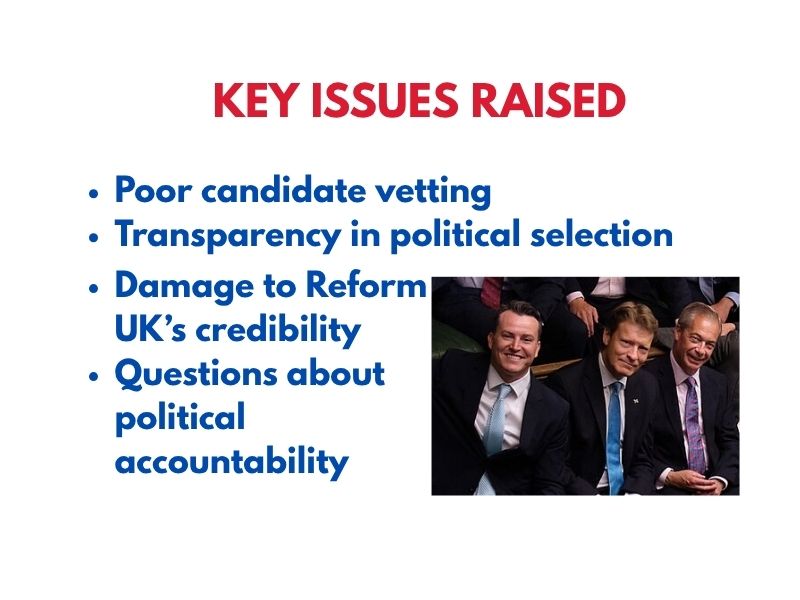
The McMurdock Reform resignation has sparked urgent conversations about candidate vetting not just within Reform UK, but across all political parties. As newer movements like Reform UK grow rapidly, their candidate selection processes often struggle to keep pace. McMurdock’s resignation reveals the high cost of prioritising visibility over scrutiny.
Reform UK’s strategy had been to recruit outsiders’ individuals from business, media, or activism to bring fresh energy to Parliament. While this approach can resonate with frustrated voters, it also increases the risk of onboarding candidates with questionable pasts. McMurdock’s case highlights that without rigorous checks, personal controversies can quickly become party-wide crises.
Experts now suggest that all political parties, especially those seeking to disrupt traditional power structures, must invest in thorough background vetting. The public expects higher standards, and any failure in that area is met with immediate scrutiny. For future candidates of Reform UK, the bar has likely been raised.
This event may even influence the broader political culture in Britain. As the dust settles, the McMurdock Reform resignation could serve as a watershed moment prompting all parties to rethink how they define, recruit, and present the people they want to send to Westminster.
Conclusion
The McMurdock Reform resignation is more than a political headline it is a cautionary tale. It underscores the urgent need for stronger candidate vetting, transparent leadership, and a commitment to public accountability. For Reform UK, the incident is a test of how it responds under pressure and whether it can evolve into a credible political force.
For voters, it’s a reminder to look beyond slogans and into substance. In an age where trust in politics is fragile, the downfall of one MP could shape the standards expected of many. Reform begins within and that’s where it must start.
FAQs
James McMurdock is a Reform UK MP who resigned the party whip following business impropriety allegations.
He resigned due to allegations involving undeclared business interests and financial misconduct.
Yes, he remains an independent MP after resigning from the Reform UK whip.
The party pledged to review its vetting process but distanced itself from McMurdock’s actions.
Future candidates will likely face tighter background checks and higher scrutiny.
As of now, inquiries are expected, but no official parliamentary investigation has been launched.
Related Posts



Previous Post
Next Post







- Business
 5
5 - Cricket5
- Department for Education49
- Departments3
- Driving and Transport
 53
53 - Education45
- Finance6
- Football13
- Golf3
- Government
 108
108 - Guides1
- Health
 5
5 - Health4
- International Politics9
- Law and Justice31
- Money and Tax23
- National Politics4
- News68
- Politics6
- Sports38
- Technology5
- Tennis3
- Transportation4
- Uncategorized4
- Visa
 17
17 - Visas and Immigration
 24
24 - Weather1