
Receiving a letter asking you to do jury service can bring mixed feelings. It’s a vital civic duty, fundamental to the justice system in the United Kingdom. However, it can also raise many questions and feel a bit daunting. What does it involve? Do you have to do it? What about work and pay?
The Jury Summons: What Happens First?
It usually starts with a letter arriving through your door: a jury summons. This official document means you’ve been randomly selected from the electoral register to potentially sit as a juror on a court case.
- What is a jury summons? It’s a legal requirement to respond. It will tell you the court location and the dates you need to be available. Think of it as your summons for jury service.
- Responding: You MUST reply to the summons by the date specified, usually within 7 days. Many people can now reply online using the jury service portal (often referred to simply as the jury service portal). The summons letter will provide details, including any jury service contact number or jury service contact information you might need. Keep the jury service booklet, if provided, as it contains useful jury service details.
- Being called for jury service is the first step in the process. Prompt is essential.
Are You Eligible for Jury Service?
Before you even think about serving, you need to meet certain basic requirements. Generally, to be eligible for jury service UK, you must be:
- Aged between 18 and 70 (the upper jury service age limit can be slightly different, for example, the jury service age limit in Scotland currently extends to 75). Always check the details for your specific UK nation. So, check the age for jury service in the UK.
- Registered to vote in the UK.
- A resident in the UK, Channel Islands, or Isle of Man for at least five years since age 13.
However, eligibility is just the start. Some people are automatically excluded or can ask to be excused.
Exemptions, Excusal, and Deferral: Can You Get Out Of Jury Service?
This is often the biggest area of concern. Can you be excused? There are several categories, and the specifics can vary significantly across the UK.
- Disqualified: Some people are legally barred due to their jury service criminal record. This usually relates to certain sentences or types of conviction.
- Ineligible: Certain jobs make you ineligible because of potential conflicts of interest. This might include judges, police officers, or others involved in the justice system. Questions like “Can solicitors do jury service?” or “Can police officers do jury service?” fall into this category – the rules can differ slightly across the UK, but generally, those directly involved in the justice system are ineligible.
- Excusal & Deferral: This is where most people’s circumstances fall. You aren’t automatically out, but you can ask not to do it at this time (deferral) or, in some cases, be excused entirely (excusal).
Applying to be Excused or Deferred
You make this request when you reply to your summons, explaining your reasons clearly. You’ll likely need proof (e.g., doctor’s note, holiday booking confirmation). Simply wanting to avoid it isn’t usually enough; you need a valid reason. People often search for the “best way to get out of jury service,” but the focus should be on legitimate reasons for excusal from jury service or deferral of jury service.
Common Reasons for Applying
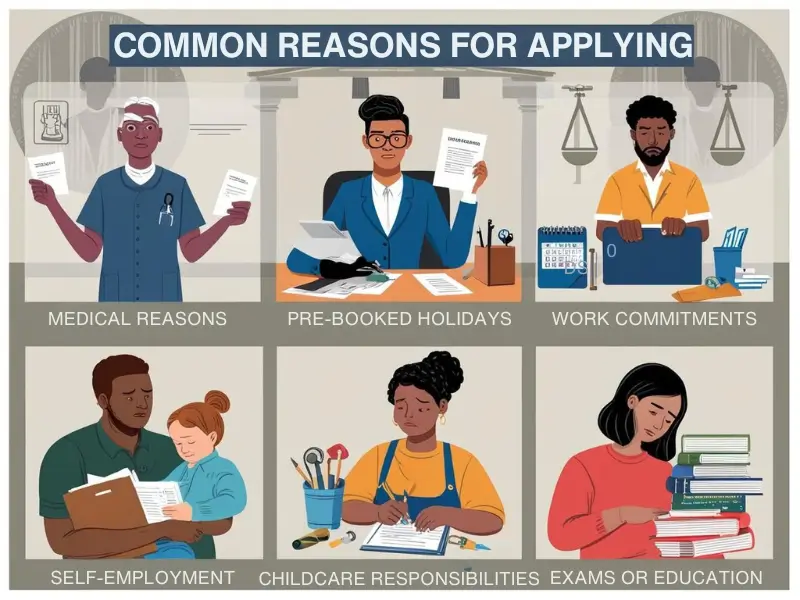
- Medical Reasons: Significant illness, a jury service disability, serious jury service anxiety disorder, or other jury service exemption mental health conditions might qualify you. You’ll usually need a jury service doctor’s note. (Medical exemption from jury service is a common request.) Even conditions like ADHD might be considered if they significantly impact your ability to serve.
- Pre-booked Holidays: If you have a jury service booked holiday that clashes with the dates, you can usually apply for jury service deferral. Mentioning “jury service but on holiday” or “jury service during holiday” is a frequent reason for applying.
- Work Commitments: This is complex. Your employer must give you time off, but if your absence would cause exceptional harm to your business (especially if small or you have a crucial role), you might apply for deferral.
- Self-Employment: Being self-employed isn’t an automatic exemption. Concerns about loss of earnings are addressed via expenses (see below), but significant, provable hardship to your business due to your absence might be grounds for deferral. Keywords like jury service self-employed, jury duty self-employed, and jury service and self-employed reflect this common query.
- Childcare Responsibilities: If you are the primary carer for young children and cannot make alternative arrangements, you may be able to get excused or deferred. Jury service and childcare or jury service childcare are key concerns for parents.
- Exams or Education: Students undergoing crucial exams may be able to defer.
- Other Hardships: Caring responsibilities for older people or ill relatives, recent bereavement, etc.
Specific National Rules on Exemptions
- England & Wales: Check the official gov.uk website for the full list of jury service exemptions in England and the rules. You’ll find details on exemptions from jury service in England. (Keywords: jury service England exemptions, jury exemption, jury duty exemptions, juror exemption, jury summons exemption).
- Scotland: Rules differ. Check the Scottish Courts and Tribunals Service website. Keywords like jury service exemptions Scotland and application for excusal from jury service Scotland highlight these differences.
- Northern Ireland (NI): Check the NI Courts and Tribunals Service website. Jury service ni rules on exemptions are specific to the region.
Remember: Being excused from jury service isn’t guaranteed. Authorities try to accommodate genuine difficulties, often by deferring your service to a later date. You might receive a jury service excuse letter template or need to write your explanation. A jury service questionnaire might also be part of the process.
Pay and Expenses: Do You Get Paid?

This is a common question: “Do you get paid for jury service?“. The simple answer is no, you don’t get paid a salary by the court. However, you can claim allowances and expenses to cover what you’ve lost or spent.
- Loss of Earnings: If you lose wages because of jury service and work, you can claim for this loss up to a daily limit. This includes those who are jury service self-employed. You’ll need proof from your employer or evidence of self-employed earnings. This is often managed via a jury service claim for loss of earnings.
- Travel Costs: Reasonable travel expenses to and from court are covered.
- Food and Drink: A daily subsistence allowance is provided.
- Childcare Costs: In some cases, exceptional childcare costs incurred due to service can be claimed (check rules for your nation).
Key Points on Pay
- Jury Service Pay/Allowance: The amounts have set daily limits, which you can find on the official government websites. Use the jury service allowance or jury service daily rate figures from official sources.
- Claiming: You’ll need to fill out a jury service claim form (sometimes called a jury service expenses form) and provide proof (receipts, employer letter). Keep track of your jury service expenses. A jury service expenses calculator might be available on official sites.
- Employer Pay: Your jury service employer is legally obligated to give you time off, but they do not have to pay you your normal salary (jury service employer pay is not required). Some employers do top up the allowance, but many don’t. This is a key point under jury service and employers.
- Can I work while on jury service in the UK? Generally, no. Your jury service takes priority during court hours.
The Jury Service Experience: What Happens?
So, you’ve replied to the summons, you’re eligible, and you haven’t been excused or deferred. What next? What does jury service involve?
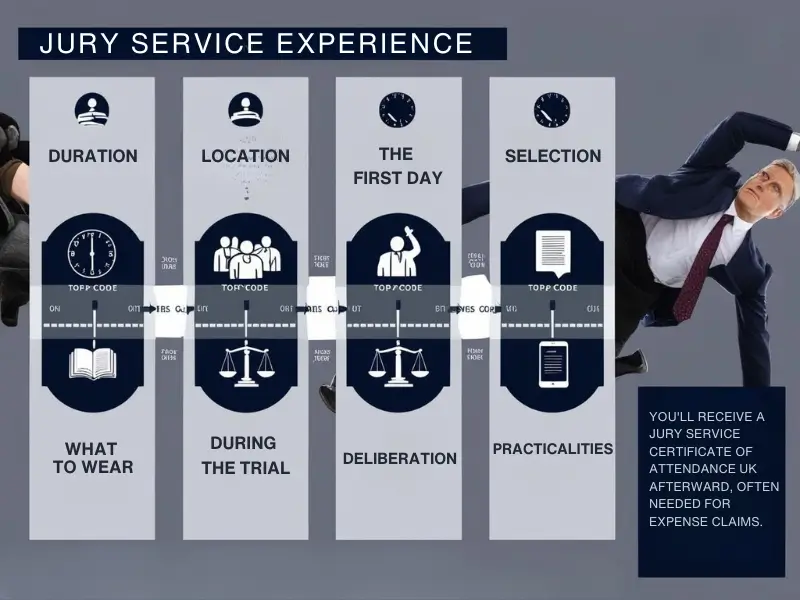
- Duration: How long is jury service? Typically, you’re asked to be available for 10 working days (two weeks). However, if you’re selected for a long trial, it could be much longer. The average length of a jury service day is usually standard court hours (e.g., 10 am – 4:30 pm), but this can vary.
- Location: You’ll usually serve at your local Crown Court (crown court jury service) or, in Scotland, the High Court or Sheriff Court.
- The First Day: Arrive on time. You’ll likely watch an introductory video, get your ID checked, and learn about the process. There’s often a lot of waiting involved.
- Selection: You and others will be taken to a courtroom. Names are drawn randomly. Lawyers from the prosecution and defense can object to jurors, but usually without giving a reason. If selected, you take an oath or affirmation.
- During the Trial: You listen to evidence, look at exhibits, and hear legal arguments. You must not discuss the case with anyone outside the jury room, even family. No independent research is allowed.
- Deliberation: After all the evidence, the judge sums up the case and explains the law. The jury retires to a private room to discuss the case and reach a verdict (guilty or not guilty).
- Not Needed? Sometimes, you might attend court but find that jury service but not needed for a trial that day, or a case might settle. You might be asked to come back the next day or released early.
- What to Wear: There’s a jury service dress code. It’s usually smart casual – avoid overly casual clothes like shorts, ripped jeans, or t-shirts with large logos. Think office wear or similar. Be comfortable but respectful. Check the jury service dress code UK guidance if unsure.
- Practicalities: Bring something to read for waiting times. Check the rules about phones/laptops. You’ll receive a jury service certificate of attendance afterward, often needed for expense claims.
Your Obligations: Do You Have To Go?
Yes. Jury service is a public duty. Ignoring the summons or refusing to attend without a valid, approved reason can lead to a fine.
- Can you refuse jury service? Not without potentially facing legal consequences unless you have been formally excused or deferred by the court service. The question “Do you have to do jury service?” is a firm yes, unless exempt. A refusal to do jury service without permission is taken seriously.
While jury service can disrupt your routine, it’s a cornerstone of the justice system. It ensures that people are tried by their peers. Understanding the process – from the initial jury duty service summons to claiming expenses and knowing what to expect in court – can make the experience less stressful. Remember the benefits of jury service: you play a direct role in justice, gain insight into the legal system, and fulfill an important civic responsibility.
Read more about the Role of a Litigation Friend in UK Courts
Source / Ref.: Citizensadvice.org.uk Contains public sector information licensed under Open Government Licence v3.0.
Written by [Ketan Borada / British Portal Team] – Founder of British Portal, dedicated to providing accurate and up-to-date information on UK public services and benefits.Related Posts


Previous Post
Next Post
Previous Post

Next Post





- Business
 5
5 - Cricket5
- Department for Education49
- Departments3
- Driving and Transport
 53
53 - Education45
- Finance6
- Football13
- Golf3
- Government
 108
108 - Guides1
- Health4
- Health
 5
5 - International Politics9
- Law and Justice31
- Money and Tax23
- National Politics4
- News68
- Politics6
- Sports38
- Technology5
- Tennis3
- Transportation4
- Uncategorized4
- Visa
 17
17 - Visas and Immigration
 24
24 - Weather1