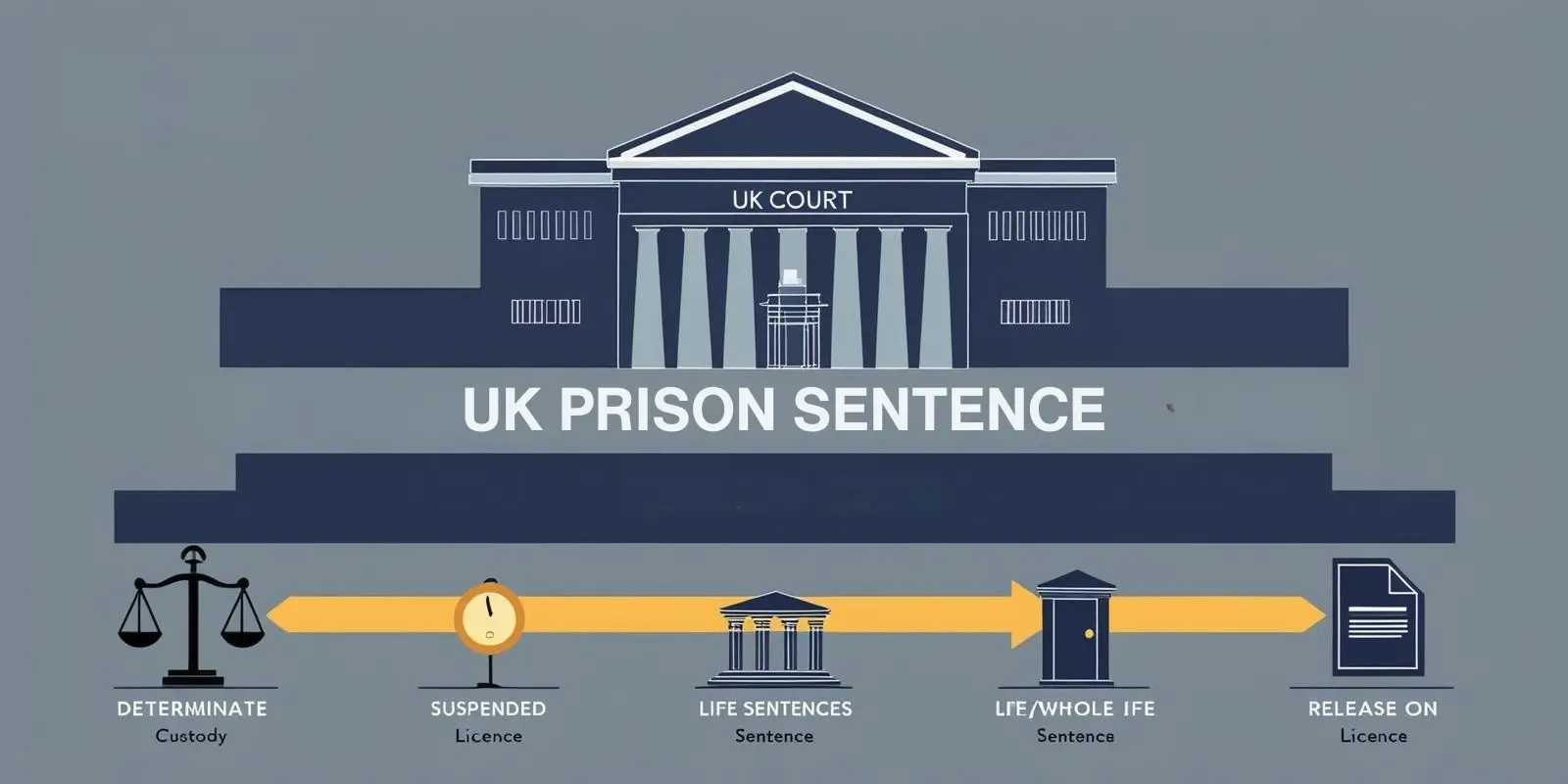
When a court in the UK finds someone guilty of a crime serious enough to warrant imprisonment, the judge imposes a sentence. However, not all prison sentences are the same. The way sentences are structured, how long someone spends in prison, and what happens upon release can vary significantly. Understanding the different types of prison sentences in the UK helps clarify how the justice system operates.
What is a Custodial Sentence?
At its core, a custodial sentence in the UK means an offender is deprived of their liberty and sent to prison. The court reserves these sentences for the most serious offences when it decides that a fine or community punishment isn’t enough because of how severe the crime is or the risk the offender poses to the public.
There are several distinct categories of custodial sentences, each with its own rules.
Determinate Sentences: A Fixed Term
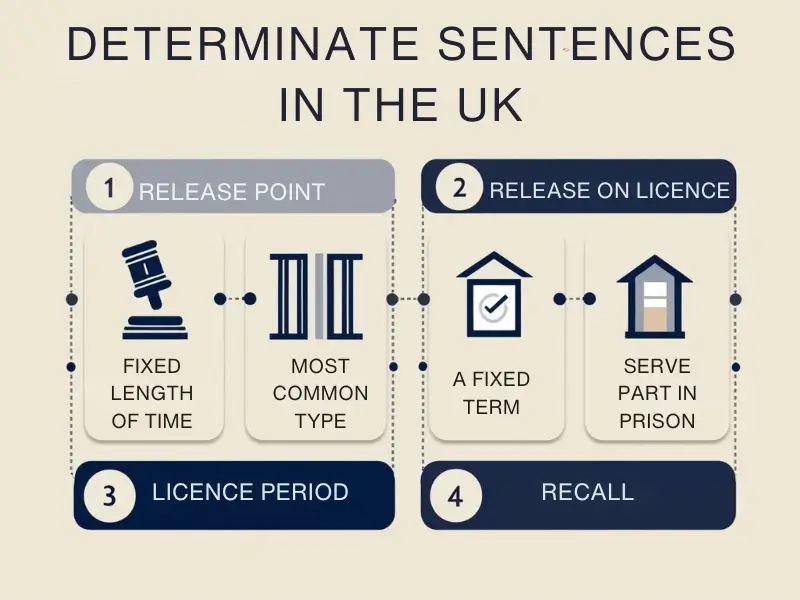
The most common type of prison sentence is a determinate sentence in UK. This means the court sets a fixed length of time for the sentence, for example, six months, two years, or ten years.
However, a key point to understand is that offenders serving standard determinate sentences do not usually spend the entire duration locked up.
- Release Point: For most determinate sentences, offenders serve the first half of the sentence in prison.
- Release on Licence: The authorities usually release the offender for the second half of the sentence to serve it in the community on licence. During this time, the offender must follow strict conditions, like meeting a probation officer, following curfews, or avoiding certain places or people.
- Licence Period: The licence usually lasts until the end date of the total sentence imposed by the court.
- Recall: If an offender breaks their licence conditions or commits another crime during that time, the authorities can recall them to prison to serve more time.
Important Exception – Longer Time for Serious Offences:
The standard early release rules of the UK prison system have an important exception. For certain serious violent, sexual, or terrorism-related offences:
- Offenders sentenced to 7 years or more must serve two-thirds of their sentence length in prison before they can be considered for release on licence.
- Recent changes mean some offenders sentenced to between 4 and 7 years for these types of serious offences may also serve two-thirds in prison.
This change reflects a move towards ensuring that those who commit the most harmful crimes spend longer in custody.
Extended Determinate Sentences (EDS): For offenders deemed “dangerous” (posing a significant risk of serious harm to the public), courts can impose an EDS. This involves a fixed custodial term (where at least two-thirds must be served) followed by a long extended period on licence, providing extra public protection.
Suspended Sentences: A Sentence Held Back
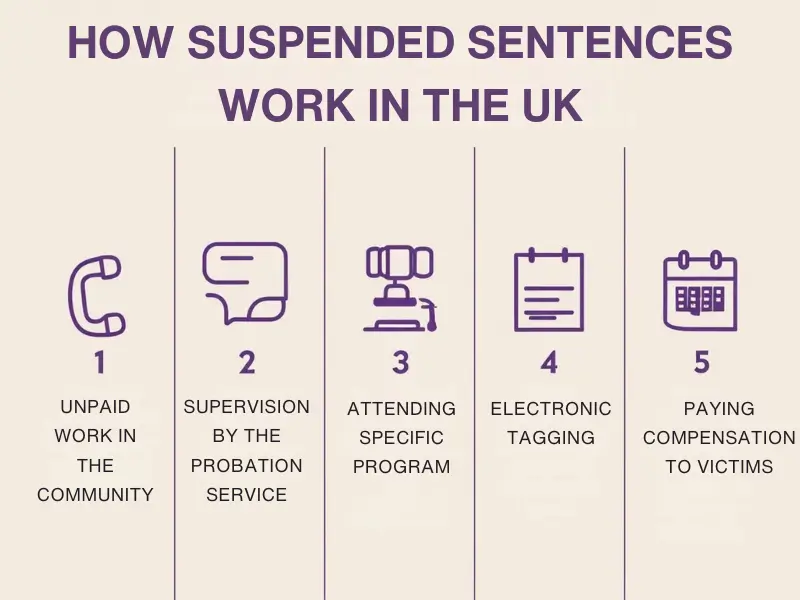
A suspended prison sentence in the UK is slightly different. Here, the court imposes a prison sentence of a specific length but decides not to send the person to prison immediately. Instead, the sentence is ‘suspended’ for a set period (the ‘operational period,’ which can be up to two years).
During this operational period, the offender must comply with specific requirements set by the court. These might include:
- Unpaid work in the community (community service)
- Supervision by the Probation Service
- Attending specific programmes (like drug or alcohol treatment)
- Curfews or electronic tagging
- Paying compensation to victims
Activation of a Suspended Sentence:
- If the offender complies with all requirements throughout the operational period and does not commit another crime, they will not go to prison for that sentence.
- If the offender breaks the rules or commits another offence during the operational period, the court will likely activate the original prison sentence and send them to prison to serve it, fully or partly.
Suspended sentences act as both a punishment and a warning, giving the offender a chance to avoid prison if they stay out of trouble and engage with rehabilitative requirements.
Life Sentences: For the Most Serious Crimes
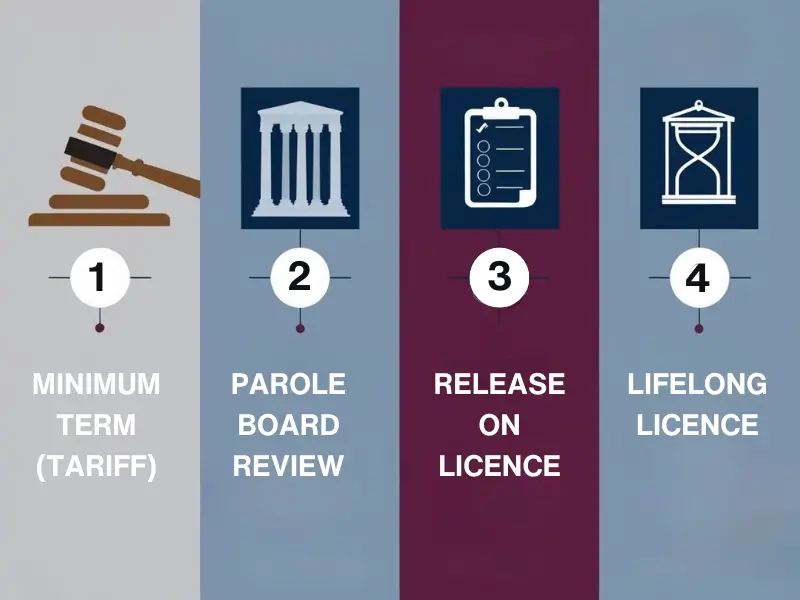
The life sentence in the UK can sometimes be confusing. Judges reserve it for the most serious crimes—it’s mandatory for murder and optional for other serious violent or sexual offences.
Here’s how a typical life sentence works:
- Minimum Term (Tariff): The judge sets a minimum period the offender must spend in prison. This tariff reflects the seriousness of the specific crime and the offender’s circumstances. It can range from around 15 years to 30 years or more.
- Parole Board Review: Once the minimum term has been served, the offender becomes eligible for review by the independent Parole Board. The Parole Board assesses whether the offender still poses a significant risk to the public.
- Release on Licence: Release is not automatic after the minimum term. If the Parole Board decides the offender’s risk is manageable in the community, they can be released, but always on a lifelong licence.
- Lifelong Licence: This is crucial – even when released, someone serving a life sentence remains subject to licence conditions for the rest of their life. They will be supervised by probation and can be recalled to prison at any time if they breach their conditions or their risk increases. So, in this sense, “life means life.”
Whole Life Orders: In the most exceptionally severe cases (e.g., multiple murders, terrorism causing mass casualties, murder of a child involving abduction or sexual motivation), a judge can impose a Whole Life Order. This means the offender will never be considered for release and will spend the rest of their natural life in prison. These are rare.
Indeterminate Sentences for Public Protection (IPP)
Before they were abolished in 2012, courts could impose an indeterminate prison sentence known as an IPP sentence. Courts gave these to offenders they considered dangerous but whose crimes didn’t justify a life sentence.
- IPP sentences have a minimum term (tariff).
- The Parole Board decides whether to release the offender after they serve the tariff, based on a risk assessment—there’s no automatic release date.
- Although abolished for new cases, thousands of people are still serving IPP sentences, facing uncertainty about their release. Release, when granted, is also on to licence with the possibility of recall.
How Multiple Sentences Are Served
Sometimes, the court sentences a person for more than one crime at the same time. Understanding concurrent vs consecutive sentences in the UK is important:
- Concurrent Sentences: If the court orders sentences to run concurrently, the offender serves all the prison terms at the same time. The offender serves the length of the longest single sentence. (e.g., sentences of 2 years and 3 years served concurrently mean a total of 3 years).
- Consecutive Sentences: If the court orders sentences to run consecutively, the offender serves them one after the other. The total time served is the sum of the individual sentences. (e.g., sentences of 2 years and 3 years served consecutively mean a total of 5 years).
The judge decides whether sentences run concurrently or consecutively based on the nature of the offences.
Other Important Considerations
- Time Spent on Remand: Time spent in prison before trial or sentencing usually counts toward the offender’s final sentence.
- Home Detention Curfew (HDC / Tagging): Some offenders serving shorter determinate sentences may be eligible for release slightly earlier than the halfway point onto an electronic tag (Home Detention Curfew). Eligibility depends on the sentence length, offence type, and risk assessment.
Sentencing Guidelines and Court Powers
Judges don’t just pick sentences out of thin air. They must follow prison sentence guidelines in the UK produced by the independent Sentencing Council. These guidelines help ensure consistency and fairness in sentencing across England and Wales. They set out starting points and ranges for sentences based on the seriousness of the offence and the offender’s background.
It’s also worth noting that different courts have different sentencing powers:
- Magistrates’ Courts: Deal with less serious offences. The maximum sentence the Magistrates Court UK can generally impose for a single offence is 6 months imprisonment (or up to 12 months total for multiple offences). More serious cases are passed to the Crown Court.
- Crown Courts: Deal with the most serious criminal cases (like robbery, rape, and murder) and have the power to impose longer sentences, including life sentences.
Understanding the Framework
The UK system of prison sentences is complex, with different structures designed for different situations and levels of offending. Each sentence type—fixed, suspended, or life—has its own rules and conditions for release or punishment. Knowing how release, licence, and guidelines work helps you understand custodial sentences in England and Wales.
Read more about Understanding Domestic Abuse Injunctions in the UK
Source / Ref.: Gov.uk Sentencingcouncil.org.uk Contains public sector information licensed under Open Government Licence v3.0.
Written by [Ketan Borada / British Portal Team] – Founder of British Portal, dedicated to providing accurate and up-to-date information on UK public services and benefits.Related Posts


Previous Post
Next Post






- Business
 5
5 - Cricket5
- Department for Education49
- Departments3
- Driving and Transport
 53
53 - Education45
- Finance6
- Football13
- Golf3
- Government
 108
108 - Guides1
- Health
 5
5 - Health4
- International Politics9
- Law and Justice31
- Money and Tax23
- National Politics4
- News68
- Politics6
- Sports38
- Technology5
- Tennis3
- Transportation4
- Uncategorized4
- Visa
 17
17 - Visas and Immigration
 24
24 - Weather1