HGV driver roles are in high demand across the UK, offering a stable and rewarding career path. With the logistics sector experiencing significant growth, there’s never been a better time to consider this profession.
This guide will walk you through the steps to become a qualified HGV driver, from obtaining your licence to finding the right training provider.
Initial Requirements and Eligibility
To embark on your journey as an HGV driver, you must meet specific criteria:
- Age Requirement: You must be at least 18 years old.
- Driving Licence: Hold a full car driving licence (Category B).
- Medical Fitness: Undergo and pass an HGV medical examination to ensure you’re fit to drive heavy vehicles.
- Provisional HGV Licence: Apply for a provisional HGV licence, which involves completing forms D2 and D4.
- Driver CPC: Obtain the Driver Certificate of Professional Competence (CPC), essential for professional HGV drivers.
Meeting these requirements is the first step towards a fulfilling career as an HGV driver.
Understanding HGV Licence Categories
To become an HGV driver, you need to understand the different licence categories available. Each category allows you to operate specific types of vehicles, based on weight and trailer capacity.
- Category C1:
Allows you to drive vehicles weighing between 3.5 and 7.5 tonnes (with or without a trailer up to 750kg). Ideal for smaller lorries. - Category C1+E:
Lets you drive a C1 vehicle with a trailer over 750kg. The combined weight must not exceed 12 tonnes. - Category C (HGV Class 2):
Authorises you to drive rigid body vehicles over 7.5 tonnes. This is a common entry point for professional drivers. - Category C+E (HGV Class 1):
Grants access to articulated lorries with a trailer over 750kg. This is the highest category and often leads to higher salaries and longer-distance jobs.
Choosing the right HGV licence depends on the type of job you’re aiming for. Many new drivers begin with HGV Class 2, then upgrade to HGV Class 1 after gaining experience.
Steps to Getting an HGV Licence
Becoming an HGV driver involves a structured process to ensure you’re fully qualified and safe on the roads. Below are the key steps:
- Apply for a Provisional HGV Licence
- Order and complete DVLA forms D2 (application) and D4 (medical).
- Submit them with your existing driving licence.
- Undergo HGV Medicals
- Book a driver medical with your GP or private provider.
- This ensures you meet the required physical health standards.
- Pass the Theory Test (CPC Module 1)
- Consists of multiple-choice questions and hazard perception.
- You must pass both parts to move forward.
- Complete the Case Studies Test (CPC Module 2)
- A computer-based test with real-life scenarios to assess your professional understanding.
- Start Practical Training with HGV Training Providers
- Choose a reputable school for HGV learning.
- Practical instruction prepares you for driving larger vehicles safely.
- Pass the Driving Ability Test (CPC Module 3)
- Tests your skills in vehicle control, road awareness, and safety practices.
- Take the Practical Demonstration (CPC Module 4)
- Demonstrates your ability to secure loads, carry out safety checks, and handle emergencies.
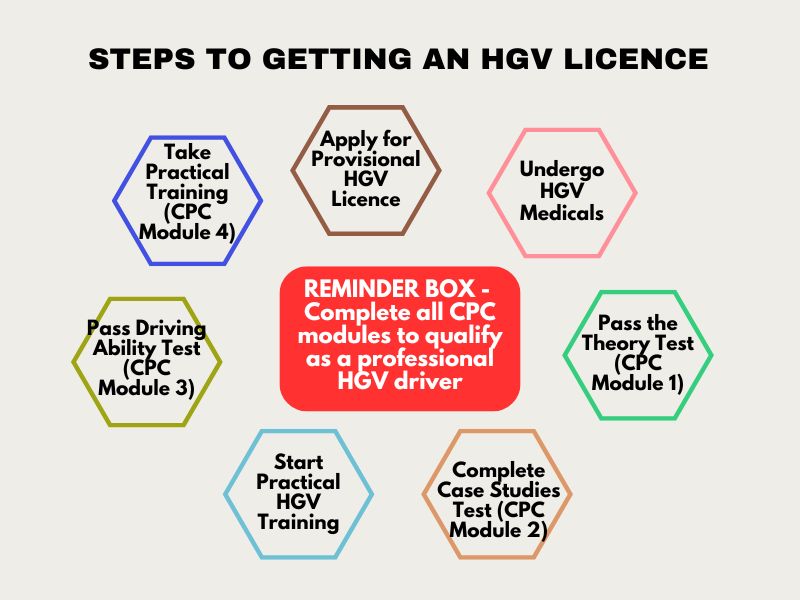
Each stage must be completed in order. Once you pass all four Driver CPC HGV modules, you’re fully qualified to drive professionally.
HGV Training Providers and Costs
Choosing the right HGV training providers is key to passing your tests and starting your career confidently. These schools offer tailored programmes to help you master both theory and practical skills.
What to Look for in a Training Provider:
- DVSA-approved instructors
- Structured learning plans for Class 1 and Class 2
- Flexible schedules or fast-track options
- High first-time pass rates
- Help with booking theory, CPC, and practical tests
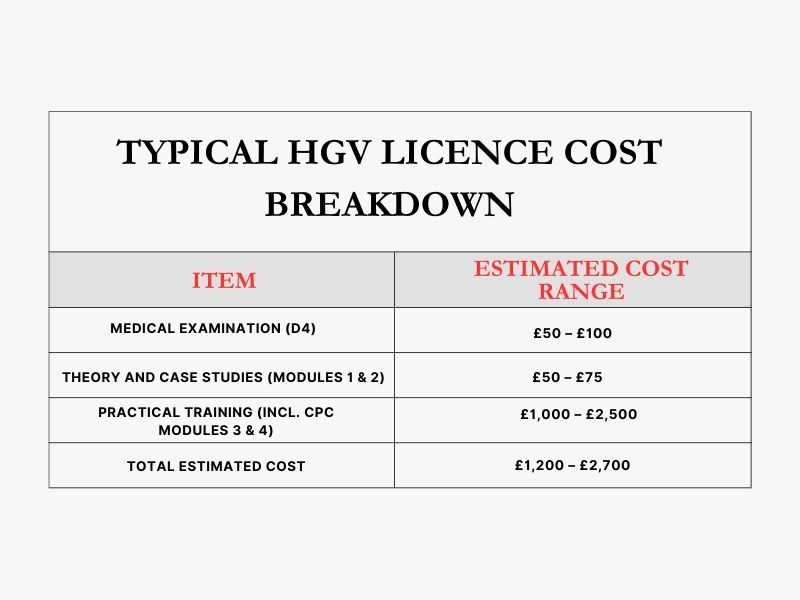
Prices vary by location, licence type (HGV Class 1 or Class 2), and provider reputation. Some companies even offer free HGV training if you agree to work with them afterward.
Investing in proper HGV learning pays off through better job readiness and increased earning potential.
Life as an HGV Driver
A career as an HGV driver offers more than just time on the road. It’s a lifestyle choice that comes with structure, independence, and the chance to explore different parts of the country.
What to Expect Day-to-Day:
- Early starts or night shifts, depending on the employer
- Long-distance or local delivery routes
- Vehicle safety checks before every trip
- Managing delivery paperwork and logs
- Regular rest breaks and compliance with driving hours
Work Environments:
- Logistics and haulage companies
- Supermarket supply chains
- Construction material delivery
- International freight (for experienced HGV Class 1 drivers)
Skills You’ll Use:
- Route planning and time management
- Vehicle handling and safety awareness
- Communication with dispatch teams and customers
- Problem-solving on the go
Many drivers enjoy the routine, job stability, and autonomy. With ongoing demand across the UK, becoming an HGV driver can offer excellent long-term prospects.
Benefits of Becoming an HGV Driver
Choosing a career as an HGV driver comes with a wide range of advantages. Whether you’re looking for job security, flexibility, or strong earning potential, HGV driving delivers.
Key Benefits:
- High Demand & Job Security
The UK is facing a shortage of qualified drivers, meaning more job opportunities and stable employment. - Competitive Salaries
Experienced drivers, especially with HGV Class 1 licences, can earn £35,000–£50,000 per year or more. - Flexible Working Options
Choose from local, regional, or long-haul routes to match your lifestyle. - Quick Entry to Employment
With intensive training, you could be on the road in a matter of weeks. - Career Progression
Start with HGV Class 2, then upgrade to Class 1 for access to higher-paying roles. - Freedom and Independence
Enjoy working solo, being out on the road, and avoiding office routines.
With proper HGV training providers, a valid Driver CPC HGV, and commitment, this career path offers excellent rewards.
After Passing: Driver CPC and Ongoing Requirements
Once you’ve passed your HGV training and obtained your licence, there are important ongoing requirements to maintain your professional standing. The Driver Certificate of Professional Competence (CPC) is one of the key elements for maintaining your HGV driving career.
What is the Driver CPC?
- The Driver CPC is a qualification that proves you meet the professional standards required for HGV drivers.
- It’s required for anyone driving large vehicles like lorries and buses for a living.
Ongoing Requirements:
- 35 hours of periodic training every 5 years
This is necessary to maintain your CPC and ensure you stay up to date with legal regulations and safety standards. Training sessions can cover topics like:- Road safety
- Driver well-being
- Vehicle maintenance
- HGV Medicals
Depending on your age, you may need to pass a medical check every 5 years to ensure you remain fit to drive. - Renewal of Your Licence
After a certain number of years, you may need to renew your HGV licence, including undergoing a medical review.
Continually meeting these requirements ensures you’re legally compliant and equipped to drive safely, making your career as an HGV driver sustainable and secure.
Safety and Legal Responsibilities for HGV Drivers
As an HGV driver, you play a critical role in ensuring road safety. Your responsibilities go beyond just driving; you’re also accountable for the safety of your vehicle, its cargo, and your own well-being. Here are some of the key safety and legal responsibilities you must adhere to:
Key Safety Responsibilities:
- Vehicle Maintenance and Checks
Before starting each shift, you must perform thorough checks on your vehicle, including brakes, lights, tyres, and load security. - Cargo Safety
Ensure that all loads are correctly secured to prevent accidents and damage. You’ll need to be knowledgeable about load distribution and securement techniques. - Driver Hours and Rest Periods
HGV drivers are regulated by the EU and UK rules on working hours and rest breaks. You must adhere to the following:- A maximum of 9 hours of driving per day (extendable to 10 hours twice a week)
- 11 hours of rest between shifts
- Weekly rest periods of at least 45 hours
- Adherence to Road Laws and Regulations
Always follow traffic rules and regulations, including speed limits, weight limits, and road restrictions for HGVs.
Legal Requirements:
- Driver CPC: Ensuring you complete the required training to keep your certification valid.
- HGV Licencing: Maintain the validity of your HGV licence and renew it as necessary.
- Insurance and Liability: Ensure that the vehicle is fully insured, and you understand your liability in case of accidents or damage.
By following these safety practices, you not only protect yourself and your cargo but also ensure you’re in full compliance with UK law.
Financial Support Options
Becoming an HGV driver involves several costs, from medical exams to training fees. However, there are financial support options available to help ease the burden.
The total cost of training can vary depending on the provider and whether you’re pursuing HGV Class 1 or Class 2. HGV learning can be a significant investment, but it opens the door to a high-paying career with opportunities for advancement.
Financial Support Options:
- Apprenticeships: Some logistics companies offer apprenticeship schemes, which combine on-the-job training with structured learning, and may cover training costs.
- Government Funding and Loans: You may be eligible for loans or grants, especially if you’re unemployed or seeking to switch careers. Check local government schemes and programs.
- Employer Sponsorship: Some employers provide sponsorship for your training in exchange for a commitment to work with them for a certain period.
With the proper funding or support, the cost of becoming an HGV driver can be significantly reduced, making the profession an accessible and rewarding choice.
How Much Does It Cost to Become an HGV Driver?
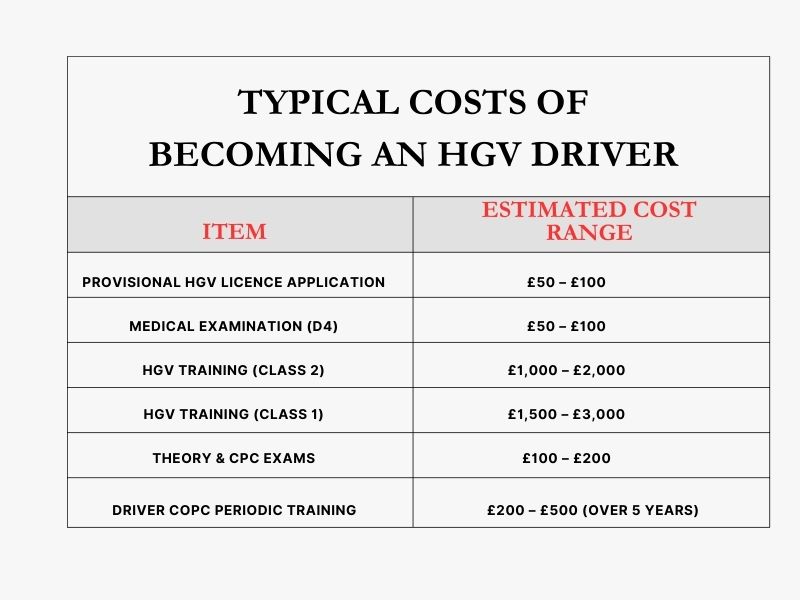
The cost of becoming an HGV driver can vary depending on several factors, such as the training provider, the type of licence you are applying for, and whether you’re taking additional certifications like the Driver CPC. Below is a breakdown of what you can expect to pay:
Breakdown of Typical Costs:
- Provisional HGV Licence: £50 – £100
This covers the application fee for the provisional licence, which is required before you can start training. - HGV Medicals: £50 – £100
A medical exam is necessary to ensure you meet the physical health requirements for driving heavy goods vehicles. - Training Costs: £1,000 – £3,000
The cost of practical and theoretical training depends on whether you’re pursuing HGV Class 2 or Class 1. Class 1 training tends to be more expensive due to the complexity of handling larger vehicles. - Theory and CPC Exams: £100 – £200
These exams include the multiple-choice theory test, hazard perception, and the Driver CPC exams (Modules 1–4). - Periodic Driver CPC Training: £200 – £500 (over 5 years)
After qualifying, you’ll need to complete 35 hours of Driver CPC training every 5 years to maintain your qualification.
Total Estimated Cost:
For a typical HGV Class 2 driver, the total cost of becoming qualified can range between £1,500 and £2,500. For HGV Class 1 drivers, costs can go up to £3,500 or more.
While the costs may seem high, the potential for earning a competitive salary—typically £30,000 to £45,000 annually—makes this investment worthwhile in the long run.
Is Becoming an HGV Driver the Right Career for You?
Becoming an HGV driver offers numerous benefits, including competitive salaries, job security, and a path to career progression. With the right training and qualifications, you can start your journey to becoming a skilled professional on the road.
Whether you’re interested in HGV Class 1 or Class 2, the steps to qualification are clear, and financial support options can make the process more accessible. Remember, ongoing training and certification—such as the Driver CPC—are key to maintaining your qualifications and ensuring a successful, long-term career.
If you’re ready to take the wheel and start your career as an HGV driver, the opportunities are vast, and the demand is higher than ever. With the right preparation, training, and determination, you can enjoy a rewarding career in the logistics and transportation industry.
FAQs
An HGV (Heavy Goods Vehicle) driver operates large vehicles used for transporting goods. They require specific licences and qualifications, such as HGV Class 2 or Class 1.
The time can vary, but typically, it takes 6-8 weeks for Class 2 training and longer for Class 1 training.
Costs range from £1,500 to £3,500, depending on the licence type and training provider.
You must be at least 18, hold a valid UK driving licence, pass a medical exam, and complete both theory and practical tests.
The Driver CPC (Certificate of Professional Competence) is a legal requirement for professional drivers, ensuring they stay qualified through periodic training.
Related Posts

Previous Post
Next Post







- Business
 5
5 - Cricket5
- Department for Education49
- Departments3
- Driving and Transport
 53
53 - Education45
- Finance6
- Football13
- Golf3
- Government
 108
108 - Guides1
- Health4
- Health
 5
5 - International Politics9
- Law and Justice31
- Money and Tax23
- National Politics4
- News68
- Politics6
- Sports38
- Technology5
- Tennis3
- Transportation4
- Uncategorized4
- Visa
 17
17 - Visas and Immigration
 24
24 - Weather1