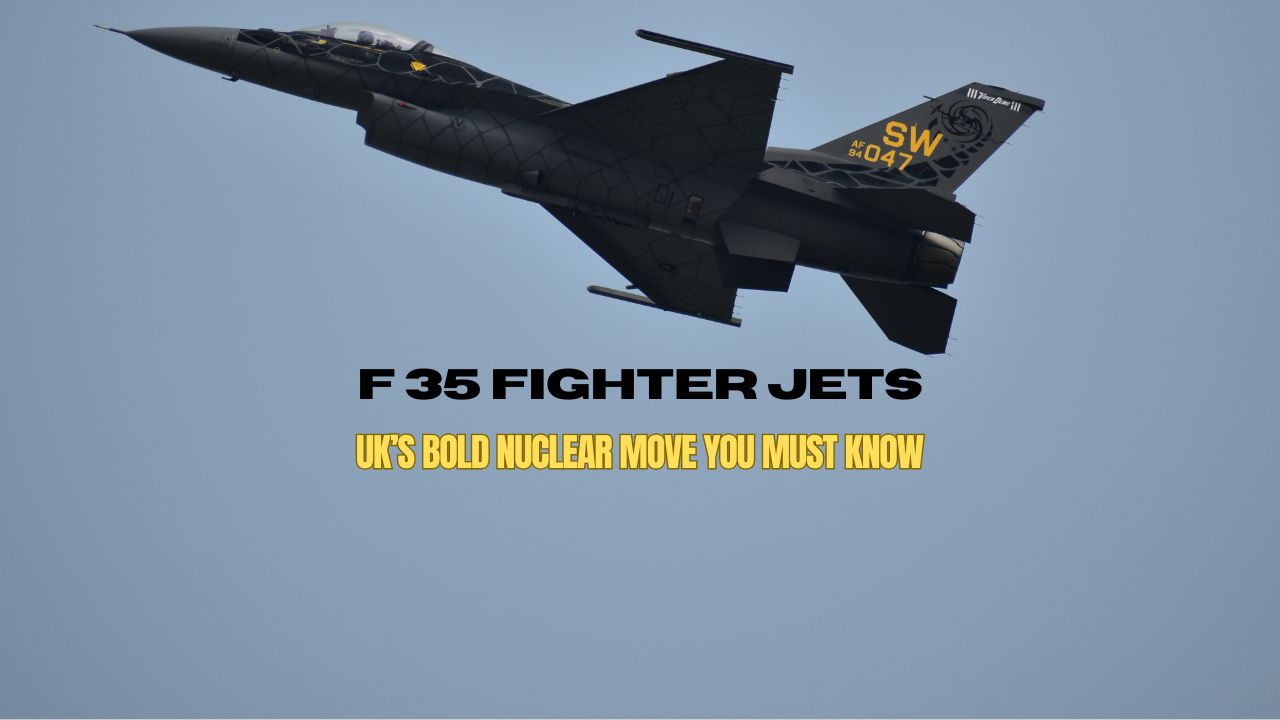
F 35 fighter jets represent the UK’s most significant defence shift since the Cold War. The government’s decision to acquire these advanced aircraft marks the return of Britain’s airborne nuclear capability. This bold move strengthens NATO’s nuclear sharing arrangement and highlights the UK’s commitment to collective security. The purchase aligns with the UK’s modernisation goals and reflects rising global tensions that demand stronger deterrence.
Details of the Purchase
The UK’s latest defence acquisition focuses on strengthening its air fleet with modern, nuclear-capable aircraft. This decision marks a turning point in the nation’s military posture. The f 35 fighter jets deal positions the Royal Air Force (RAF) at the forefront of NATO’s airborne nuclear deterrence.
Key Facts About the Purchase
- The UK plans to acquire the F-35A variant, suited for conventional runways.
- Lockheed Martin, the US defence giant, is the supplier.
- These jets will work with NATO’s B61-12 nuclear bombs.
- Fleet size and cost details are classified, but experts expect a major expansion.
- The aircraft will complement, not replace, the F-35B jets already in RAF service.
This purchase reflects Britain’s aim to modernise its airpower and bolster NATO nuclear readiness. Moreover, it signals a deeper commitment to allied security at a time of global instability.
Nuclear Capability
The introduction of the F-35A variant will restore the UK’s airborne nuclear mission, a capability absent since the Cold War. Designed for versatility and strength, these jets can carry the US-supplied B61-12 nuclear bombs, aligning with NATO’s nuclear sharing strategy.
The f 35 fighter jets will provide the RAF with the means to deliver nuclear weapons using precision technology while operating within NATO command structures. This move enhances deterrence against potential threats and reassures allies of the UK’s unwavering commitment to collective defence. Furthermore, the aircraft’s advanced avionics and stealth features will ensure the success of nuclear missions, even in contested airspace.
Strategic Objectives
The UK’s decision to acquire these advanced jets reflects a major shift in defence priorities. This strategy goes beyond simply upgrading technology; it reshapes the nation’s role within NATO and the global security landscape.
Importantly, the purchase of f 35 fighter jets serves multiple strategic aims that address both immediate threats and long-term defence goals:
- Strengthen NATO’s nuclear posture: The jets provide vital airborne nuclear capability under NATO’s sharing arrangement.
- Deter adversaries: They send a clear message of readiness and resolve in the face of global tensions.
- Enhance rapid-response capability: The F-35A offers speed and precision for missions involving both conventional and nuclear weapons.
- Modernise UK defence assets: This acquisition fits within a broader plan to upgrade and integrate advanced systems.
- Support collective security: The jets allow closer alignment with allies and joint operations across Europe.
This powerful combination of objectives highlights how the UK is adapting to modern security challenges while honouring its international commitments.
Comparison to Previous UK Nuclear Air Power
The return of airborne nuclear capability marks a historic moment in Britain’s defence policy. After decades without such a force, the UK is now restoring this vital element of deterrence.
In contrast to the modern f 35 fighter jets, earlier aircraft had different technologies, roles, and limitations. The table below highlights how this new fleet compares to Britain’s last nuclear-capable jets:
UK Nuclear Air Power: Then vs Now
| Feature | Tornado (Cold War Era) | F 35 Fighter Jets (Modern Era) |
|---|---|---|
| Nuclear role | Carried WE.177 bombs | B61-12 compatible |
| Stealth | No | Yes |
| Precision targeting | Limited | Advanced |
| Avionics | Analogue systems | Cutting-edge digital systems |
| Integration | National missions | NATO nuclear sharing missions |
The shift to the F-35A reflects both technological advancement and a renewed focus on working with allies to maintain peace through strength.
Broader Defence Strategy
The addition of the F-35A aircraft is not an isolated upgrade; it forms part of a wider plan to modernise UK defence forces. This move fits into the government’s ongoing efforts to ensure Britain remains ready for future security challenges.
Moreover, the f 35 fighter jets acquisition works alongside several key initiatives designed to strengthen overall military capability:
- Nuclear submarine modernisation: Continued investment in the Trident missile programme ensures a strong sea-based deterrent.
- Cyber defence expansion: The UK is boosting resources to counter emerging cyber threats.
- Space and unmanned systems: The armed forces are incorporating cutting-edge space surveillance and drone technologies.
- Joint operations readiness: Enhanced cooperation with NATO and allied forces supports rapid deployment in crisis scenarios.
By integrating these aircraft into a broader strategy, the UK signals its intent to lead in both conventional and nuclear defence within Europe.
Reactions & Implications
The announcement of the UK’s renewed airborne nuclear capability has triggered significant domestic and international reactions. This move is seen as both a strategic necessity and a subject of policy debate.
In fact, the decision to procure f 35 fighter jets with nuclear capability has produced wide-ranging implications across defence, politics, and diplomacy:
- NATO support: Allies welcome the UK’s contribution to collective nuclear deterrence, reinforcing shared security goals.
- Domestic concerns: Some political groups and citizens question the costs and risks associated with reviving nuclear airpower.
- Arms control impact: The purchase sparks discussions on global arms race dynamics and the future of non-proliferation efforts.
- Adversary response: Potential rivals may view this upgrade as an escalation, prompting military and diplomatic countermeasures.
Overall, the move is reshaping the security dialogue both within the UK and across Europe, signalling a new phase of strategic commitment.
Reactions & Implications
The UK’s decision to acquire f 35 fighter jets equipped for nuclear missions has sparked strong reactions at home and abroad. NATO allies have praised the move, viewing it as a firm commitment to collective defence and a vital boost to the alliance’s nuclear posture. At the same time, domestic critics have raised concerns about the financial cost, strategic risks, and moral questions linked to reintroducing airborne nuclear weapons.
Internationally, this decision has drawn attention from potential adversaries, who may interpret the upgrade as an escalation that could fuel an arms race. Furthermore, the acquisition has added fresh urgency to discussions about arms control agreements and non-proliferation efforts in an increasingly tense global environment.
Conclusion
The UK’s decision to purchase f 35 fighter jets marks a bold return to airborne nuclear capability and a clear signal of its commitment to NATO. This move reflects not only a technological upgrade but also a strategic repositioning in response to a changing global security environment.
By integrating these advanced jets into its armed forces, the UK reinforces its deterrence posture while supporting allied defence efforts. As the jets are delivered and operational plans take shape, Britain’s role in nuclear security will once again take flight, this time with cutting-edge precision and international cooperation at its core.
FAQs
They are advanced stealth multirole combat aircraft designed for air superiority and ground attack.
The UK is acquiring them to restore airborne nuclear capability and strengthen NATO deterrence.
The UK plans to buy the F-35A variant for its nuclear compatibility.
Deliveries and full operational readiness are expected in the early 2030s.
Yes, the F-35A variant is designed to carry B61-12 nuclear bombs.
They offer advanced stealth, precision targeting, and NATO nuclear integration.
Related Posts



Previous Post
Next Post







- Business
 5
5 - Cricket5
- Department for Education49
- Departments3
- Driving and Transport
 53
53 - Education45
- Finance6
- Football13
- Golf3
- Government
 108
108 - Guides1
- Health
 5
5 - Health4
- International Politics9
- Law and Justice31
- Money and Tax23
- National Politics4
- News68
- Politics6
- Sports38
- Technology5
- Tennis3
- Transportation4
- Uncategorized4
- Visa
 17
17 - Visas and Immigration
 24
24 - Weather1