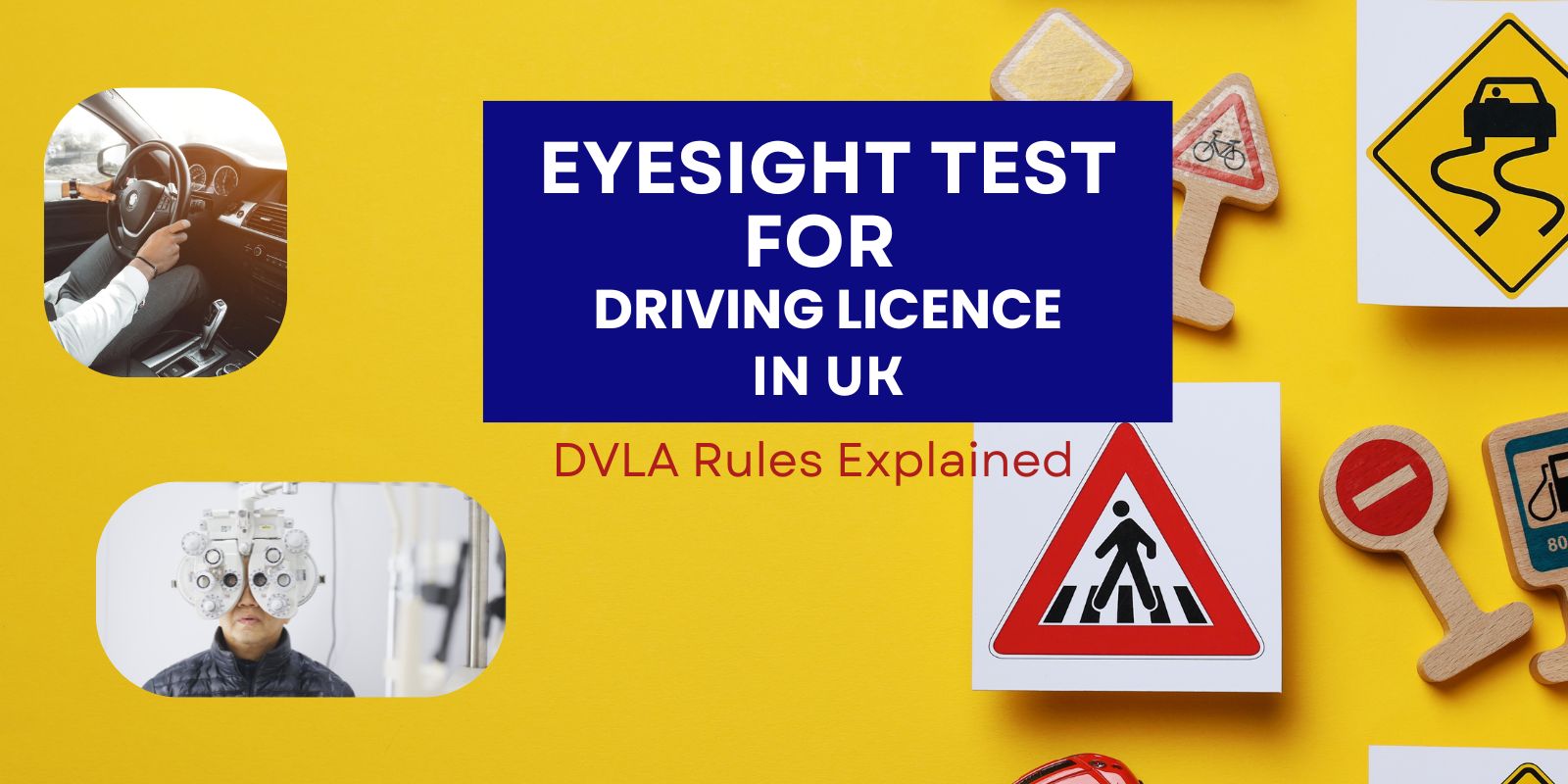
Eyesight test for driving licence is a legal requirement every UK driver must meet before hitting the road. Whether you’re applying for your first licence or renewing one after 70, your vision plays a critical role in road safety.
The DVLA eye test has clear standards for how well you must see, including the ability to read a number plate from 20 metres.
However, there’s more to it than just reading letters on a plate. From colour vision issues to long-sightedness and field of view assessments, various conditions can impact your eligibility.
Understanding the requirements helps avoid fines, ensure compliance, and, most importantly, protect yourself and others on the road.
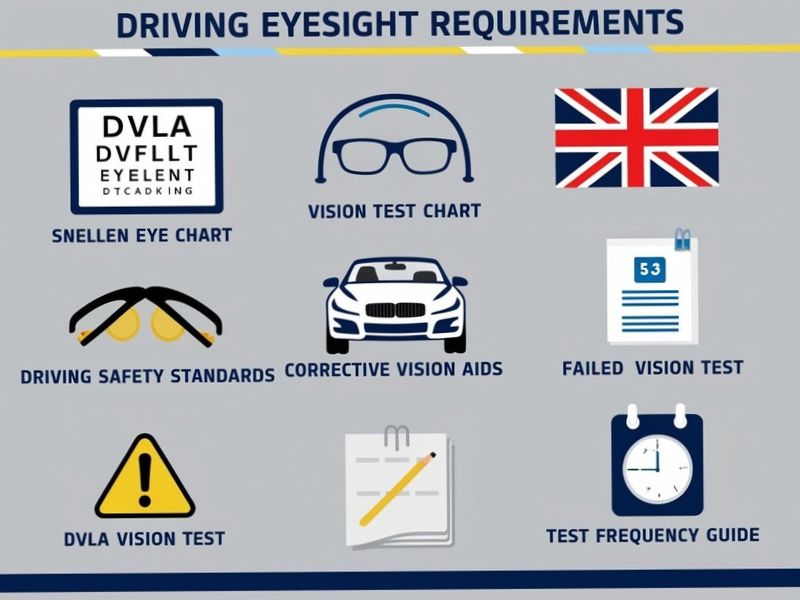
Driving Eyesight Requirements
Eyesight test for driving licence is a legal requirement to ensure road safety. Every UK driver must meet certain vision standards as set by the DVLA.
- You must read a number plate from 20 metres.
- You may wear glasses or contact lenses to meet this standard.
- Your peripheral vision must also meet set requirements.
If your eyesight is below the legal standard, you must stop driving immediately. You must take corrective action or notify the DVLA if a condition is diagnosed.
Standard Vision for Driving
Standard vision means sufficient clarity and peripheral awareness. This enables safe navigation and quick reaction on the road.
Visual acuity must meet these benchmarks:
- Read a vehicle number plate (20 metres) in good daylight.
- Achieve 6/12 vision on a DVLA Snellen chart in both eyes (or one eye only if monocular).
- Have adequate horizontal visual field.
One in eight drivers on UK roads may not meet minimum eyesight standards.
Vision should be corrected using lenses if natural eyesight falls short. If you need lenses to meet the standard, they must be worn when driving.
Minimum Requirements for Lorry and Bus Drivers
Professional drivers must meet stricter standards under Group 2 licensing (for buses and lorries).
Key requirements include:
- Visual acuity of at least 6/7.5 in one eye and 6/60 in the other.
- Full visual field as tested using a binocular Esterman test.
- No uncorrected diplopia (double vision).
- Corrective lenses must not exceed +8.00 dioptres.
Additional testing is often required:
- DVLA may request a vision assessment form (D4) from an optometrist.
- Routine medical renewals are required every 5 years (or every year after age 65).
Eye Test for Driving Licence with Glasses
If glasses or contact lenses are needed to meet legal standards, they must be worn at all times while driving.
DVLA does not ban drivers for needing corrective lenses. However:
- Failure to wear them while driving is a legal offence.
- Eyesight test for driving licence are done with the correction applied (if worn).
Some drivers may undergo a visual acuity check with and without lenses. The licence will reflect if lenses are required.
What if Failed
Failing the eyesight test for driving licence will result in:
- Immediate disqualification from driving if standard is not met.
- Possible requirement to surrender your licence voluntarily.
- Medical investigation if an underlying condition is suspected.
Options include:
- Visiting an optometrist for corrective prescription.
- Re-taking the test with corrected vision.
- Reporting the change to DVLA, which may initiate an assessment.
Failing to report changes in vision can result in fines or licence revocation.
Frequency of Eyesight Test for Driving Licence
There is no legal requirement to re-test vision periodically. However:
- You are responsible for ensuring your eyesight meets the standard.
- DVLA recommends regular eyesight test for driving licence, especially after age 45.
- Mandatory renewals with vision review occur at age 70 and every 3 years after.
Group 2 licence holders:
- Must undergo vision checks every 5 years under age 65.
- Annual medical and vision checks are needed after 65.
Fine if Not Get Eyesight Test for Driving Licence
Not testing your eyesight isn’t fined directly—but driving without meeting the standard is a criminal offence.
Penalties may include:
- Fine up to £1,000.
- 3 penalty points on your driving record.
- Disqualification in case of accidents related to poor vision.
Failing to report a vision problem may also invalidate your insurance.
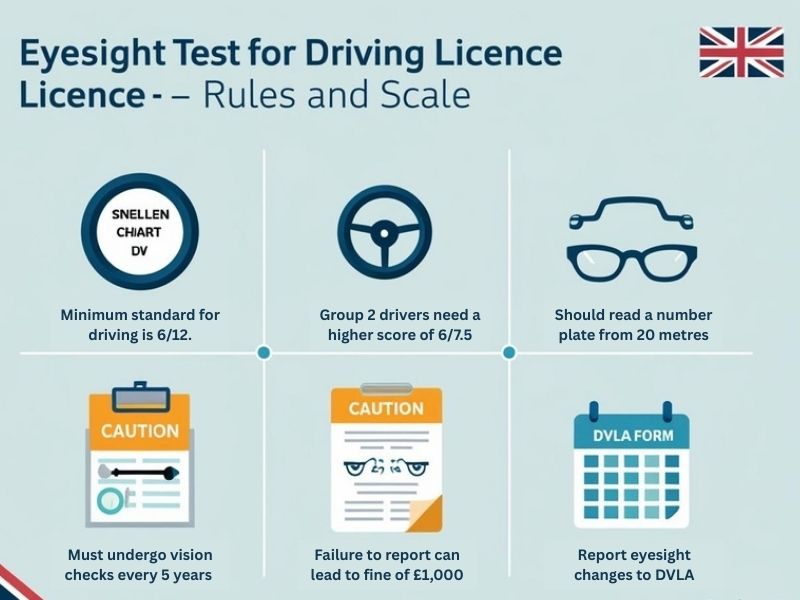
Eyesight Test for Driving Licence – Rules and Scale
Visual acuity is measured using standardised scales like the Snellen chart.
- You must achieve at least 6/12 with both eyes (or in the better eye).
- Group 2 drivers need a higher score of 6/7.5.
The Snellen scale is the gold standard in UK eyesight test for driving licence.
Practical Eyesight Test for Driving Licence – Online Component
There is no online vision eye test for DMV as part of the UK practical driving test. However:
- Before your test begins, the examiner will ask you to read a number plate from 20 metres.
- If you fail this, the test is cancelled.
Online vision test for DMVs (like vision screening apps) are not DVLA-approved.
The Snellen Test for Visual Acuity
The Snellen chart includes letters of decreasing size. It measures how clearly you can see at various distances.
- Standard vision is considered 6/6.
- The minimum standard for driving is 6/12.
The result helps determine if lenses are needed for driving.
Sight Loss in One of Your Eyes
Drivers with sight in only one eye (monocular vision) may still be eligible to drive.
Requirements include:
- Meet full visual acuity standard in the functioning eye.
- Have adapted to the vision change (DVLA assesses this).
Special considerations may be applied. Professional driving may be restricted.
Reporting Changes of Eyesight Test for Driving Licence
If your eyesight changes significantly, you must report this to the DVLA.
- Use the official online service or post medical forms.
- Eye conditions like glaucoma, macular degeneration, or retinopathy must be declared.
- Failure to report can lead to fines and prosecution.
RNIB estimates over 250 people start to lose their sight every day in the UK.
Being proactive keeps you and others safe—and keeps your driving licence valid.
Medical Conditions and Standards for Eyesight
Certain health conditions can impact your ability to drive safely and legally. Eyesight test for driving licence rules require that all medical conditions affecting vision be reported. You must understand how medical issues interact with the DVLA’s licensing rules.
Check if a Health Condition Affects Your Driving
Not every condition affects driving, but many can alter vision or reaction times.
Examples of relevant medical conditions include:
- Glaucoma
- Cataracts
- Retinitis pigmentosa
- Macular degeneration
- Diabetes-related retinopathy
- Stroke-related vision loss
These conditions may cause blurred vision, tunnel vision, or slow response to light.
a. Check if Your Condition Needs to Be Reported
Use the online medical conditions checker on GOV.UK to see if your condition:
- Requires notification to DVLA
- Could lead to a licence review
- Needs additional documentation from your GP or eye specialist
You are legally responsible for informing the DVLA if your eyesight is affected.
Failing to do so can result in:
- £1,000 fine
- Licence revocation
- Invalidated insurance
b. If You Have a Bus, Lorry, or Coach Licence
Drivers with Group 2 licences (bus, lorry, coach) face stricter rules:
- Must declare any change in vision or general health
- May need a D4 medical form completed by an optician or doctor
- Face periodic medical reviews every 5 years (or annually after 65)
Each year, DVLA receives over 600,000 medical notifications, many involving vision concerns.
Medical Conditions, Disabilities, and Driving: Telling DVLA
Notifying DVLA about health changes helps prevent unsafe driving and supports road safety.
DVLA may:
- Place codes or restrictions on your licence
- Ask for specialist medical assessments
- Issue a shorter-term licence (1, 2, or 3 years)
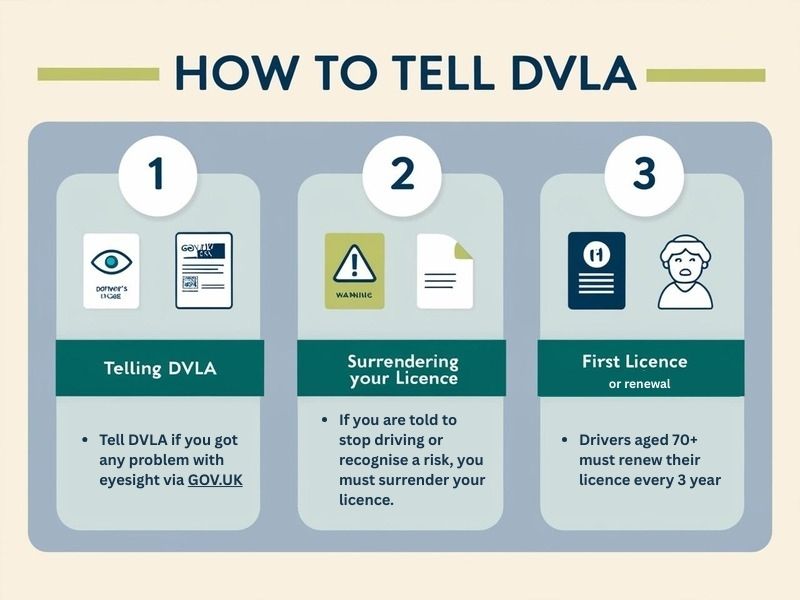
a. How to Tell DVLA
You can report your condition:
- Tell DVLA if you got any problem with eyesight via GOV.UK
- By downloading and posting the relevant medical forms
- With your doctor’s or optician’s support
Required documents may include:
- Medical Evidence Report
- Visual field test results
- Snellen test results
DVLA eye test may take several weeks to assess your case.
b. Surrendering Your Licence
If you are told to stop driving or recognise a risk, you must surrender your licence.
Steps include:
- Fill out the ‘Voluntary Surrender’ form (available online)
- Send in your photocard or paper licence
You may reapply when your health improves. DVLA provides guidance on this process.
c. First Licence or Renewal if You’re 70 or Over
Drivers aged 70+ must renew their licence every 3 years.
This process includes:
- Self-declaration of medical conditions
- Confirmation of visual fitness
No compulsory eyesight test for driving licence is required—but honesty is crucial.
The renewal form (D46P) includes medical history questions.
Conclusion
Eyesight test for driving licence compliance is essential for personal and public safety.
Regular vision checks help identify problems before they lead to dangerous outcomes. Poor eyesight can cause misjudged distances, missed signs, or delayed reaction times.
Studies show up to 2,900 road accidents per year are linked to poor vision in the UK.
Keeping the DVLA informed is a legal duty and a civic responsibility. Drivers with changes in vision must notify promptly to avoid penalties or invalid insurance. Those with licences for lorries or buses should be even more proactive.
Maintaining proper vision ensures:
- Safer roads
- Fewer collisions
- Greater confidence behind the wheel
Meeting the driving eyesight rules protects both drivers and others.
Stay informed, get tested regularly, and ensure your vision keeps you and others safe.
Source / Ref.: Gov.uk Contains public sector information licensed under Open Government Licence v3.0.
Written by [Ketan Borada / British Portal Team] – Founder of British Portal, dedicated to providing accurate and up-to-date information on UK public services and benefits.Related Posts
Previous Post
Next Post





- Business
 5
5 - Cricket5
- Department for Education49
- Departments3
- Driving and Transport
 53
53 - Education45
- Finance6
- Football13
- Golf3
- Government
 108
108 - Guides1
- Health4
- Health
 5
5 - International Politics9
- Law and Justice31
- Money and Tax23
- National Politics4
- News68
- Politics6
- Sports38
- Technology5
- Tennis3
- Transportation4
- Uncategorized4
- Visa
 17
17 - Visas and Immigration
 24
24 - Weather1