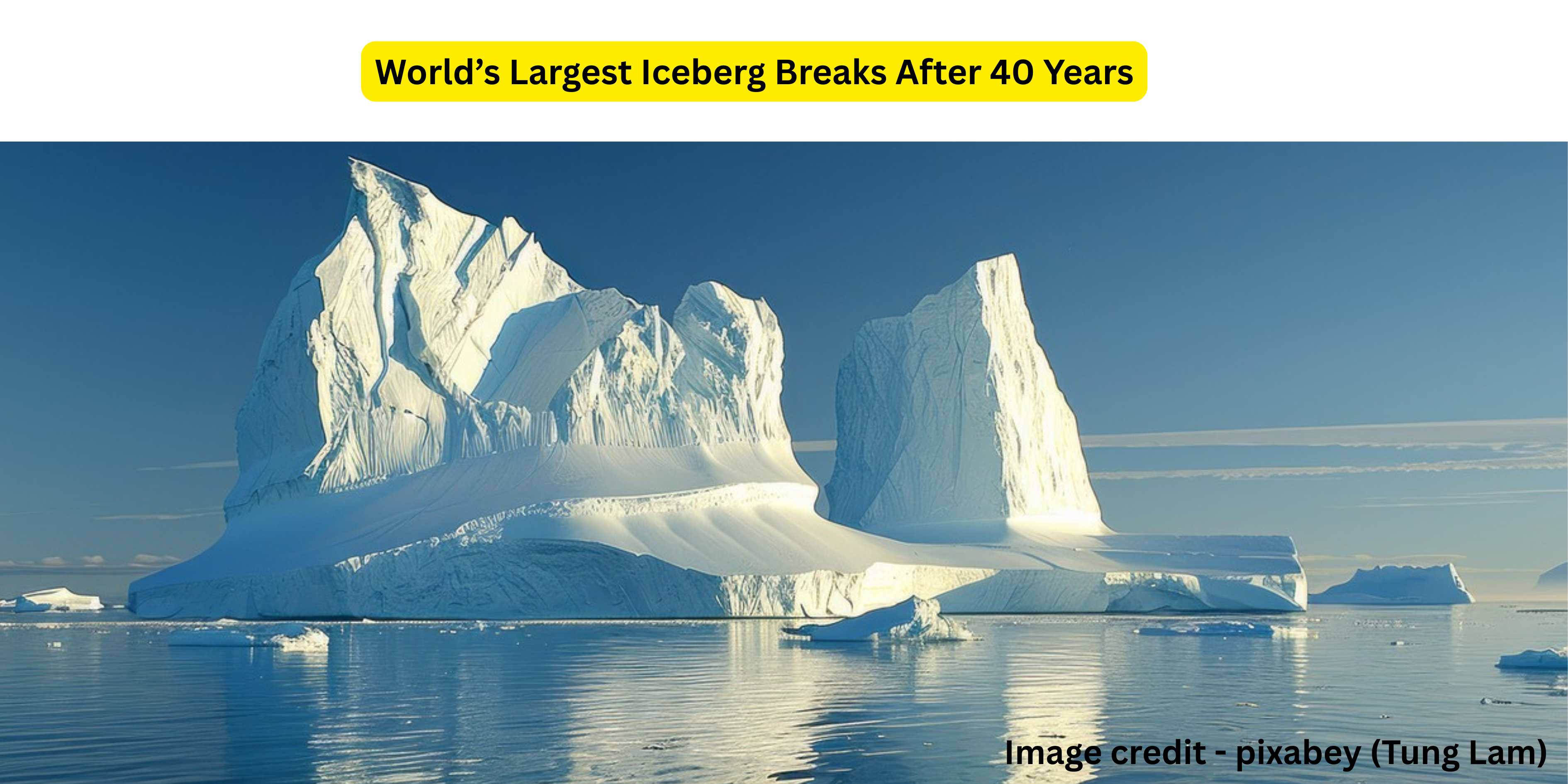
Megaberg A23a, one of the largest and longest standing icebergs in the world, is finally separating after almost 40 years of drifting since it split off Antarctica. A23a, which was at one time more than twice the size of Greater London, now begins to break up at a very rapid rate in warmer water, forming momentary dangers to shipping. Scientists speculate that it is no longer than a few weeks before it goes extinct.The World’s Largest Iceberg Breaks After 40 Years, marking a historic moment in climate and ocean change.
The Journey of A23a
A23a separated two and a half decades ago (nearly 40 years) off the continent of Antarctica and has since been drifting across the Southern Ocean. It had earlier in the year grounded off South Georgia one of the UK’s remoter overseas territories. Back then scientists were concerned that it might cause penguins, seals and seabirds, who roam on the island, to die out.
A Giant on the Verge of Collapse
A23a had originally been a trillion-tonne block of ice (over 1,700 sq km).
At March it remained more than twice the extent of Greater London.
But now cracks and large ice-cavities have undermined it and huge chunks of ice have broken off, one of which was 80 sq km an iceberg in itself.
Hazards to Shipping
The separation of A23a poses a short-term shipping threat to fishing ships and cruise ships headed to Antarctica. The smaller the pieces grow, the harder it is to follow them with the satellite and the more dangerous it becomes to navigate the Southern Ocean. UK RAF Operation Cold Stare is currently surveying the icebergs like A23a to ensure safe shipping routes.
Impact on Wildlife
The proximity to South Georgia raised concerns among penguins, seals an,d seabirds at the time when the iceberg grounded, but due to its northward movement, the direct threat to wildlife has now diminished.
Climate Change Connection
Scientists are not sure whether giant icebergs such as A23a are increasing in number as a result of global warming. However, good evidence indicates that the West Antarctic Ice Sheet is melting fast.
- An average of 150 billion tonnes of water is lost by Antarctica every year.
2. Approximately half of this loss is in the form of icebergs such as A23a.
The story of A23a is an adaptive example of how climate change is transforming polar lands of the world.
Conclusion
Iceberg A23a is finally being brought to an end after nearly drifting away over 40 years. It is a frozen giant that is currently splitting into smaller pieces in warmer waters when it was once whole. It does not pose any serious threat to wildlife, but the fact that it is rapidly breaking up, is a very strong wake-up call as to just how exposed our polar regions have become. The melting of the ice in the Antarctic is natural process but the message is that the climate change is gradually taking the world over.
FAQ
A23a is considered to be one of the largest and longest-lasting icebergs in the world; it was initially a trillion tonne iceberg over two times larger than Greater London.
Having slept almost 40 years, A23a is now subjected to warmer waters, and it is now weakened, and large pieces of it are broken off.
Concerns were originally raised over penguins, seals, and seabirds around South Georgia but as A23a moved north the threat to wildlife has decreased.
Yes. The smaller the segments, the more difficult it becomes to track it using satellites, and in the process, it poses short-term risks to fishing ships and cruise vessels heading to Antarctica.
Related Posts



Previous Post
Next Post






- Business
 5
5 - Cricket5
- Department for Education49
- Departments3
- Driving and Transport
 53
53 - Education45
- Finance6
- Football13
- Golf3
- Government
 108
108 - Guides1
- Health4
- Health
 5
5 - International Politics9
- Law and Justice31
- Money and Tax23
- National Politics4
- News68
- Politics6
- Sports38
- Technology5
- Tennis3
- Transportation4
- Uncategorized4
- Visa
 17
17 - Visas and Immigration
 24
24 - Weather1