A major shift in global trade policy is on the horizon as US trade tariffs are now scheduled to take effect on August 1, 2025. Former President Donald Trump, speaking alongside Commerce Secretary, announced that the tariff implementation previously delayed will now proceed as final touches are made on a series of pivotal international trade deals. The announcement has sparked widespread interest among economists, trade analysts, and global markets, with many closely watching how these developments may reshape economic relations, especially with countries like China, Mexico, and members of the European Union.
As the world braces for the next wave of trade reforms, the United States is signaling a renewed focus on securing what Trump calls “fair and reciprocal trade.” With tariffs back on the table and high-stakes negotiations nearing completion, the coming weeks could mark a defining moment in the evolution of post-pandemic global commerce.
Background on UK Trade Tariff Delays
With the renewed push for US trade tariffs, it’s important to understand how the situation developed and why officials delayed the original rollout.
The administration initially planned to implement the tariffs earlier this year but postponed them for strategic reasons. However, the Trump administration opted for a strategic pause. The delay was not due to hesitation, but rather a calculated move to strengthen the U.S. negotiating position as key trade deals moved closer to finalization.
Here’s a breakdown of what led to the delay:
- Focus on Diplomacy First: Trump stated that the U.S. preferred to “finalize fair trade deals” before implementing any new tariffs.
- Commerce Secretary’s Statement: U.S. Commerce Secretary emphasized that talks were “in the final stages,” justifying a delay to avoid disrupting ongoing negotiations.
- China Factor: Discussions with Beijing were reportedly progressing, and both parties were aiming to avoid immediate economic disruption.
- Market Sensitivity: Financial markets responded cautiously to early tariff threats, prompting the administration to time announcements for minimal market volatility.
- Election-Year Strategy: Analysts suggest Trump’s team is strategically aligning economic decisions with campaign goals, using tariffs as leverage for stronger global trade terms.
Despite the delay, Washington consistently emphasized that tariffs remain an option they’re timing them for maximum impact. Now, with August 1 confirmed as the go-date, the global economy is watching closely.
August 1 Deadline – What It Means
With the August 1, 2025 date now confirmed, the countdown has begun for the reintroduction of US trade tariffs a move expected to have widespread consequences across multiple sectors and international markets.
The deadline isn’t just a date on the calendar it represents a strategic economic pivot.It signals that the U.S. will take a harder line on trade if it doesn’t secure final deals in time.
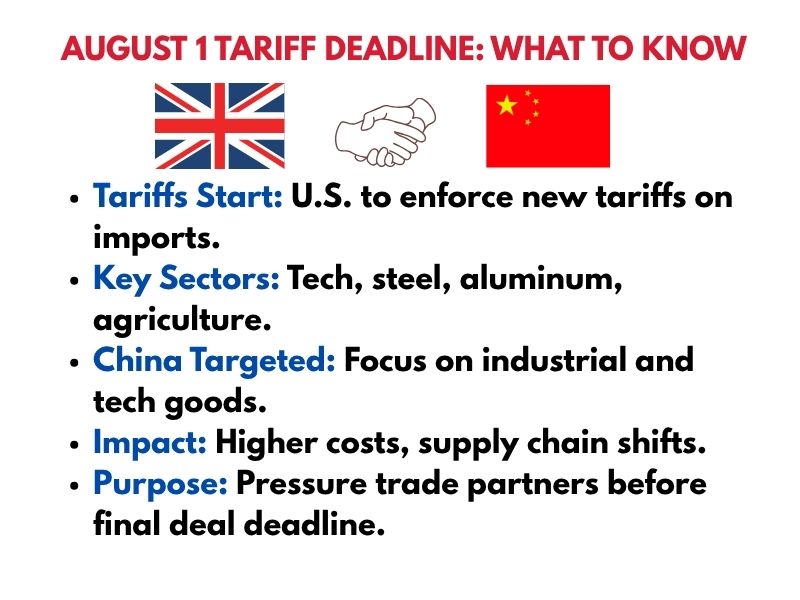
Here’s what this deadline entails:
- Tariffs Set to Take Effect: The U.S. will begin imposing new or revised tariffs on imported goods, especially targeting countries with persistent trade imbalances.
- Key Sectors Affected: Industries likely to face immediate impact include:
- Technology and Electronics (e.g., semiconductors, telecom equipment)
- Steel and Aluminum
- Agricultural Products (e.g., soybeans, corn, dairy)
- Focus on China: The U.S. is expected to impose the largest share of new tariffs on China, particularly targeting high-value industrial goods and tech components.
- Global Supply Chain Disruption: The new tariffs could force companies to rethink sourcing strategies, potentially increasing costs for manufacturers and consumers.
- Market Anticipation: Investors and corporations are closely watching the White House for any signs of adjustments before the deadline.
The administration is positioning the August 1 milestone as both a deadline and a diplomatic tool. If global partners don’t sign final agreements by then, the U.S. will move forward with tariffs to send a strong message that trade reciprocity is non-negotiable.
Trade Deals Near Completion
Former President Donald Trump and top economic advisors have confirmed that several major trade deals are nearing finalization, even as the U.S. prepares to enforce trade tariffs on August 1. This revelation adds another layer of complexity and urgency to the evolving global trade landscape.
On July 6, Trump said, “Multiple trade agreements are almost done.” Lori Bessent, a senior advisor, added that announcements could come this week. The message is clear: the administration is using tariffs as pressure. If deals succeed, they could reshape global trade before any tariff takes effect.
Countries and Deals on the Table:
- China: Negotiations with Beijing are reportedly in their final stages. This deal is expected to cover:
- High-tech goods
- Agricultural exports
- Intellectual property protections
- Mexico: Talks focus on labor standards, cross-border trade efficiencies, and North American manufacturing cooperation.
- European Union: Tariff exemptions may be offered in exchange for access to EU markets, particularly in finance, automotive, and clean energy.
- Other Allies: Quiet progress is also being made with countries like Canada, Japan, and South Korea, hinting at a broader coalition of new U.S. trade alignments.
What Makes These Deals Urgent:
- Avoiding tariff escalation on both sides
- Stabilizing global supply chains ahead of 2026 fiscal planning
- Supporting U.S. exports and creating domestic jobs
- Strengthening America’s trade position before the presidential election
With the administration linking the August 1 tariff enforcement to deal closures, the coming days could prove critical. If these agreements succeed, tariffs may serve more as negotiation leverage than long-term policy.
Economic and Global Implications
The upcoming US trade tariffs could reshape global trade dynamics. While aimed at protecting American industries, the global economic impact could be significant.
Key Effects:
- Supply Chains: Companies may shift sourcing from China, increasing short-term costs.
- Consumer Prices: Tariffs could raise prices on goods like electronics and food, adding to inflation.
- Market Reactions: Currencies and stocks may face volatility ahead of August 1.
- Global Retaliation: Affected countries may impose counter-tariffs on U.S. exports.
- Investor Sentiment: Some view tariffs as leverage; others fear trade instability.
Potential Gains:
- Domestic Industry Boost: Tariffs may help revive U.S. manufacturing.
- Better Trade Terms: If deals succeed, the U.S. could gain improved access to key markets.
The success of this strategy hinges on swift deal closures and how global markets absorb the policy shift.
Political and Strategic Motivations
The August 1 US trade tariffs deadline isn’t just economic it’s political.
Trump is using this policy to bolster his re-election narrative as a strong negotiator. By delaying tariffs until now, he’s aligning economic action with campaign timing to appeal to voters in key industrial states.
The “America First” message is central, aimed at promoting domestic production and reducing reliance on imports. Simultaneously, coordinated messaging from the White House and Commerce Department signals strategic control, using tariff threats as pressure points in final negotiations.
The administration crafted the timing of these announcements for global impact and maximum political visibility.
Conclusion
With US trade tariffs set to begin on August 1, and several major trade deals reportedly close to completion, the coming days could reshape global economic relations. Trump’s strategy combining tariff pressure with fast-moving negotiations is both a political maneuver and an economic gamble.
The U.S. is clearly signaling its firm stance on fair trade, whether it finalizes the deals or enforces the tariffs. As global markets await the next move, all eyes remain on Washington and its partners to see how this high-stakes strategy plays out.
FAQs
The tariffs are scheduled to begin on August 1, 2025.
Former President Donald Trump and the US Commerce Secretary.
Primarily China, with possible impacts on the EU and Mexico.
No official signings yet, but several are reportedly near completion.
Yes, some countries may respond with their own trade measures.
Cautiously, with mixed responses from investors and analysts.
Related Posts

Previous Post
Next Post






- Business
 5
5 - Cricket5
- Department for Education49
- Departments3
- Driving and Transport
 53
53 - Education45
- Finance6
- Football13
- Golf3
- Government
 108
108 - Guides1
- Health
 5
5 - Health4
- International Politics9
- Law and Justice31
- Money and Tax23
- National Politics4
- News68
- Politics6
- Sports38
- Technology5
- Tennis3
- Transportation4
- Uncategorized4
- Visa
 17
17 - Visas and Immigration
 24
24 - Weather1