
Tesla UK sales staged a powerful comeback in June 2025, recording one of the brand’s best-performing months in recent history. Driven largely by the launch of the refreshed Model Y, Tesla regained momentum in a competitive and fast-evolving electric vehicle (EV) market. The Model Y quickly became the UK’s top-selling EV, drawing strong consumer interest with its updated design and improved features.
This surge coincided with a broader upswing in the UK car market total registrations rose 6.7% year-on-year, while battery electric vehicles soared 39%, accounting for 25% of all new car sales. Tesla registered over 7,700 units in June alone, reflecting a 224% month-on-month spike. This performance signals a potential turning point in Tesla’s competitive strategy and market presence.
Model Y Refresh Fuels Consumer Excitement
After months of uncertainty, Tesla’s decision to refresh its most popular vehicle has paid dividends. The newly updated Model Y has quickly become a game-changer in the UK’s electric vehicle landscape. Sleek exterior tweaks, software improvements, and enhanced driving comfort are just a few reasons buyers flocked to dealerships in June.
What makes this refresh especially powerful is how well it aligns with British consumer expectations affordability, range confidence, and updated design aesthetics. This model appears tailor-made for a market that’s increasingly sensitive to value and innovation.
Here’s why the Model Y refresh turned heads:
- First deliveries hit in early June, just in time to influence monthly sales.
- Subtle but impactful design updates made it feel like a “new generation” model without a full redesign.
- Improved driving range and performance specs met growing demands for efficiency.
- In-car software updates enhanced user experience with smoother UI and more customization.
- Strategic pricing kept it competitive against offerings from BYD, Ford, and Kia.
In the middle of this industry-wide shift, Tesla UK sales spiked with force, largely driven by the revived demand for the Model Y. This proves how vital product refresh cycles are in the electric car market especially when consumer interest is highly reactive to novelty and perceived value.
As we transition into Q3, all eyes are on whether this momentum can be maintained or if it was a one-off surge triggered by the launch window.
UK EV Market Trends
The UK’s electric vehicle (EV) market is undergoing a period of rapid evolution. June 2025 showcased a pivotal moment not just for Tesla but for the entire industry. As traditional automakers ramp up production and new players enter the fray, consumers are presented with more options than ever before.
A significant driver of growth has been government incentives and the public’s rising environmental consciousness. From low-emission zones in cities to expanding charging infrastructure, the UK is steadily reshaping its transport ecosystem. This creates fertile ground for brands like Tesla to thrive but only if they continue to innovate.
During this transformation:
- Battery electric vehicle (BEV) registrations rose by 39% year-on-year in June.
- One in every four new cars sold in the UK is now electric.
- Government schemes and subsidies played a key role in reducing upfront costs for buyers.
- Fleet and corporate EV sales contributed significantly to volume growth.
In this landscape, Tesla UK sales not only rebounded but outpaced many competitors, capturing a large share of this expanding segment. While other brands benefited from fleet deals and discounts, Tesla’s brand strength and updated lineup gave it a unique edge.
These trends point toward sustained interest in EVs through the rest of 2025 though the real test lies in whether supply can keep up with demand and if incentive programs continue.
Rising Competition Challenges Tesla’s Market Share
While Tesla’s June rebound was impressive, it didn’t happen in isolation. The electric vehicle space is becoming increasingly crowded, and rivals are quickly gaining ground. Traditional manufacturers and fast-growing Chinese brands are using aggressive pricing, fleet deals, and broader model lineups to attract customers.
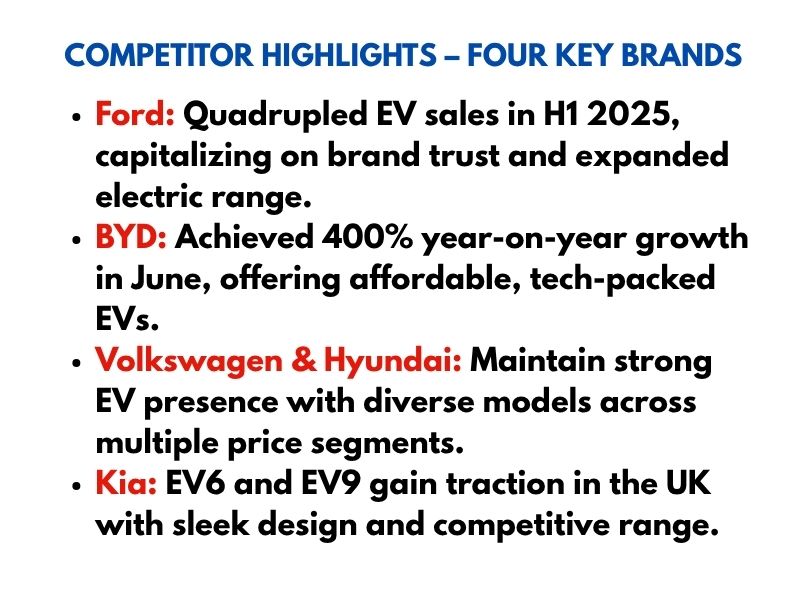
Key competitors shaping the UK EV landscape:
- Ford saw its electric vehicle sales in the UK increase more than fourfold in the first half of 2025.
- BYD, the Chinese automaker, recorded a massive 400% year-on-year jump, with nearly 2,500 units sold in June.
- Volkswagen and Hyundai continue to hold significant EV market shares with diverse offerings across price points.
- Kia’s EV6 and EV9 are gaining popularity among premium buyers seeking alternatives to Tesla.
Even with this pressure, Tesla UK sales stood out due to the successful Model Y refresh. However, the sustainability of this lead is far from guaranteed. These competitors are not only offering attractive entry-level models but are also expanding their reach in both urban and rural areas with better after-sales support and more affordable service plans.
As new vehicle launches from these rivals are expected in Q3 and Q4, Tesla must remain proactive with innovation and pricing strategies. Otherwise, this brief surge could quickly be overshadowed by the aggressive growth of its challengers.
Policy Support and Incentives Driving EV Adoption
Beyond product innovation and market competition, one of the most critical drivers of electric vehicle growth in the UK has been government policy. Strategic incentives, tax breaks, and infrastructure investment have helped tip the scales in favour of EV adoption. For Tesla, this supportive environment has been a vital lever in its June success story.
In recent months, the UK government has:
- Extended plug-in vehicle grant schemes for selected EV categories.
- Supported the development of nationwide public charging networks.
- Maintained zero road tax for fully electric vehicles, incentivising long-term ownership.
- Implemented fleet-focused benefits for corporate buyers through lower Benefit-in-Kind (BiK) tax rates.
These measures have made electric vehicles more accessible to both individual and business buyers. In this climate, Tesla UK sales were primed to rebound, particularly with the introduction of a newly refreshed model and ongoing brand loyalty among tech-forward consumers.
However, these benefits may not last forever. Several schemes are already under review for potential reduction or phase-out by mid-2026. This places added pressure on automakers to maintain momentum without relying heavily on policy crutches.
As incentive structures evolve, the next phase of growth will depend more on affordability, performance, and customer experience areas where Tesla must continue to lead.
Mixed Signals Across the European Market
While the UK market gave Tesla a much-needed boost in June, the picture across Europe is more complex. Tesla’s performance varied dramatically across countries, revealing both opportunities and underlying challenges as the company navigates a highly competitive region.
In Spain, Tesla sales soared:
- June 2025 sales jumped 61%, with over 2,600 vehicles sold.
- Despite the monthly boost, H1 sales remained flat, pointing to earlier slowdowns.
Meanwhile, Scandinavian countries painted a different picture:
- Norway delivered a bright spot with 54% growth, thanks to strong demand for the refreshed Model Y.
- Sweden and Denmark, however, saw sales drop over 60% year-on-year, impacted by economic pressure and shifting EV incentives.
This disparity shows Tesla’s uneven footing across Europe. While Tesla UK sales surged due to timely product updates and policy support, other countries reflect a need for localized strategies. Economic conditions, policy changes, and cultural preferences all play significant roles in how EVs are received.
Tesla must now consider tailoring its marketing, pricing, and service models to meet country-specific expectations. Without this shift, the brand risks losing momentum in regions where it once held dominant market share.
Conclusion
The strong rebound in Tesla UK sales during June signals more than a one-time spike it marks a strategic turning point. Backed by a refreshed Model Y, supportive government policies, and growing consumer trust, Tesla has reasserted its presence in a rapidly shifting EV market.
However, with fierce competition and fluctuating performance across Europe, sustaining this momentum will require adaptability, innovation, and market-sensitive tactics. As we move into the second half of 2025, Tesla’s ability to evolve in the face of regional challenges will determine whether June’s success was a spark or the start of a resurgence.
FAQs
A refreshed Model Y and strong EV incentives drove the spike in sales.
The Model Y led Tesla’s sales surge in the UK.
Tesla saw growth in Spain and Norway, but sales dropped in Sweden and Denmark.
Yes, but some are expected to phase out by 2026.
Ford, BYD, Kia, and Volkswagen are key rivals in the UK market.
Related Posts



Previous Post
Next Post







- Business
 5
5 - Cricket5
- Department for Education49
- Departments3
- Driving and Transport
 53
53 - Education45
- Finance6
- Football13
- Golf3
- Government
 108
108 - Guides1
- Health4
- Health
 5
5 - International Politics9
- Law and Justice31
- Money and Tax23
- National Politics4
- News68
- Politics6
- Sports38
- Technology5
- Tennis3
- Transportation4
- Uncategorized4
- Visa
 17
17 - Visas and Immigration
 24
24 - Weather1