Air India Crash investigations have sparked worldwide attention after a UK law firm flagged two serious technical failures that may have led to the tragedy. The catastrophic incident involving a Boeing 787‑8 Dreamliner near Ahmedabad left 270 people dead and raised alarm bells not just in India but across international aviation watchdogs. As grieving families seek justice, two critical questions emerge: why did the Ram Air Turbine deploy, and what caused both engines to lose thrust?
This tragic episode is now being probed from legal, engineering, and human rights angles. Families from the UK where 20 citizens lost their lives have engaged Keystone Law to pursue legal action. The incident has raised urgent questions about aircraft safety standards, pilot response systems, and manufacturer responsibility. At the heart of this discussion lies a renewed debate on global aviation accountability.
Legal Fallout from the Air India Crash
In the aftermath of the devastating incident, grieving families are turning their pain into purpose. Many have chosen to seek justice through legal means, especially those based in the United Kingdom. To support them, prominent UK-based Keystone Law has stepped forward, initiating early investigations into the causes of the Air India Crash and potential legal avenues.
As investigations unfold, the law firm is focusing on two pivotal legal priorities. But first, it’s essential to understand why families are not just waiting for answers they are demanding them.
Here’s what the families are seeking:
- Clear accountability from Air India and aircraft manufacturer Boeing
- Transparency in the investigation process, including black box analysis
- Fair compensation based on international aviation laws
- Legal representation to file lawsuits in UK and US courts
- Immediate updates through the UK coronial inquest process
Moreover, under international aviation law specifically the Montreal Convention affected passengers or their next of kin can seek damages not just in the country where the crash occurred, but also in the country of their residence or the airline’s primary place of business.
Transitioning from the legal framework to technical concerns, the next section will examine the two major questions raised by Keystone Law and why they matter for global aviation safety.
Two Failures Behind the Air India Crash
While legal proceedings are in motion, experts are focused on what actually caused the Air India Crash. A leading concern comes from two critical technical failures identified by Keystone Law, which could hold the key to understanding the tragedy.
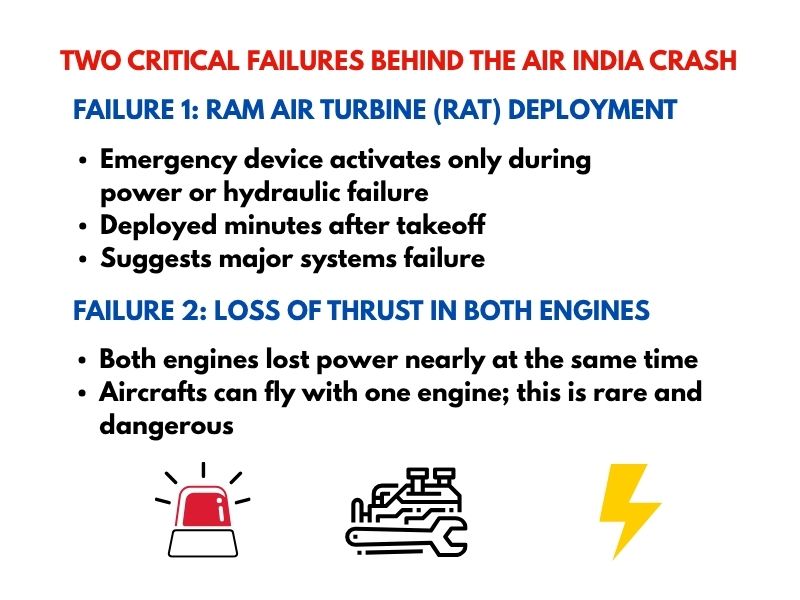
These aren’t just routine mechanical questions they raise serious doubts about aircraft safety and airline preparedness. According to early findings and expert analysis, the two alarming issues are:
- Deployment of the Ram Air Turbine (RAT)
This emergency device only activates when an aircraft loses power or hydraulic systems. Its sudden deployment right after takeoff strongly suggests that the plane suffered a critical systems failure within minutes. - Loss of thrust in both engines
Modern aircraft are designed to continue flying even if one engine fails. But here, both engines lost power nearly simultaneously a rare and deeply troubling scenario that has aviation investigators on alert.
These failures have prompted multiple agencies including India’s Aircraft Accident Investigation Bureau (AAIB), UK officials, and US-based teams to coordinate their efforts.
Moving forward, understanding the role of these mechanical breakdowns could shape not only the outcome of this case but also future air safety protocols worldwide.
Global Investigation Teams Join In
Following the initial shock of the Air India Crash, international aviation bodies swiftly began coordinating efforts to uncover the truth. This tragedy did not remain a domestic matter. Instead, it triggered a full-scale, cross-border investigation involving some of the world’s top safety and technical experts.
To ensure a transparent and thorough inquiry, the following agencies have become directly involved:
- India’s AAIB (Aircraft Accident Investigation Bureau) – leading the official investigation
- UK Air Accidents Investigation Branch – assisting due to the number of British nationals on board
- US National Transportation Safety Board (NTSB) – involved as the aircraft was manufactured by Boeing
- Boeing representatives and Rolls-Royce (engine maker) – expected to respond to technical queries
In addition to these bodies, the International Civil Aviation Organization (ICAO) has been monitoring the situation closely, as the outcome may influence future global aviation policy.
Importantly, the UK coroner’s inquest process will run in parallel, meaning families will be receiving information not just from Indian authorities, but also from independent UK legal and investigative sources.
As we move deeper, the timeline for findings and the legal implications for Boeing and Air India are becoming central to the narrative.
Air India Crash: What’s Next?
As global teams work together, all eyes are now on the unfolding investigation timeline. The next few weeks will be crucial for both technical clarity and legal direction. Families affected by the Air India Crash are anxiously awaiting official findings that could provide long-overdue answers and accountability.
Here’s what to expect in the coming days:
- Preliminary Report – Due by the end of July, this document will summarize early findings, black box data, and any signs of pilot or system failure.
- Black Box Analysis – The cockpit voice recorder and flight data recorder are expected to reveal the final moments leading to the crash.
- International Legal Filings – Families may begin civil claims in the UK and US courts shortly after the report is released.
- Coroner Inquests (UK) – British authorities will open formal inquests, especially in cases involving UK citizens.
- Potential Safety Advisories – Based on findings, ICAO and DGCA India may recommend changes for Boeing 787‑8 operations globally.
While this process is complex, legal teams emphasize that victims’ families should not rush to accept early settlements. Waiting for the full investigation could significantly impact long-term outcomes and justice.
Next, let’s explore how international aviation law especially the Montreal Convention shapes the rights of crash victims and their families.
Families Speak Out
As the dust settles after the Air India Crash, families of the victims are stepping forward—not just to grieve, but to demand action. For many, the fight is no longer just about answers; it’s about justice, accountability, and change.
Relatives of British passengers have united to bring international pressure on both Air India and Boeing. Their voices are being amplified through legal firms and public platforms, urging a deeper investigation and long-term policy reform.
Key concerns raised by families include:
- Lack of immediate transparency from authorities
- Insufficient communication during the early hours after the crash
- Early settlement offers without clear explanation of legal rights
- Delays in retrieving personal belongings and remains
- Emotional trauma with little official mental health support
Families have urged others not to sign early settlement offers until all facts are on the table. Their message is clear: “This isn’t just about money. It’s about making sure this never happens again.”
Next, we’ll explore how Boeing and Air India have responded under this mounting scrutiny.
Boeing and Air India Respond
As investigations continue, both Boeing and Air India have begun responding to public and legal pressure. Their statements, however, have raised more questions than they’ve answered. In the context of the Air India Crash, families, aviation experts, and legal teams are carefully analyzing every word.
Air India released a statement expressing condolences and confirming its cooperation with Indian and international investigative bodies. Boeing, meanwhile, has said it is “actively supporting the technical inquiry,” but has stopped short of accepting any liability.
So far, their responses include:
- Air India: Ordered additional maintenance checks on its Boeing 787-8 and 787-9 fleet
- Boeing: Offered to assist investigators and review black box data
- Both: Refrained from commenting on legal action or compensation specifics
Critics argue that these steps are reactive, not proactive. Aviation analysts stress that transparency and accountability should come before legal shielding. And for the families, silence or generic statements are not enough they want detailed explanations, not damage control.
Looking ahead, the final report and legal outcomes may determine whether Boeing and Air India face financial penalties or broader reputational damage.
Conclusion
The Air India Crash stands as a grim reminder of the need for accountability, transparency, and global aviation reform. With lives lost and families forever changed, this tragedy goes beyond a technical failure it highlights cracks in how airlines, manufacturers, and regulators handle safety and crisis.
As investigations continue and legal actions unfold, the world must learn from this disaster. Victims deserve justice, and future passengers deserve better protections. Only through truth, action, and reform can such a catastrophe become a turning point for safer skies.
FAQs
Investigations suggest two major failures: RAT deployment and dual engine thrust loss.
The crash claimed 270 lives, with only one known survivor.
India’s AAIB is leading, with help from UK and US aviation authorities.
Yes, under the Montreal Convention, legal claims can be filed internationally.
A preliminary report is expected by late July, with black box data under review.
Related Posts
Previous Post
Next Post






- Business
 5
5 - Cricket5
- Department for Education49
- Departments3
- Driving and Transport
 53
53 - Education45
- Finance6
- Football13
- Golf3
- Government
 108
108 - Guides1
- Health4
- Health
 5
5 - International Politics9
- Law and Justice31
- Money and Tax23
- National Politics4
- News68
- Politics6
- Sports38
- Technology5
- Tennis3
- Transportation4
- Uncategorized4
- Visa
 17
17 - Visas and Immigration
 24
24 - Weather1