
Kartal stuns Wimbledon in a breathtaking opener that lit up Centre Court and reignited British tennis dreams. Wildcard Sonay Kartal, facing one of the tournament’s toughest seeded veterans, pulled off a fearless and emotional victory that left the crowd roaring and the tennis world talking.
She didn’t just win she rewrote history. Kartal became the first British woman in the modern era to defeat a former Grand Slam champion in her Wimbledon debut. Her comeback performance, delivered under intense pressure and home-court scrutiny, marks a breakout moment not just for her, but for a nation searching for its next tennis hero.
The buzz surrounding this young talent has shifted from curiosity to conviction. Kartal has announced herself on the sport’s grandest stage not as a promising name for the future, but as a force for now.
How Kartal overcame Ostapenko?
From the very first point, Sonay Kartal stuns Wimbledon not only in outcome but in composure. Facing Jelena Ostapenko a former French Open champion and current world No. 20; Kartal was expected to struggle. Instead, she delivered a fearless, calculated performance that defied the odds.
The match began with nerves. Kartal quickly fell behind 2–5 in the opening set, and Ostapenko looked in full control. But the British underdog dug deep, saving three set points and clawing her way back with calm, confident shot-making. In a gripping turnaround, she reeled off five straight games to take the first set 7–5.
Ostapenko struck back hard in the second. Known for her power and unpredictability, she hit 15 winners and broke Kartal’s serve with ease, taking the set 6–2. Kartal didn’t panic. Instead, she reset and entered the final set with renewed focus.
In the decider, Kartal broke serve early and stormed to a 5–0 lead. She kept her foot on the gas, returning Ostapenko’s fire with controlled aggression. Despite a minor slip while serving for the match, she sealed the win 6–2, ending nearly two hours of high-pressure tennis with poise and purpose.
This wasn’t luck. It was the product of confidence, mental grit, and exceptional match awareness qualities she’ll need again in round two.
Breaking barriers
Kartal stuns Wimbledon and in doing so, she rewrites the record books for British tennis. With her win over Jelena Ostapenko, Kartal became the first British woman in the Open Era to defeat a former Grand Slam singles champion in the first round at Wimbledon.
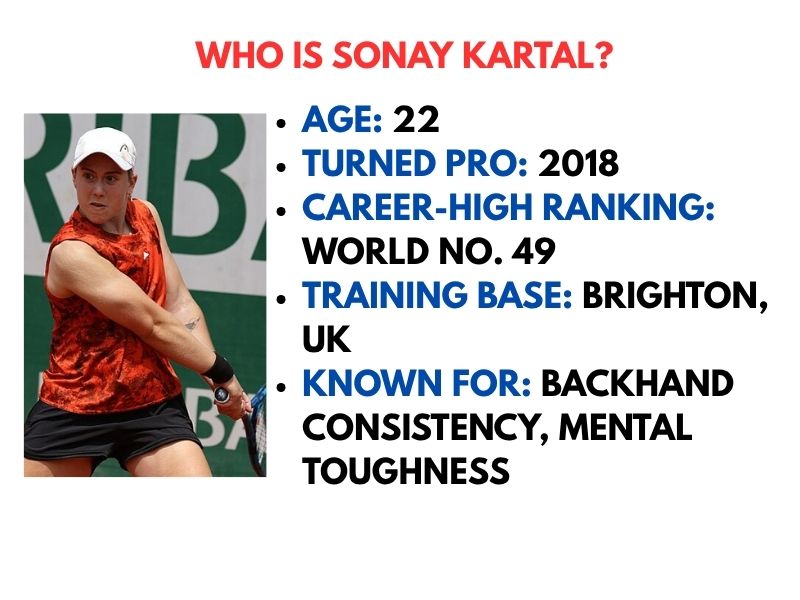
This isn’t just a personal milestone it’s a national statement.
Ostapenko isn’t just any seed. She’s a former French Open champion and a 2018 Wimbledon semi-finalist, ranked inside the world’s top 20. For Kartal, who only recently broke into the top 100, this was a true David vs Goliath moment one that ended in her favour.
Her victory also highlights the growing strength of British women’s tennis. With Emma Raducanu back in form, Katie Boulter climbing the ranks, and Kartal now emerging as a fearless talent, there’s a new wave forming.
And Kartal is right at the front of it.
What makes her feat more impressive is the pressure that comes with playing as a wildcard on home soil. Many crumble. She rose.
That resilience, and the history she’s now etched into the tournament’s legacy, marks her out as a serious contender not just for this year, but for the future of British tennis.
What the stats reveal?
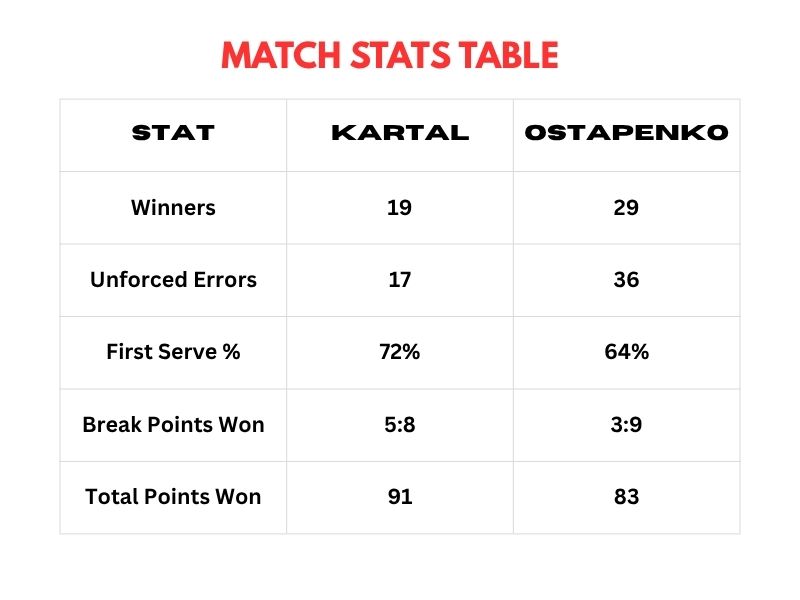
Numbers often tell the deeper story behind a headline win and this match delivered some compelling stats. In Kartal’s opening set, she committed just six unforced errors compared to Ostapenko’s 14. That composure under pressure allowed her to stage a five-game comeback from 2–5 down.
The second set told a different story. Ostapenko, aggressive and clean, fired 15 winners and made only four unforced errors. Kartal struggled to find rhythm as the Latvian capitalised on short returns and poor serving.
But in the final set, the momentum swung once more. Kartal’s first-serve percentage climbed above 70%, and she won 86% of points behind her first serve. She broke Ostapenko twice and raced to a 5–0 lead.
At this point, Kartal stuns Wimbledon not just with determination, but with the numbers to back it. She hit fewer winners overall but committed far fewer errors proving that consistency outlasts chaos.
Her ability to adjust tactics between sets, improve serve percentages, and exploit Ostapenko’s volatility made the difference. That match awareness is rare in players with limited Grand Slam experience—and it’s what turned a tough draw into a career-defining moment.
Voices from Centre Court
The atmosphere on No. 2 Court was electric as fans rose to applaud Kartal’s stunning victory. Reporters, commentators, and fellow players all took notice not just of the result, but of how composed and commanding she looked under pressure.
After the match, Kartal spoke with quiet confidence. She called it “one of the toughest matches” of her career and credited the home crowd for lifting her spirits when the first set seemed out of reach. The support from British fans created a cauldron-like environment tense, loud, and emotional.
Even Ostapenko, visibly frustrated by the end, acknowledged Kartal’s level. Though she showed signs of agitation gesturing toward the crowd and muttering after missed shots her post-match comments hinted at respect for her opponent’s tenacity.
It was also a big moment for British tennis officials and coaches. Many from the LTA (Lawn Tennis Association) had their eyes on Kartal as a rising prospect, but Kartal stuns Wimbledon with a performance that surpassed even internal expectations.
Media reactions mirrored the buzz around the grounds. Headlines quickly labelled it one of the “shocks of the tournament,” and pundits praised her mental strength more than her statistics. This wasn’t just a wildcard winning a match it was a player earning her place on the biggest stage.
Home players rising
This year, Wimbledon has seen an unprecedented surge in homegrown talent. A total of 23 British players entered the singles draws more than in any edition since 1984. That wave isn’t just symbolic. It’s proving to be competitive.
Kartal stuns Wimbledon, but she’s not alone in driving momentum for the British camp. On the men’s side, Oliver Tarvet made headlines with a straight-sets victory on his debut, while Jack Draper fresh off a strong grass season is considered a genuine second-week contender. On the women’s side, Emma Raducanu returned to action with confidence, and Katie Boulter remains a dark horse.
The LTA’s strategy of awarding wildcards to promising young Brits is paying off. These players aren’t just there to gain experience they’re winning and winning big. The blend of experienced names and fresh faces has turned Wimbledon 2025 into a showcase for British tennis depth.
That depth is now a story of belief as much as skill. Seeing someone like Kartal take down a seeded Grand Slam winner inspires the rest of the group. These early wins have lit a fuse, creating the possibility of multiple home players advancing deep into the second week.
With the crowd behind them and the confidence flowing, there’s a real chance this becomes one of the most successful Wimbledons for Britain in decades.
Conclusion
After headlines declared Kartal stuns Wimbledon, the British wildcard now sets her sights on Viktoriya Tomova in round two. Though less experienced than Ostapenko, Tomova’s consistency will test Kartal’s patience and precision. The pressure is different now Kartal steps in as the favourite. Staying composed and exploiting her opponent’s weaknesses will be key. A win could lead to a high-stakes third-round clash. Regardless of the outcome, Kartal’s fearless Wimbledon debut has captured hearts and shifted expectations. She’s no longer just a wildcard she’s the face of a rising British tennis wave.
Ask ChatGPT
Written by [Ketan Borada / British Portal Team] – Founder of British Portal, dedicated to providing accurate and up-to-date information on UK public services and benefits.Related Posts



Previous Post
Next Post







- Business
 5
5 - Cricket5
- Department for Education49
- Departments3
- Driving and Transport
 53
53 - Education45
- Finance6
- Football13
- Golf3
- Government
 108
108 - Guides1
- Health
 5
5 - Health4
- International Politics9
- Law and Justice31
- Money and Tax23
- National Politics4
- News68
- Politics6
- Sports38
- Technology5
- Tennis3
- Transportation4
- Uncategorized4
- Visa
 17
17 - Visas and Immigration
 24
24 - Weather1