
Support for ill workers is finally receiving national attention, as the UK Government takes a vital step forward. With a renewed focus on civil service support, ministers have signed the Dying to Work Charter, ensuring better protections and dignity for those facing terminal or serious illnesses.
This move not only reflects empathy but sets a precedent across the country, reinforcing the importance of worker rights UK. The decision safeguards job security, offers flexible options, and aims to reduce the emotional burden on ill employees and their families.
Government Signs Dying to Work Charter
In June 2025, the UK Government demonstrated its commitment to protecting vulnerable employees by officially signing the Dying to Work Charter. Spearheaded by Deputy Prime Minister Angela Rayner and backed by ministers Georgia Gould and Justin Madders, this move ensures that terminally ill civil servants receive the support they need to continue working with dignity.
This isn’t just a policy shift it’s a statement. The government has publicly pledged to support employees through some of the most difficult moments of their lives, showing that illness should never mean isolation or job loss.
What the Charter Means for Civil Servants:
- Signed by the Deputy Prime Minister and key cabinet ministers
- Applies across the entire civil service workforce
- Prioritises job retention and employee well-being
- Reinforces structured and empathetic civil service support
By embedding this principle, the government strengthens its message: support for ill workers is not optional it’s essential. This approach lays the foundation for broader adoption and raises the standard of worker rights UK across all industries.
Supporting Civil Servants with Compassion
The civil service’s commitment goes beyond ticking a policy box it recognises the emotional and financial toll serious illness can take. By signing the charter, the government has pledged to handle each case with empathy, flexibility, and respect.
Civil service support now includes a formal promise to allow terminally ill employees to decide if they wish to remain in work with full security and without added pressure.
This compassionate approach helps preserve:
- A sense of normalcy for the employee
- Financial stability for their families
- Dignity throughout their final months or years
Compassion in Action:
- No forced resignations or early retirements
- Adjusted roles and responsibilities based on employee preference
- Mental and emotional support integrated into HR practices
For many, continuing to work offers purpose, routine, and social contact all of which can significantly boost mental wellbeing. The new civil service policy ensures that support for ill workers isn’t left to interpretation; it’s an embedded part of employment rights.
As more employers mirror this approach, consequently, the broader landscape of worker rights UK begins to shift from reactive to proactive, and from procedural to personal.
Rights, Security and Peace of Mind
One of the most powerful aspects of the Dying to Work Charter is the assurance of rights and long-term security for terminally ill employees. Indeed, support for ill workers must go beyond empathy it must include practical protections.
The charter guarantees that civil servants facing a terminal illness will not lose their:
- Employment status
- Income
- Pension contributions
- Death-in-service benefits for their families
These promises bring stability to what is often the most uncertain time in someone’s life. Employees know they can continue working without fear, and families are assured financial protection should the worst happen.
How the Charter Provides Peace of Mind:
- Employment decisions are made with employee input
- Flexible work arrangements are available upon request
- Death-in-service benefits remain intact even if duties are reduced
- No employee will be pushed out of work due to their diagnosis
This approach puts people first not procedures. It elevates civil service support into a model of how public institutions should treat staff during hardship.
By protecting these essential rights, the government helps reshape expectations around worker rights UK, encouraging other employers to adopt similar standards.
Leadership Voices on the Commitment
Leaders from across government and trade unions have praised the charter as a defining moment for ethical employment. Together, their statements reflect a unified message: support for ill workers is not just policy it’s a matter of principle.
Deputy Prime Minister Angela Rayner emphasised that no one with a terminal illness should have to worry about losing their job. She described the charter as a “symbol of dignity and respect in public service.”
Similarly, Employment Rights Minister Justin Madders echoed her view, urging UK employers to become more sympathetic and flexible. He stressed that employees facing terminal illness should be trusted to choose what’s best for them without pressure or prejudice.
In addition, TUC representative Sian Elliott highlighted that nearly two million workers are now protected under the charter, and encouraged more employers to join the movement.
What Leaders Are Saying:
- “This is about preserving dignity in the toughest of times.” – Angela Rayner
- “Terminally ill workers deserve respect and real choices.” – Justin Madders
- “The civil service is setting an example the whole country should follow.” – Sian Elliott
These voices are shaping a national conversation about fairness, responsibility, and the future of worker rights UK. Moreover, with senior leaders driving the message, the reach of civil service support continues to grow stronger every day.
Expanding the Reach of Protection
With the civil service now fully signed on, the Dying to Work Charter covers more than two million workers across the UK. That includes staff from over 400 organisations from public sector bodies to major private companies.
The goal is clear: make support for ill workers a national standard, not a rare exception.
As the UK’s largest employer, the civil service holds influence beyond its own workforce. Therefore, its adoption of the charter sends a powerful signal to other sectors from healthcare to finance, and furthermore, from education to retail that compassionate employment should be a default, not a debate.
The Ripple Effect Across the UK:
- Employers are reviewing sick leave, job retention, and flexible working policies.
- Unions are pushing for mandatory protection clauses in contracts.
- Awareness of terminal illness rights is growing among HR teams and managers.
The growth of this movement also boosts visibility for worker rights UK, helping employees better understand what they’re entitled to during difficult periods of life.
By setting the benchmark, civil service support is guiding both private and public employers towards a future where job security and empathy coexist. And as awareness spreads, more organisations are expected to join the charter making protection the rule, not the exception.
Charter Principles at a Glance
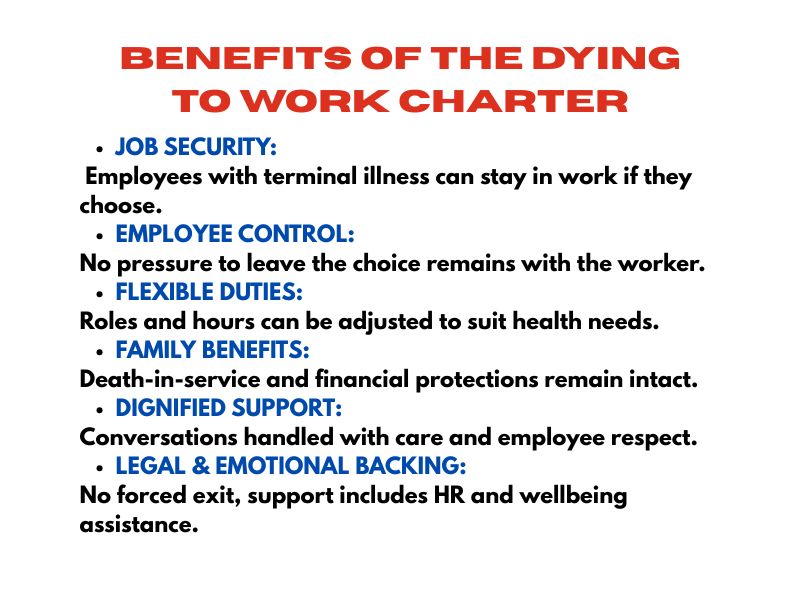
At its core, the Dying to Work Charter outlines simple yet powerful principles that redefine how we treat employees during serious illness. These principles are not just ideals they are actionable policies that prioritise the dignity and wellbeing of every worker.
By committing to these values, the government ensures that support for ill workers is not left to chance or individual discretion.
Core Principles of the Charter:
- Employee Choice: Terminally ill staff decide if they want to stay in work.
- Role Flexibility: Employers must adapt job responsibilities to meet individual needs.
- Job Security: No dismissal or forced early retirement due to diagnosis.
- Financial Protection: Full access to sick pay, pensions, and death-in-service benefits.
- Dignified Communication: All decisions must be made respectfully, with employee input.
These points make up the framework for fair and compassionate civil service support, and they’re being used as a model for other employers to replicate.
Ultimately, the charter provides a humane foundation that strengthens worker rights UK. In doing so, it reminds us that employment policies must adapt to the human realities of life and illness.
Conclusion
The UK Government’s adoption of the Dying to Work Charter marks a vital shift in how we define fair treatment in the workplace. It proves that support for ill workers is not just a moral imperative, but an achievable standard when leadership aligns with compassion.
Through its commitment to civil service support, the government has created a workplace model that values dignity, flexibility, and protection even in life’s most difficult moments. This charter doesn’t just help individuals; it strengthens entire families by preserving financial security and emotional stability.
And as this initiative gains traction across other sectors, it reshapes the national conversation about employment and health. It reaffirms that worker rights UK must evolve with the realities of modern life where care, choice, and security belong at the heart of every job.
FAQs
A voluntary pledge to protect terminally ill employees’ job security and dignity at work.
The UK Government, including the Deputy Prime Minister and civil service leaders.
They can choose to stay employed with full rights and financial protection.
Over two million employees across 400+ UK employers.
Yes, many private companies have also adopted the charter.
It boosts awareness and improves legal and ethical employment standards nationwide.
Job retention, role flexibility, full sick pay, and death-in-service benefits.
Related Posts



Previous Post
Next Post







- Business
 5
5 - Cricket5
- Department for Education49
- Departments3
- Driving and Transport
 53
53 - Education45
- Finance6
- Football13
- Golf3
- Government
 108
108 - Guides1
- Health
 5
5 - Health4
- International Politics9
- Law and Justice31
- Money and Tax23
- National Politics4
- News68
- Politics6
- Sports38
- Technology5
- Tennis3
- Transportation4
- Uncategorized4
- Visa
 17
17 - Visas and Immigration
 24
24 - Weather1