Driving licence changes coming into effect in June 2025 mark a significant shift for UK motorists. With updated regulations, drivers holding a Category B licence can now operate electric and hydrogen-powered vehicles with a higher Maximum Authorised Mass (MAM), making it easier to transition to zero-emission transport. Additionally, new towing rules provide greater flexibility for those using trailers. In this article, we break down the updates, their impact, and what drivers need to know.
Changes to Driving Licence Categories
The June 2025 driving licence changes introduce updates for Category B licence holders, broadening the scope of vehicles they can legally operate.
Under the new rules:
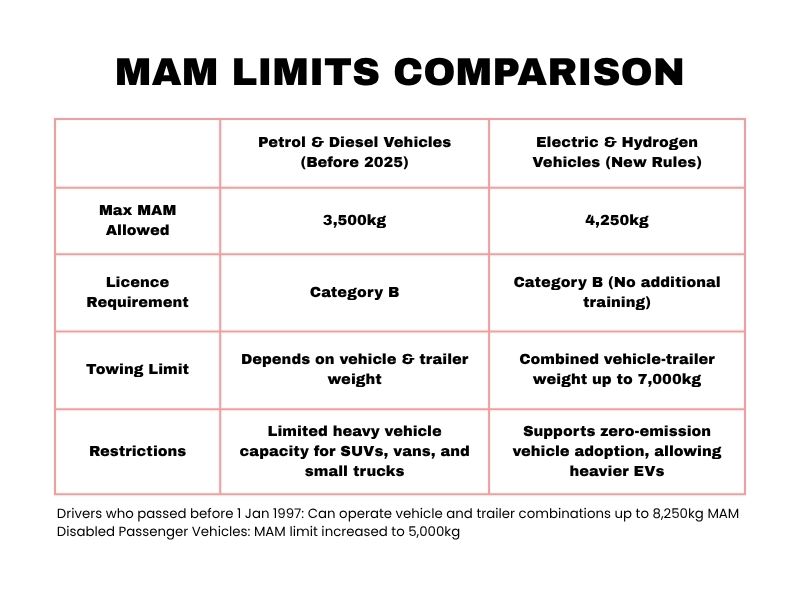
- Category B licence drivers can now operate electric vehicles and hydrogen vehicles weighing up to 4,250kg Maximum Authorised Mass (MAM).
- Previously, only petrol and diesel vehicles with a limit of 3,500kg MAM were permitted.
- This update aligns with the UK’s push towards zero-emission vehicles, making it easier for motorists to transition to cleaner transport options.
Additionally, towing regulations have changed. Motorists who passed their test before 1 January 1997 are now eligible to drive vehicle and trailer combinations up to 8,250kg MAM, improving flexibility for heavy loads and trailer transport.
The government, alongside the British Vehicle Rental and Leasing Association (BVRLA), supports these revisions, calling for further updates in MOT testing and tachograph requirements to enhance road safety and efficiency.
Impact of Driving Licence Changes on UK Motorists
The June 2025 driving licence changes directly impact millions of UK motorists, particularly those looking to operate zero-emission vehicles or take advantage of updated towing regulations.
These new rules provide greater flexibility, making it easier for drivers to transition to electric vehicles and hydrogen vehicles, as well as improving opportunities for towing trailers and heavy loads without additional training.
Here’s what drivers need to know:
- Increased Vehicle Weight Limit – Drivers with a Category B licence can now legally operate electric and hydrogen-powered vehicles up to 4,250kg MAM, compared to the previous 3,500kg limit for petrol and diesel vehicles.
- Towing Benefits – Those who passed their test before 1 January 1997 can now drive vehicle and trailer combinations with a combined 8,250kg MAM, significantly expanding towing capacity for SUVs, vans, minibuses, and small trucks.
- Better Accessibility for Disabled Drivers – Special provisions allow disabled passenger vehicles with a Maximum Authorised Mass of up to 5,000kg, supporting mobility needs without additional licensing requirements.
These updates are part of the UK’s broader commitment to sustainable transport, encouraging zero-emission vehicle adoption while simplifying regulatory processes for motorists.
Towing Regulations and Maximum Authorised Mass (MAM)
The updated towing regulations introduced in June 2025 offer more flexibility to Category B licence holders, particularly those looking to operate trailers and heavy loads with zero-emission vehicles.
Key Towing Updates
- Drivers can now tow using a 4.25-tonne zero-emission vehicle, provided the combined MAM of the vehicle and trailer does not exceed 7,000kg.
- Those who passed their test before 1 January 1997 can operate vehicle and trailer combinations up to 8,250kg MAM, increasing their towing capacity.
- Special provisions allow disabled passenger vehicles to operate with a Maximum Authorised Mass of up to 5,000kg without extra licensing requirements.
This marks a major shift for drivers transitioning to electric vehicles and hydrogen-powered vehicles, offering a simplified towing process while maintaining road safety standards.
Industry and Government Response to Driving Licence Changes
The June 2025 driving licence updates have been welcomed by industry experts and government officials, who see them as a step forward in promoting zero-emission vehicles while simplifying towing regulations.
Government’s Commitment to Sustainable Transport
- The UK government aims to support the transition to electric vehicles and hydrogen vehicles, reducing reliance on traditional petrol and diesel vehicles.
- These changes align with long-term plans to lower carbon emissions and improve transport sustainability.
Industry Reactions and Calls for Further Updates
- The British Vehicle Rental and Leasing Association (BVRLA) praised the adjustments, emphasizing their importance in modernizing road regulations.
- Experts are calling for additional reforms, including MOT testing improvements and tachograph requirements to enhance road safety and compliance.
These responses highlight a positive shift towards more flexible, environmentally conscious driving policies, ensuring UK motorists can adapt smoothly.
Future Implications of Driving Licence Changes
The June 2025 driving licence updates represent a pivotal moment in the UK’s journey towards sustainable transport. By expanding the vehicle weight limit for electric vehicles and hydrogen vehicles, these regulations promote a cleaner, greener approach to driving while encouraging motorists to transition away from petrol and diesel vehicles.
Additionally, the towing rules grant more freedom to drivers, making it easier to transport trailers, vans, minibuses, and other heavy loads without additional licensing burdens. This is particularly beneficial for business owners, delivery services, and individuals requiring extra cargo space.
With these changes, the government solidifies its commitment to reducing carbon emissions, ensuring UK roads remain accessible while keeping environmental concerns at the forefront. Industry leaders continue to push for further refinements, including updates to MOT testing and tachograph requirements, ensuring that future regulations align with evolving technology and road safety standards.
Conclusion
The June 2025 driving licence changes introduce key updates for UK motorists, making it easier to operate zero-emission vehicles and tow trailers under new regulations. Category B licence holders can now drive electric and hydrogen-powered vehicles up to 4,250kg Maximum Authorised Mass (MAM), while eligible drivers can tow combinations up to 8,250kg MAM.
Special provisions for disabled passenger vehicles and industry support from the British Vehicle Rental and Leasing Association (BVRLA) highlight the shift towards sustainable transport and improved road flexibility.
FAQs
Category B licence holders can now drive electric and hydrogen-powered vehicles up to 4,250kg MAM.
Those who passed before 1 January 1997 can tow vehicle-trailer combinations up to 8,250kg MAM.
Special provisions allow disabled passenger vehicles with a 5,000kg MAM limit.
Businesses, delivery services, and rental fleets gain flexibility with higher towing capacities.
No additional training is required for Category B licence holders.
To encourage zero-emission transport and simplify road regulations for UK motorists.
Related Posts
Previous Post
Next Post






- Business
 5
5 - Cricket5
- Department for Education49
- Departments3
- Driving and Transport
 53
53 - Education45
- Finance6
- Football13
- Golf3
- Government
 108
108 - Guides1
- Health
 5
5 - Health4
- International Politics9
- Law and Justice31
- Money and Tax23
- National Politics4
- News68
- Politics6
- Sports38
- Technology5
- Tennis3
- Transportation4
- Uncategorized4
- Visa
 17
17 - Visas and Immigration
 24
24 - Weather1