Trump Travel Ban 2025 – 19 Nations Blocked from US Entry

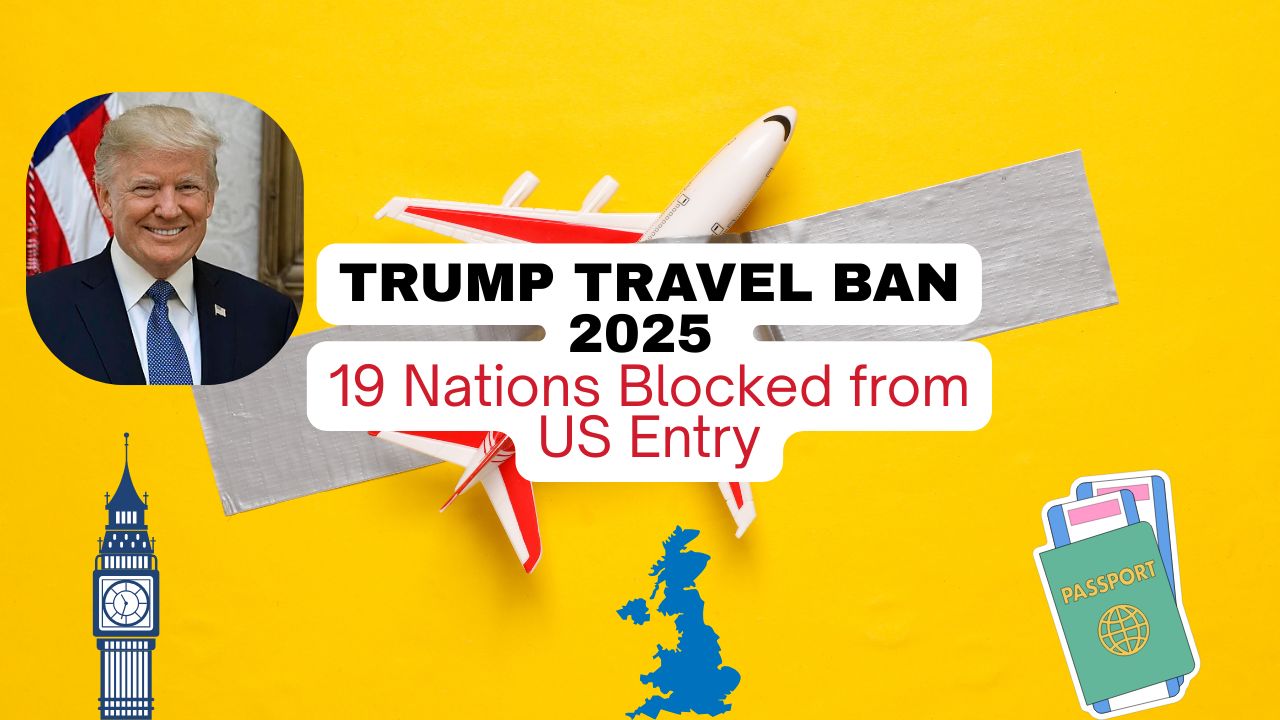
Trump travel ban is once again making headlines as the former US president enforces new restrictions. The Trump travel ban 2025 targets 19 nations, blocking entry from 12 Muslim-majority and seven other countries, citing national security.
Echoing the 2017 ban but with a broader scope, the move is drawing global criticism. This article explains the new ban, countries affected, key reactions, and its impact on travellers, including British tourists.
Global Reactions to the Trump Travel Ban 2025
The global response to the Trump travel ban 2025 has been swift and polarised. Leaders from several of the 19 affected nations have condemned the decision, calling it discriminatory and politically motivated.
Middle Eastern Nations React Strongly
Iran was among the first to issue an official statement. The Iranian Foreign Ministry described the move as showing “deep hostility towards Iranians and Muslims.” Officials warned it would damage diplomatic ties and fuel anti-American sentiment in the region.
Similarly, governments of countries like Yemen, Libya, and Syria denounced the ban. Many view it as a continuation of Trump’s Muslim ban legacy, which previously faced legal challenges and mass protests.
European Allies Voice Concern
European allies, particularly the United Kingdom, expressed unease about the impact on British tourists and dual nationals. The UK Foreign Office issued guidance to travellers, warning of potential delays and visa complications for British citizens with dual nationality linked to the banned countries.
European Union officials criticised the US decision, citing concerns over human rights and international mobility. Some European leaders have called for the policy to be reviewed at the international level.
US Political Divide
Domestically, the ban has reignited partisan divisions. Republican supporters argue that the Trump immigration policy prioritises national security. They frame the move as necessary in a volatile global climate.
Conversely, Democratic lawmakers, civil rights groups, and immigration advocates strongly oppose the ban. They claim it unfairly targets Muslim-majority countries and undermines America’s reputation as a welcoming nation.
Public protests have already begun in major US cities. Advocacy groups, including the ACLU, are preparing legal challenges to contest the executive order’s constitutionality.
How It Impacts British Tourists and Global Travellers
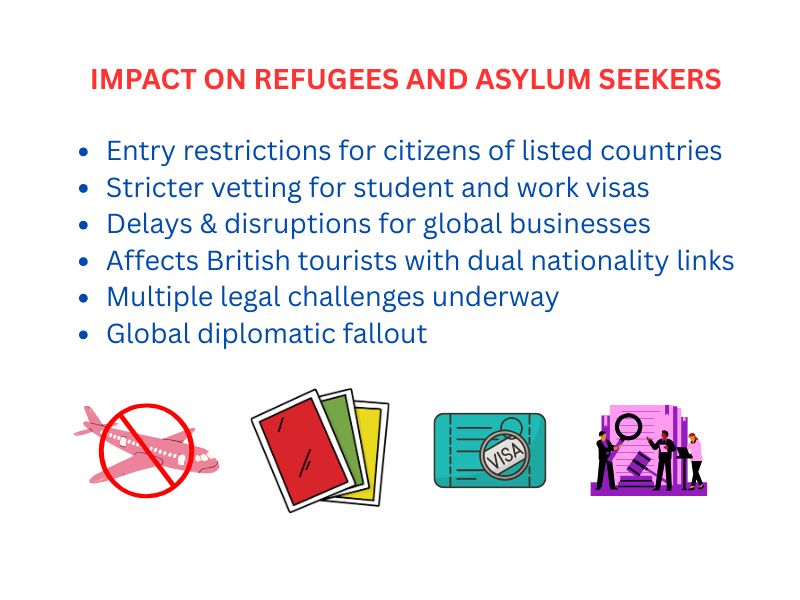
The Trump travel ban 2025 is not limited to foreign nationals from the 19 targeted countries. It is also creating confusion and concern among global travellers, including British tourists.
British Travellers Facing New Challenges
According to reports, British citizens with dual nationality linked to any of the banned countries may face additional scrutiny or even denied entry to the US. The UK Foreign Office has already updated its travel advice, urging caution and recommending that affected British citizens check their visa status before travelling.
Some British travellers have reported delays in visa processing or having to undergo extended security interviews. Travel agents are also seeing a surge in customer inquiries about how the ban might affect planned US trips.
Broader Global Impact
Globally, the travel and tourism industry is bracing for wider effects:
- Airlines may face rerouted flights and passenger cancellations.
- International conferences and events in the US may see reduced participation.
- Family reunions and business travel involving affected nations are likely to be disrupted.
The Trump travel restrictions have also impacted students and academic exchanges. Universities in the US are expressing concern that the new ban could deter international students from applying, particularly from countries affected by the order.
Heightened Uncertainty
One of the main criticisms of the Trump travel ban is the lack of clarity and consistency in its implementation. Legal experts note that temporary waivers are being granted inconsistently, leaving travellers uncertain about their status until they arrive at a US port of entry.
In short, the ban’s broad scope and ambiguous enforcement are causing disruption not just for targeted countries, but for the wider global community of travellers and international businesses.
Legal Challenges and Human Rights Concerns
The introduction of the Trump travel ban 2025 has already sparked a wave of legal challenges and human rights concerns across the globe. Civil liberties groups argue that the ban violates fundamental rights and discriminates based on nationality and religion.
Legal Actions in the US
Several lawsuits have been filed against the new Trump executive order travel ban in US federal courts. The American Civil Liberties Union (ACLU) and other advocacy groups claim that the policy breaches the US Constitution’s guarantees of equal protection and religious freedom.
Some judges have already scheduled hearings to consider temporary injunctions, while others have requested more details on how the administration plans to implement the restrictions.
Legal scholars point out that while the US president holds broad powers over immigration and border security, those powers are not unlimited. The Supreme Court previously upheld parts of Trump’s 2017 travel ban but also placed limits on its scope. The current legal debate centres on whether the Trump travel restrictions in 2025 go too far.
International Human Rights Concerns
Human rights organisations such as Amnesty International and Human Rights Watch have condemned the Trump travel ban as discriminatory and unjust. They argue that the policy:
- Violates the principle of non-discrimination in international law
- Disrupts the right to family life for many affected individuals
- Harms refugees seeking safety from conflict zones
The United Nations Human Rights Council has called for the United States to reconsider the ban and engage in dialogue with affected countries.
Impact on Refugees and Asylum Seekers
Particularly concerning is the ban’s effect on refugees. The 2025 order blocks refugee admissions from several countries facing humanitarian crises, including Syria and Yemen. Aid groups warn that this could leave vulnerable people without safe resettlement options.
Critics argue that the Trump immigration policy prioritises political messaging over humanitarian obligations. Legal experts expect further court battles in the weeks ahead as advocacy groups push to overturn or limit the ban.
Countries on the US Travel Ban List and Their Responses
The Trump travel ban 2025 currently targets 19 nations. These countries face varying levels of restrictions from full entry bans to tightened visa requirements. Many of the affected nations have responded with strong diplomatic opposition.
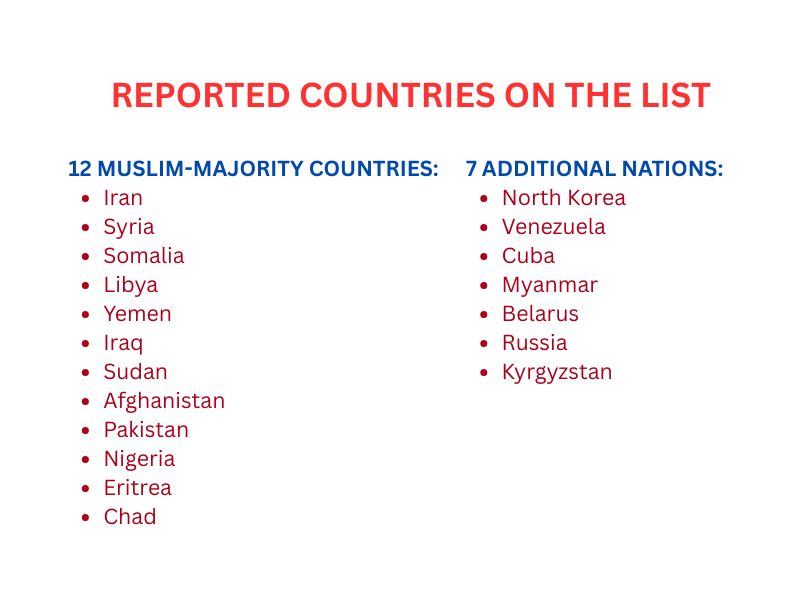
Reported Countries on the List
While the complete list is still being finalised, media reports and official statements suggest the following countries are included:
12 Muslim-majority countries:
- Iran
- Syria
- Somalia
- Libya
- Yemen
- Iraq
- Sudan
- Afghanistan
- Pakistan
- Nigeria
- Eritrea
- Chad
7 additional nations:
- North Korea
- Venezuela (certain government officials and their families)
- Cuba
- Myanmar
- Belarus
- Russia (targeted categories such as intelligence and military-linked individuals)
- Kyrgyzstan
The US travel ban list remains subject to change as diplomatic negotiations and legal reviews continue.
Reactions from Affected Countries
Iran has condemned the Trump travel ban, accusing the US of showing “deep hostility towards Iranians and Muslims.” Iranian officials warned that the move will strain US-Iran relations and fuel anti-American sentiment.
Syria, Yemen, and Libya have also issued sharp rebukes, labelling the ban unjust and politically driven. Leaders from these nations argue that the policy punishes ordinary citizens rather than targeting genuine security threats.
African countries such as Nigeria and Eritrea have expressed disappointment. Nigerian officials noted that the ban could harm economic and educational exchanges between the two nations.
Russia and Belarus reacted by accusing the US of using the ban as a geopolitical tool rather than a legitimate security measure.
Diplomatic Fallout
The Trump travel ban impact extends beyond bilateral relations. Some nations are considering reciprocal measures or lodging formal complaints through international bodies such as the United Nations.
Diplomats warn that the ban risks deepening global divisions at a time when international cooperation is needed on major issues such as climate change and global security.
Comparing the 2025 Trump Travel Ban to Previous Bans
The Trump travel ban 2025 builds on but also significantly expands the policies first introduced during Trump’s presidency in 2017. To understand the current situation, it helps to compare this latest ban to earlier versions.
The 2017 Travel Ban
The original Trump Muslim ban of 2017 (Executive Order 13769) was one of Trump’s first major immigration policies. It blocked entry for citizens of seven Muslim-majority countries and temporarily halted the US refugee program.
That order faced swift legal challenges, leading to multiple revisions. In 2018, a version of the ban was ultimately upheld by the US Supreme Court, allowing travel restrictions on five Muslim-majority countries plus North Korea and Venezuela.
Key Differences in the 2025 Ban
Broader scope:
The Trump travel ban 2025 targets 19 nations more than double the number in the 2017 order.
Expanded rationale:
While the 2017 ban cited terrorism risks, the 2025 version also lists “lack of cooperation with US law enforcement” and “insufficient identity verification procedures” as justifications.
More complex restrictions:
In addition to full entry bans, the current order includes:
- Targeted visa bans (e.g. on government officials or military-linked individuals)
- Stricter vetting for student and work visas
- Greater discretionary power for US border agents to deny entry
Impacts beyond Muslim-majority countries:
Unlike the 2017 order, the new ban affects non-Muslim-majority nations such as Cuba, Russia, and Venezuela broadening the political implications.
Public and Political Response
While Trump’s supporters argue that the new ban improves national security, critics see it as a continuation of the original Trump immigration policy that unfairly targets certain populations.
Legal experts expect the broader scope of the Trump travel restrictions in 2025 to face new legal challenges potentially testing the limits of presidential authority on immigration once again.
Conclusion
The Trump travel ban 2025 has reignited global controversy over immigration and national security. Legal challenges are underway, and political outcomes in the US could shape the policy’s future.
Travellers, especially British tourists and those linked to affected nations, should stay updated and prepare for possible disruptions.
The world now watches to see whether this expanded ban becomes a lasting element of US immigration policy or faces limits through the courts or political change.
FAQs
Former President Donald Trump announced the travel ban.
The ban was introduced citing national security and immigration control concerns.
Countries from Africa, the Middle East, and South Asia are among those affected.
Yes, US citizens and green card holders can return, but may face additional screening.
Public and international reactions have been mixed, with protests in some areas.
The travel ban came into effect in June 2025.
Related Posts

Previous Post
Next Post






- Business
 5
5 - Cricket5
- Department for Education49
- Departments3
- Driving and Transport
 53
53 - Education45
- Finance6
- Football13
- Golf3
- Government
 108
108 - Guides1
- Health
 5
5 - Health4
- International Politics9
- Law and Justice31
- Money and Tax23
- National Politics4
- News68
- Politics6
- Sports38
- Technology5
- Tennis3
- Transportation4
- Uncategorized4
- Visa
 17
17 - Visas and Immigration
 24
24 - Weather1