UK growth forecast upgrades have offered a rare positive signal in a turbulent global economy. The International Monetary Fund (IMF) has lifted its 2025 prediction for the UK to 1.2%, slightly up from its earlier 1.1% estimate.
This revision comes on the back of better-than-expected economic data in early 2024, indicating the UK has managed to steer clear of recession. However, warnings remain. The IMF has pointed to rising global trade tensions, particularly from U.S. tariff policies, as a looming risk to sustained recovery.
With both optimism and caution in equal measure, the latest UK growth forecast captures the delicate balancing act facing Britain’s economy.
IMF’s UK Growth Forecast: Why the Outlook Improved
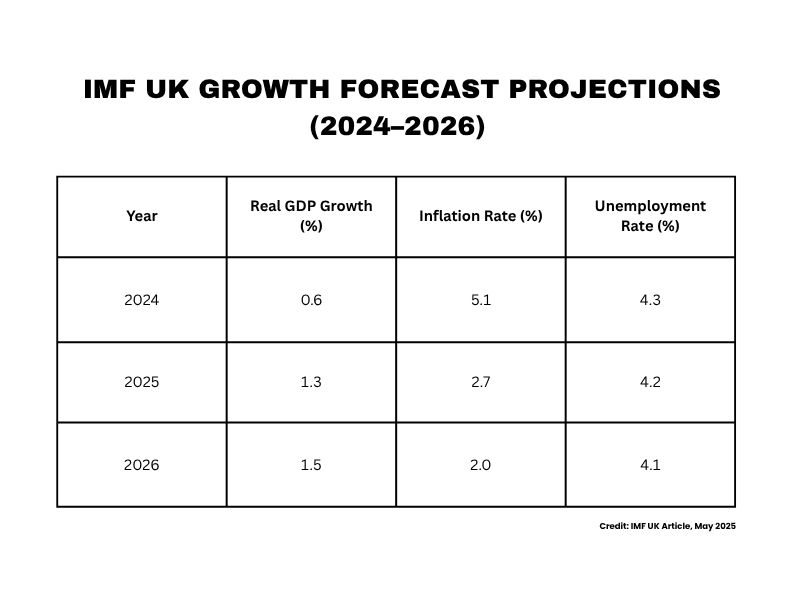
The UK growth forecast was revised upward by the International Monetary Fund after stronger-than-expected economic data in early 2024. The IMF now projects the UK economy will grow by 1.2% in 2025, up from the previous 1.1% estimate.
This upgrade reflects positive momentum from the first quarter. Official data showed the UK narrowly avoided a recession. GDP expanded modestly but consistently. Growth was supported by steady consumer spending and improved business confidence. Early signs of recovery appeared in sectors like construction and manufacturing.
Government efforts also helped improve the forecast. Policies focusing on infrastructure and housing reforms are expected to boost long-term productivity and investment. If these plans are implemented well, they could strengthen the economy further.
While the increase seems small, it signals renewed confidence. The UK is stabilising after years of uncertainty caused by Brexit and inflation pressures. Still, the IMF warns that global risks, especially trade tensions, could affect future growth.
What Trade Tensions Mean for the UK Growth Forecast
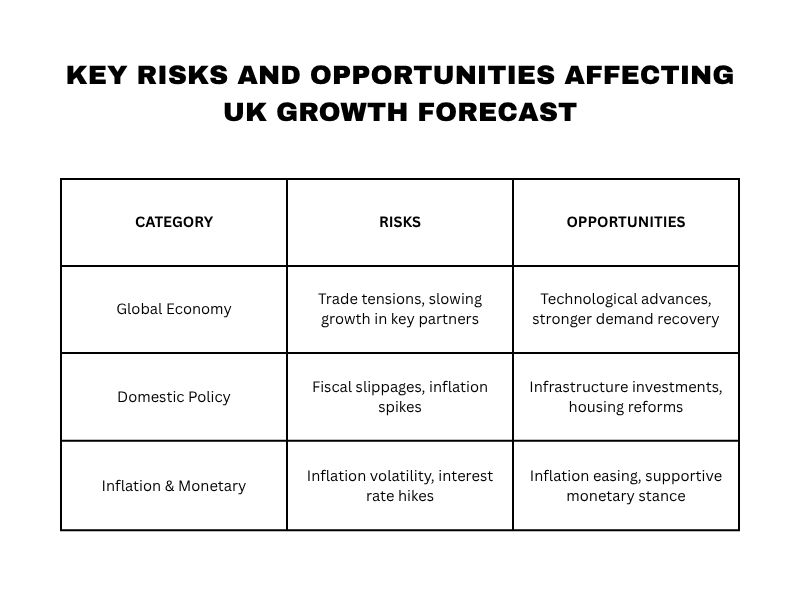
The UK growth forecast faces risks due to rising global trade tensions. Even with the IMF’s upgrade, uncertainty remains because of tariff disputes. Protectionist policies, especially from the United States, are a concern.
The IMF estimates that U.S. tariffs on European goods could cut UK growth by about 0.3 percentage points next year. These tariffs raise costs for UK exporters. They also disrupt supply chains. This makes British businesses less competitive on the global stage.
The UK continues to deal with post-Brexit trade challenges. Customs checks and new regulations have slowed trade with the European Union. Since the EU is the UK’s biggest trading partner, this adds uncertainty. These hurdles limit potential gains from the better domestic economy.
Trade tensions also risk pushing inflation higher. Higher inflation can reduce consumer spending, which currently drives growth. The IMF says policymakers must balance trade policies with support for demand and investment.
In short, while the IMF’s revised UK growth forecast is cautiously positive, global trade tensions remain a major threat to sustained growth in 2025 and beyond.
How Government Policy Shapes the UK Growth Forecast
Government policy plays a crucial role in shaping the UK growth forecast. The International Monetary Fund highlights that maintaining fiscal discipline is essential for sustainable growth.
Chancellor Rachel Reeves is urged to stick to fiscal rules balancing spending with tax revenue. The goal is to reduce national debt as a share of income by 2029–30. This approach aims to keep the UK’s finances stable, which supports investor confidence and economic resilience.
Moreover, the government’s planned infrastructure investments and reforms in housing supply could further boost the UK growth forecast. These measures can create jobs, raise productivity, and attract business investment.
However, success depends on effective implementation. Delays or policy reversals could weaken growth prospects.
The IMF’s outlook assumes these policies remain on track. Combined with strong consumer demand and business confidence, they contribute to the modest upgrade in the UK growth forecast.
Still, uncertainty about global trade and inflation remains. Policymakers must navigate these risks carefully to sustain growth momentum through 2025.
Consumer Spending and Business Investment Impact
Consumer spending and business investment remain key drivers behind the improved UK growth forecast. Despite inflationary pressures earlier in 2024, household spending has shown surprising resilience.
Rising wages and easing energy costs have helped maintain consumer confidence. Many households are gradually increasing their purchases, especially in retail and services. This steady demand supports businesses and contributes to GDP growth.
At the same time, business investment is beginning to pick up. Companies are cautiously expanding, driven by better economic signals and government incentives. Investment in technology and infrastructure projects also plays a vital role.
However, uncertainties around global trade and potential interest rate changes could slow this progress. If businesses face higher costs or disrupted supply chains, they may hold back on investment.
The balance between consumer spending and business investment will heavily influence the UK growth forecast in the months ahead. For now, the combination of steady demand and cautious optimism underpins the IMF’s upgraded outlook.
Role of Inflation in the UK Growth Forecast
Inflation remains a critical factor influencing the UK growth forecast. In early 2024, inflation rates showed signs of easing after reaching highs in previous years. This relief has helped improve consumer purchasing power and business planning.
Lower inflation reduces the pressure on household budgets, encouraging more spending. It also lowers input costs for businesses, which can boost profit margins and support investment decisions.
However, the IMF warns that inflation risks persist. Global commodity prices and supply chain disruptions could cause sudden spikes. Additionally, trade tensions might increase costs through tariffs, pushing inflation higher again.
If inflation rises unexpectedly, the Bank of England may need to raise interest rates. Higher borrowing costs could slow down consumer spending and business investment, negatively affecting growth.
The interplay between inflation and monetary policy is crucial for the UK growth forecast. Policymakers must strike a balance to maintain price stability without stifling economic momentum.
Conclusion
The UK growth forecast reflects cautious optimism amid complex global and domestic challenges. The IMF’s upgraded projection signals resilience supported by steady consumer spending, improving business investment, and government reforms.
However, risks from trade tensions, inflation fluctuations, and uncertain global conditions continue to cloud the outlook. Policymakers face the critical task of balancing fiscal discipline with growth-supporting measures.
Sustaining momentum will require navigating these uncertainties carefully. Success depends on effective government policies, stable inflation, and strong trade relations.
For businesses and consumers alike, understanding these factors can help prepare for the economic shifts ahead. Keeping a close eye on the evolving UK growth forecast will be vital as 2025 unfolds.
FAQs
The IMF projects the UK economy will grow by around 1.2% in 2025.
Stronger economic data and improved consumer spending boosted the forecast.
Trade disputes and tariffs risk slowing UK exports and overall growth.
Fiscal discipline and infrastructure investments support sustainable development.
Lower inflation boosts spending and investment, while spikes may slow growth.
Slower growth in key economies and geopolitical risks add uncertainty.
Yes, increased investment signals economic confidence and drives growth.
By maintaining stable policies, managing inflation, and expanding trade ties.
Related Posts



Previous Post
Next Post







- Business
 5
5 - Cricket5
- Department for Education49
- Departments3
- Driving and Transport
 53
53 - Education45
- Finance6
- Football13
- Golf3
- Government
 108
108 - Guides1
- Health4
- Health
 5
5 - International Politics9
- Law and Justice31
- Money and Tax23
- National Politics4
- News68
- Politics6
- Sports38
- Technology5
- Tennis3
- Transportation4
- Uncategorized4
- Visa
 17
17 - Visas and Immigration
 24
24 - Weather1