Scariest NFL player is not a title you earn by accident. For Jack Tatum, it came with bone-crunching hits, bloodied rivals, and one unforgettable moment that changed football forever. Known as “The Assassin,” Tatum was feared not just for what he did but for what he might do next.
Players avoided his zone, coaches warned rookies about him, and legends still whisper his name when talking about the most violent era in NFL history. But behind the highlight reels and brutal tackles lies a chilling story: one hit that left an opponent paralysed and an entire league shaken.
Jack Tatum – The NFL’s Most Feared Defender
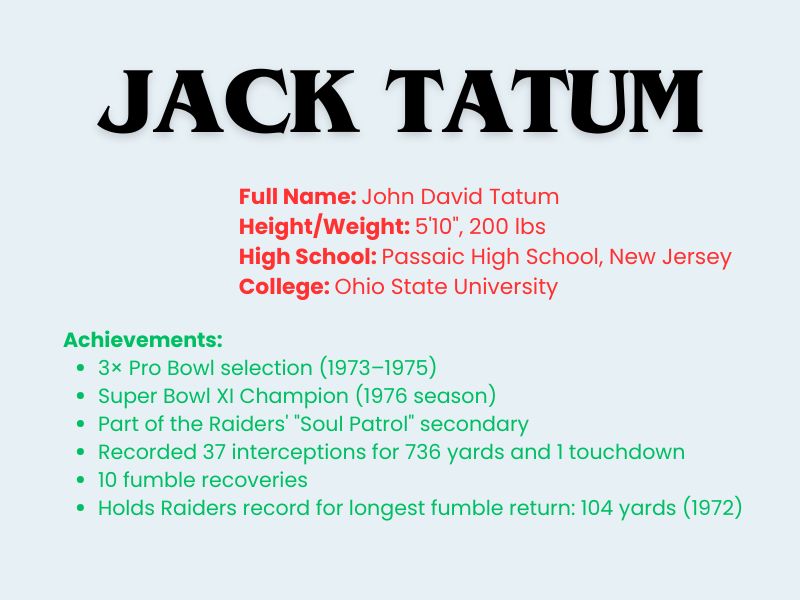
Jack Tatum wasn’t built like a monster he became one on the field. Drafted by the Oakland Raiders in 1971, the Ohio State standout brought a new level of aggression to pro football. Standing 5’10” and weighing just over 200 pounds, Tatum didn’t tower over opponents.
He didn’t have to. What made him terrifying was his explosive speed, perfect timing, and a style of play that could stop a receiver cold, literally.
In a time when defensive backs were expected to hit hard, Tatum set the gold standard. He didn’t just tackle, he was punished. Wide receivers often had second thoughts about going over the middle when they saw #32 lurking in the secondary.
He turned routine plays into hospital visits, and his nickname “The Assassin” wasn’t a marketing gimmick it was a warning.
Tatum’s reputation only grew with each devastating hit. He thrived in an era that celebrated violent football, yet even in that context, he stood apart. Opposing quarterbacks knew where he was before every snap. Teammates admired him. Fans cheered for him. But many in the league feared him and with good reason.
The Hit That Made the Scariest NFL Player a Legend
On August 12, 1978, a pre-season game between the Oakland Raiders and New England Patriots took a horrific turn. In what was meant to be just another tune-up before the regular season, Jack Tatum delivered a hit that would become one of the darkest moments in NFL history.
Late in the first quarter, Patriots wide receiver Darryl Stingley ran a short crossing route. As the ball approached, so did Tatum like a missile. In one brutal collision, shoulder met helmet, and Stingley collapsed instantly. The crowd gasped. Players froze. The silence was louder than any roar a stadium could produce.
Stingley never got up again.
The impact shattered his fourth and fifth cervical vertebrae, leaving him paralysed from the chest down for the rest of his life. The hit was legal by the standards of the time there were no flags, no fines. But morally, it split the football world. Some defended Tatum’s intent; others questioned how a sport could allow such violence.
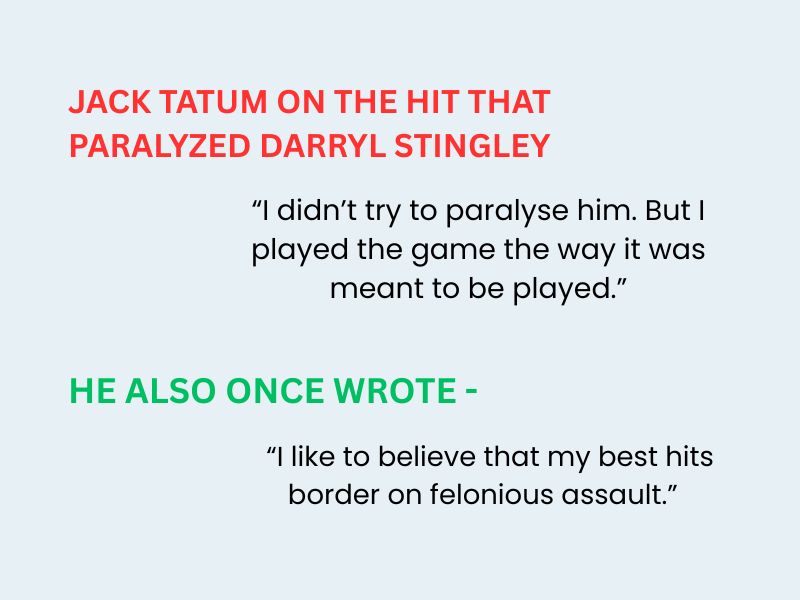
What made the moment even more unsettling was Tatum’s response. He never apologised. In interviews, he expressed regret but stood firm: “I didn’t try to paralyse him. But I played the game the way it was meant to be played.” To some, it showed conviction. To others, it showed coldness.
That one hit didn’t just end a promising career it forced the NFL to look at itself in the mirror. Conversations about player safety, head trauma, and rules around contact would only intensify in the years that followed.
How the Scariest NFL Player Became ‘The Assassin’
The nickname “The Assassin” wasn’t handed to Jack Tatum by chance it was earned. Game after game, hit after hit, Tatum built a persona that was as feared as it was celebrated. But beneath the shoulder pads and menacing stare, was there a man lost in the myth?
Tatum embraced his image. He spoke openly about wanting to dominate, to intimidate, to hurt but not injure. He once wrote, “I like to believe that my best hits border on felonious assault.” To fans of the Raiders, it was thrilling. To his critics, it was proof that the game had gone too far.
Yet despite the blood and bruises he left behind; Tatum wasn’t a villain in his own eyes. He saw himself as a competitor who simply played by the rules of his era rules that encouraged physicality over finesse. And truthfully, the NFL profited from it. “Assassin vs. Iron Curtain” or “Tatum’s Terror Hits” were the kind of headlines that sold tickets.
But the persona had a cost.
Off the field, Tatum became a lightning rod. He was cheered in Oakland but booed in nearly every other stadium. His role in the Stingley incident shadowed him for the rest of his life. Although he never reached out personally to Stingley, he insisted it wasn’t due to lack of remorse but because lawyers advised against it during the legal aftermath.
So was Jack Tatum a monster? Or was he simply the product of a brutal sport in its rawest form?
In truth, he was both man and myth. A complex figure who blurred the line between legend and controversy just as the NFL itself often does.
Why the Scariest NFL Player’s Legacy Still Divides Fans
Jack Tatum didn’t just hit players he shook the foundations of the NFL. His style of play, and especially that infamous hit on Darryl Stingley, sparked a reckoning that still echoes through the league today.
At the time, violence was part of football’s identity. Big hits were replayed over and over, drawing cheers and headlines. But Tatum’s hit drew something else: outrage. It forced the NFL to confront a haunting question: how much violence is too much?
Soon after the Stingley incident, conversations around player safety gained serious momentum. Though no immediate rule changes followed, it was the beginning of a shift. Over the next few decades, the league introduced new penalties, targeting rules, and helmet-to-helmet contact bans. Tatum didn’t cause the change alone, but his shadow loomed large over every discussion.
Players today still know his name. Coaches show his highlights as cautionary tales. Even fans unfamiliar with the 1970s know the legacy: defenders who hit too hard risk fines, suspensions, and public backlash.
The assassin-style tackle? It’s nearly extinct now.
More importantly, the NFL’s approach to brain injuries changed. With growing research around CTE and long-term trauma, the league began taking head injuries seriously. What once made players legends like Tatum’s signature blows now makes them cautionary figures in a more safety-conscious era.
Ironically, the scariest NFL player helped make the league safer. Not through intention but by becoming the example of what unchecked violence can do.
A Controversial Legacy – Loved, Hated, Remembered
Jack Tatum’s legacy is a storm of contradictions equal parts glory, grief, and grit. To Raiders fans, he remains a legend. To others, he’s the face of an era many are glad is over. But one thing is certain: no one forgets him.
In Oakland, Tatum is remembered as a warrior. His hits, his swagger, and his fearless style defined the rough-and-tumble identity of the 1970s Raiders. Jack’s jersey still sells. His name still echoes through black-and-silver circles like a battle cry. To those fans, he was exactly what football needed: raw, real, and ruthless.
But for others, especially supporters of Darryl Stingley, Tatum’s image never recovered. Many found his lack of a direct apology hard to forgive. Even after Stingley’s death in 2007, the tension lingered.
Some called him cold, others said he was misunderstood. What’s undeniable is that his silence after the hit hurt almost as much as the hit itself.
Away from football, Tatum faced his own challenges. In his later years, he battled diabetes, lost a leg, and eventually passed away in 2010 at age 61. But even then, his story didn’t end.
Debates still rage online and on sports talk shows: Was Tatum a hero or a villain?
Truthfully, he was both. A man who played by the rules of his time but also pushed them to their violent limits. His legacy is not clean. But it is unforgettable.
That’s what makes him the scariest NFL player to ever step onto the field.
Conclusion
Scariest NFL player isn’t a title you win. It’s one that’s burned into memory by force, by fear, and by ferocity. Jack Tatum didn’t just earn that title; he defined it.
His name still chills players who grew up watching his hits. His story continues to stir debate, even long after his final snap. He wasn’t the fastest. He wasn’t the biggest. But he played with an intensity that made opponents think twice about going across the middle.
Tatum’s story isn’t just about brutality, it’s about football’s soul. About how a game built on contact must confront its consequences. About how legends can both inspire and terrify. And about how, sometimes, the line between playing hard and going too far isn’t drawn until someone’s life is changed forever.
The NFL has changed. The rules have changed. But the memory of “The Assassin” lingers etched into highlight reels, rulebooks, and the minds of anyone who ever watched him play.
Jack Tatum didn’t just hit people.
He hit the sport itself and left a permanent mark.
Related Posts



Previous Post
Next Post







- Business
 5
5 - Cricket5
- Department for Education49
- Departments3
- Driving and Transport
 53
53 - Education45
- Finance6
- Football13
- Golf3
- Government
 108
108 - Guides1
- Health
 5
5 - Health4
- International Politics9
- Law and Justice31
- Money and Tax23
- National Politics4
- News68
- Politics6
- Sports38
- Technology5
- Tennis3
- Transportation4
- Uncategorized4
- Visa
 17
17 - Visas and Immigration
 24
24 - Weather1