Significant changes are coming to minimum pay rates in the UK. If you work, it’s essential to know about the National Minimum Wage (NMW) and National Living Wage (NLW). These are the legal minimum amounts employers must pay you per hour.
The government reviews these rates annually, and new rates take effect on April 1st each year. Understanding the upcoming changes for 2025 helps ensure you receive the correct pay for your work.
The Minimum Wage Rates from April 1st, 2025
The government has officially announced the new minimum wage rates that will apply from April 1st, 2025, until March 31st, 2026. These represent a notable increase from the previous year.
Here are the confirmed national minimum wage rates 2025 and national living wage rates 2025:
| Category | Age | Hourly Rate (From April 1st, 2025) | Wage Type |
| National Living Wage | 21 and over | £12.21 | NLW |
| National Minimum Wage | 18 to 20 | £10.00 | NMW |
| National Minimum Wage | Under 18 | £7.55 | NMW |
| Apprentice Rate | Apprentices* | £7.55 | NMW (Apprentice Rate) |
Remember: The Apprentice Rate applies if you are under 19, OR if you are 19 or over, BUT in your first year of apprenticeship. Once an apprentice aged 19+ finishes their first year, they must be paid the higher NMW or NLW rate for their actual age.
These new rates mean millions of workers across the UK will see an increase in their minimum hourly pay starting in April 2025.
Rates Before April 2025
To understand the increase, it’s helpful to see the rates that are currently in place until March 31st, 2025. The national minimum wage and national living wage rates for 2024 are:
| Category | Age | Hourly Rate (April 2024 – March 2025) | Wage Type |
| National Living Wage | 21 and over | £11.44 | NLW |
| National Minimum Wage | 18 to 20 | £8.60 | NMW |
| National Minimum Wage | Under 18 | £6.40 | NMW |
| Apprentice Rate | Apprentices* | £6.40 | NMW (Apprentice Rate) |
These national minimum wage rates UK 2024 and the national living wage rates April 2024 have been the legal minimums for the current period. They represent the current national minimum wage rates in the UK that employers must pay until the switchover on April 1st, 2025.
Understanding the Terms: NLW vs NMW
What’s the difference between the National Living Wage and National Minimum Wage? It mainly comes down to age.
- National Living Wage (NLW): This is the highest minimum wage rate. From April 2025, it applies to all workers aged 21 and over. So, what is the national living wage in the UK? From April 2025, it’s the legal minimum hourly pay of £12.21 for those aged 21+. This specific UK national living wage hourly rate is the main figure many people refer to.
- National Minimum Wage (NMW): This term covers the minimum wage rates for workers younger than 21, and also the apprentice rate.
- Workers aged 18 to 20 will have a minimum rate of £10.00 per hour from April 2025.
- Workers under 18 (but above school leaving age) have a minimum rate. The national minimum wage for 16-year-old workers, for instance, will be £7.55 per hour from April 2025.
- Apprentice Rate: This specific NMW rate (£7.55 from April 2025) has special rules:
- It applies to all apprentices under 19.
- It applies to apprentices aged 19 or over only during their first year.
- Crucially, once an apprentice aged 19 or over completes their first year, they must jump to the full NMW or NLW rate appropriate for their age (£10.00 for 19-20 year olds, £12.21 for those 21+ from April 2025).
Who Should Receive These Minimum Rates?
Most people working in the UK are entitled to receive the correct NMW or NLW rate for their age and situation. This includes:
- People with an employment contract (’employees’).
- Most other individuals who perform work (‘workers’), even if they don’t have a traditional employment contract.
- Part-time staff.
- Casual workers.
- Agency workers.
- Those on zero-hours contracts.
- Homeworkers are paid by output.
However, some groups are generally not entitled, such as:
- Genuinely self-employed people running their own business.
- Company directors (unless they also have an employment contract).
- Volunteers.
- People on work experience by their education course.
- People younger than the school-leaving age.
Important Factors That Affect Your Minimum Wage Calculation
Getting paid correctly isn’t just about the headline hourly rate. Other factors can influence whether you’re receiving the legal minimum:
- What Counts as Working Time? Your pay must meet the minimum wage for all hours considered ‘working time’. This usually includes:
- Time spent doing your job at your workplace.
- Time spent travelling between different work sites (but usually not your regular commute from home).
- Time spent on job-related training is required by your employer.
- The time you are required to be ‘on call’ at your place of work.
- Salaried Workers: If you get paid a set salary each year (e.g., £25,000 per year), you are still covered by minimum wage rules. Your employer must make sure your average hourly pay, calculated over your regular pay period (e.g., weekly or monthly), doesn’t fall below the NMW or NLW rate that applies to you.
- Deducations from Your Pay: Sometime,s employers take money from your wages for things like uniforms, tools, or transport. Most of these deductions cannot legally take your average pay below the minimum wage. The main exceptions are statutory deductions like Income Tax and National Insurance, or specific agreed repayments. Be wary if other deductions reduce your pay below the NMW/NLW level.
- Accommodation Offset: If your job includes accommodation provided by your employer (like a room on-site), your employer can count a set amount of this benefit towards your minimum wage pay. This is called the ‘accommodation offset‘. There’s a maximum daily amount they can offset (for 2024/25 it was £9.99 per day – always check the current offset rate on gov.uk as it may change). Even with this offset, your overall pay calculation must meet the minimum wage standard.
Minimum Wage vs Real Living Wage: Knowing the Difference
You might hear about the ‘Real Living Wage’ – it’s important not to confuse this with the government’s National Living Wage (NLW). The relationship between the national minimum wage, vs national living wage, and the Real Living Wage is distinct:
| Feature | National Minimum Wage (NMW) / National Living Wage (NLW) | Real Living Wage / London Living Wage |
| Who Sets It? | UK Government (official, legal rates) | Living Wage Foundation (independent charity) |
| Is it Legal? | Yes, employers MUST pay at least this. | No, it’s a voluntary rate. |
| How Calculated? | Based on government economic targets & LPC advice. | Based on research into actual living costs. |
| Rates | Different rates by age and apprentice status. | Usually higher. One UK rate, one London rate. |
Thousands of UK employers voluntarily choose to pay the Real Living Wage because they believe it better reflects the true cost of living. However, the NMW and NLW (including the £12.21 rate from April 2025) are the only rates employers are legally required to meet.
How to Check Your Pay – Especially After April 2025
When the new rates come in on April 1st, 2025, it’s wise to check your payslip to ensure you’re being paid correctly based on the updated figures.
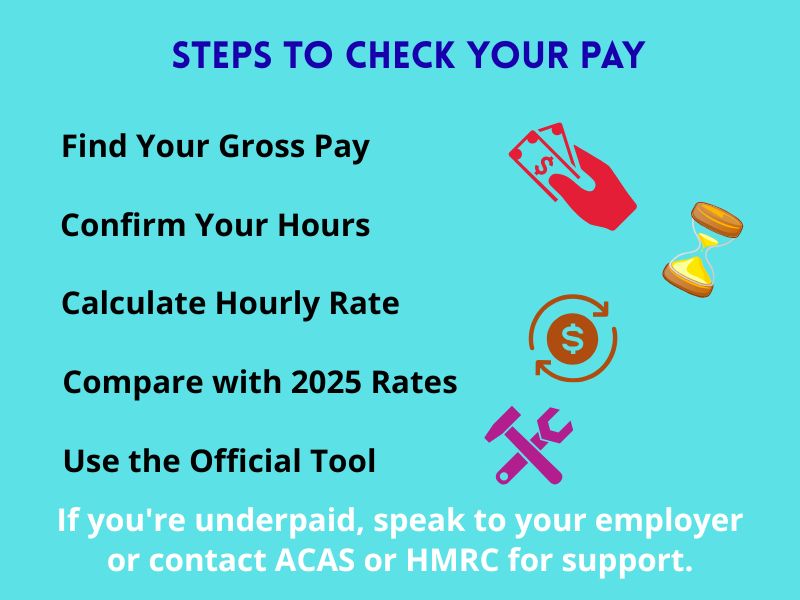
- Find Your Gross Pay: Look at your payslip for the pay period starting on or after April 1st, 2025. Find your pay before tax and National Insurance are taken off.
- Confirm Your Hours: Check the total hours you worked during that pay period (e.g., for that week or month).
- Calculate Average Hourly Rate: Divide your gross pay by the total hours worked.
- Compare with the 2025 Rate: Check if your calculated average hourly rate is equal to or more than the new national minimum wage rates 2025 or national living wage rates 2025 that apply to your age group (see the table at the start).
- Use the Official Tool: The easiest way to check is often the government’s minimum wage calculator. Search online for “check your pay gov uk” to find it.
What To Do If You Believe You’re Being Underpaid
Discovering you might be paid less than the legal minimum can be worrying. Here’s a clear process to follow:
- Speak to Your Employer: Approach your manager, payroll department, or HR first if you feel comfortable. Many underpayments are genuine errors in calculation and can be fixed quickly once highlighted. Explain calmly why you think your pay is below the minimum rate.
- Contact ACAS: If talking to your employer doesn’t resolve the issue, or you prefer not to approach them directly, contact ACAS (Advisory, Conciliation and Arbitration Service). They provide free, impartial, and confidential advice on workplace rights. They can explain your options and help mediate if needed. You can find their helpline number and website easily online.
- Report to HMRC: If necessary, you can report the underpayment confidentially to HM Revenue and Customs (HMRC). HMRC investigates minimum wage complaints and has the power to order employers to pay back any arrears owed to workers. You can find the reporting form on the gov.uk website.
Remember, it’s illegal for your employer to penalise you or treat you unfairly for raising concerns about your minimum wage pay.
The Trend of Minimum Wage Increases
The UK introduced the National Minimum Wage in 1999 to provide a basic level of pay protection. The National Living Wage came later, initially for older workers, but the age threshold has gradually reduced (now 21+). Rates have increased almost every year, particularly the NLW, reflecting government policy aimed at improving incomes for the lowest paid. The significant jump planned for April 2025 continues this long-term trend.
Key Points to Remember for 2025
- New, higher NMW and NLW rates take effect from April 1st, 2025.
- The National Living Wage (for those 21+) will be £12.21 per hour.
- Rates for younger workers (18-20, under 18) and apprentices also increase significantly.
- Check your pay after April 1st, 2025, to ensure you receive the correct new rate.
- Know the rules around working time, deductions, and accommodation offset.
- Use official resources like the gov.uk calculator and seek advice from ACAS if you have concerns.
Staying informed about these changes empowers you to understand your rights and ensure you are paid fairly according to the law.
Read more about UK Income Tax 2025-26 – What to Know Before April 2025
Frequently Asked Questions
These new rates, including the £12.21 National Living Wage (for age 21+), apply from April 1st, 2025.
Yes. Your average hourly pay must still meet the correct minimum wage rate for your age, even if you’re salaried.
You should get the NMW rate for 18-20 year olds (£10.00/hour) from April 2025, as you’re over 19 and past your first apprentice year.
No. These are gross rates before tax and National Insurance deductions. Your take-home pay will be lower.
Use the official minimum wage calculator on the gov.uk website
Source / Ref.: Gov.uk Gov.uk Contains public sector information licensed under Open Government Licence v3.0.
Written by [Ketan Borada / British Portal Team] – Founder of British Portal, dedicated to providing accurate and up-to-date information on UK public services and benefits.Related Posts



Previous Post
Next Post







- Business
 5
5 - Cricket5
- Department for Education49
- Departments3
- Driving and Transport
 53
53 - Education45
- Finance6
- Football13
- Golf3
- Government
 108
108 - Guides1
- Health
 5
5 - Health4
- International Politics9
- Law and Justice31
- Money and Tax23
- National Politics4
- News68
- Politics6
- Sports38
- Technology5
- Tennis3
- Transportation4
- Uncategorized4
- Visa
 17
17 - Visas and Immigration
 24
24 - Weather1