Vehicle categories define what types of vehicles you are allowed to drive legally. Whether you’re aiming for a lorry, bus, or minibus licence, understanding each category is crucial. Upgrading your driving licence opens new career opportunities and driving freedoms.
This guide breaks down every important detail, from C1 to D1E, to help you pass your driving test and meet all DVLA provisional requirements.
What Are Vehicle Categories on a Driving Licence?
When you hold a UK driving licence, you are only permitted to drive specific types of vehicles. These types are known as vehicle categories. Each category represents different vehicle classes, from small vans to articulated lorries and buses.
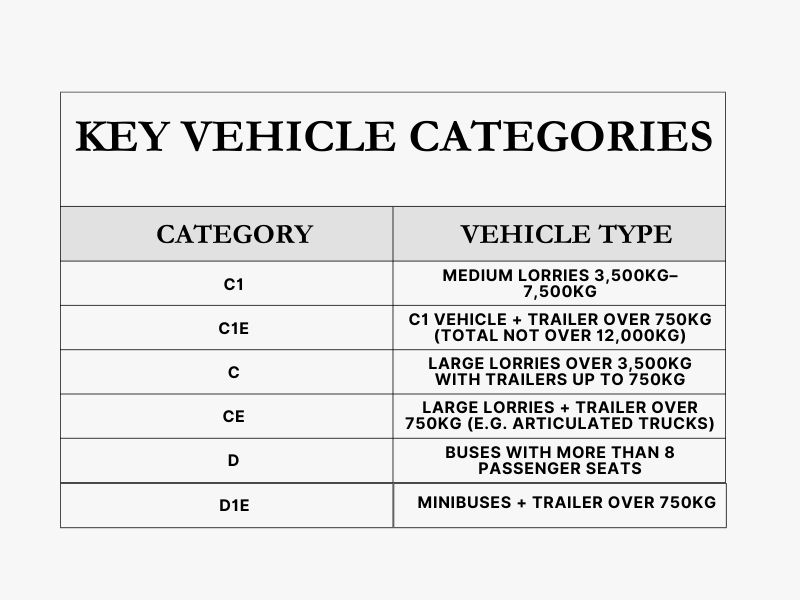
Understanding your category of vehicle is essential if you want to add new permissions. For example:
- Category C1: Medium-sized lorries weighing between 3,500kg and 7,500kg.
- Category C1E: C1 vehicles with trailers over 750kg, provided the combined weight is within 12,000kg.
- Category C: Large lorries over 3,500kg, with trailers up to 750kg.
- Category CE: Large lorries with trailers over 750kg (articulated trucks).
- Category D: Buses with more than eight passenger seats.
- Category D1E: Minibuses with trailers over 750kg.
Adding higher vehicle categories typically requires a new driving test and provisional entitlement from the DVLA. Before you can apply, you must meet medical standards, apply for a DVLA provisional licence for the new category, and pass the relevant practical tests.
How to Apply for Higher Vehicle Categories
To drive larger vehicles, you must apply for additional vehicle categories through the DVLA. The process is straightforward but requires careful steps.
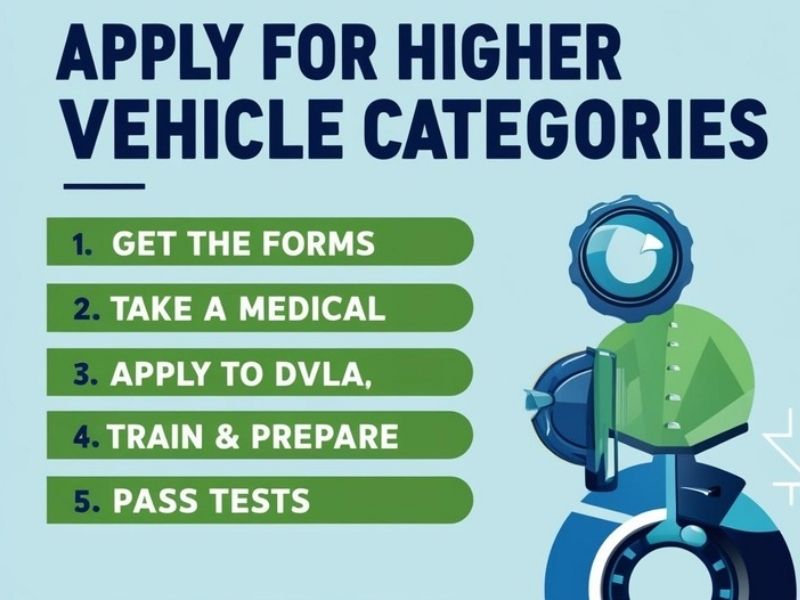
Here’s how you can apply:
- Order the correct forms: Request the D2 (application form) and D4 (medical examination report) from the DVLA.
- Pass a medical exam: A registered doctor must complete your D4 form, confirming you meet the health standards for the new category of vehicle.
- Apply for a DVLA provisional licence: Submit the D2 and D4 forms to the DVLA to gain provisional entitlement for the higher category.
- Prepare for the driving test: After receiving your provisional, you can book a specialised driving test for the new vehicle type.
- Pass the theory and practical tests: These tests assess your ability to handle larger or different vehicles safely.
Remember: If you’re upgrading to C1, C1E, C, CE, D, or DE categories, you must complete this process even if you already hold a full car licence.
Adding more vehicle categories is a valuable skill for personal use and career growth, especially in transport, logistics, and public service sectors.
Medical Requirements for Adding New Vehicle Categories
Before you can add new vehicle categories to your driving licence, you must meet strict medical standards. These checks ensure that you are fit to drive larger or passenger-carrying vehicles safely.
Here’s what you need to know:
- Medical Examination: A full medical exam is needed, especially for C1, C1E, C, CE, D, and DE applications.
- Form D4: A doctor must fill out a D4 medical form after examining you.
- Health Conditions: The DVLA will check for issues like eyesight problems, epilepsy, diabetes, and cardiovascular health.
- DVLA Assessment: If any concerns arise, the DVLA may ask for further tests before granting your DVLA provisional entitlement.
- Medical Renewal: Once you hold a new category of vehicle, you must renew your medical certification every five years after the age of 45.
Without passing the medical, you cannot progress to the next step taking your driving test for the upgraded vehicle category.
Booking Your Driving Test
Once your medical is approved and your DVLA provisional licence is updated, you can book your driving test for new vehicle categories.
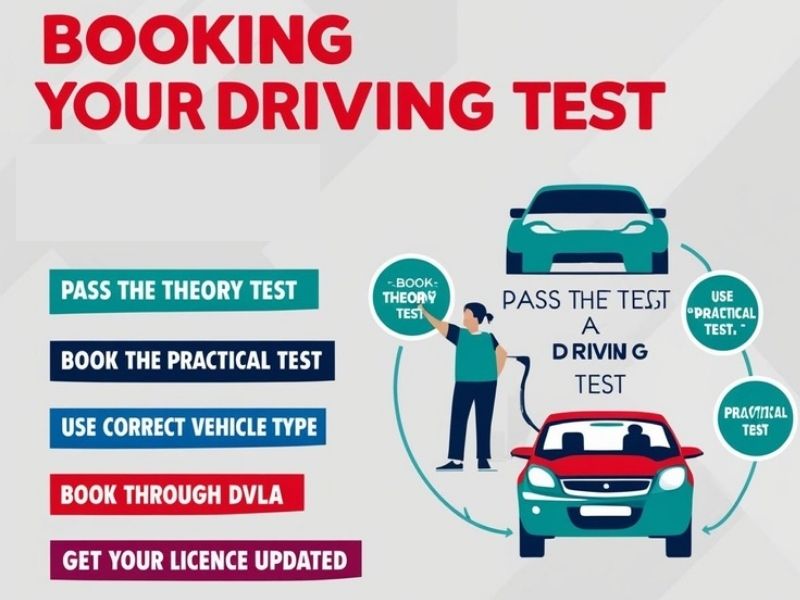
Here’s the process to follow:
- Theory Test: You must first pass a theory test specific to your chosen category of vehicle. It covers hazard perception and vehicle-specific questions.
- Practical Test: After passing the theory exam, book your practical driving test. It includes off-road exercises, safety questions, and on-road driving skills.
- Test Vehicles: You must take the test in an appropriate vehicle for the category. For example:
- C1 and C1E require medium-sized lorries.
- C and CE require large articulated lorries.
- D and DE require buses or coaches.
- Booking Portal: Use the official DVLA system or an approved training provider to book your tests.
Passing the relevant tests will officially add the new vehicle categories to your full driving licence!
Common Vehicle Categories Explained
Understanding the most common vehicle categories helps you choose the right path for your career or personal driving needs.
Here’s a breakdown:
- C1: Medium-sized lorries between 3,500kg and 7,500kg.
- C1E: C1 vehicle plus trailer over 750kg, total weight up to 12,000kg.
- C: Large lorries over 3,500kg with trailers up to 750kg.
- CE: Large articulated lorries with trailers over 750kg.
- D1: Minibuses carrying between 9 to 16 passengers.
- D1E: Minibuses with trailers over 750kg.
- D: Buses with more than 8 passenger seats.
- DE: Buses with trailers over 750kg.
Each category of vehicle demands specific skills, making the driving test tailored to the size and complexity of the vehicle.
Choosing the right vehicle categories can unlock opportunities in logistics, public transport, emergency services, and more.
Costs Involved in Adding Higher Vehicle Categories
Adding higher vehicle categories to your driving licence does come with some costs. It’s important to plan ahead so there are no surprises.
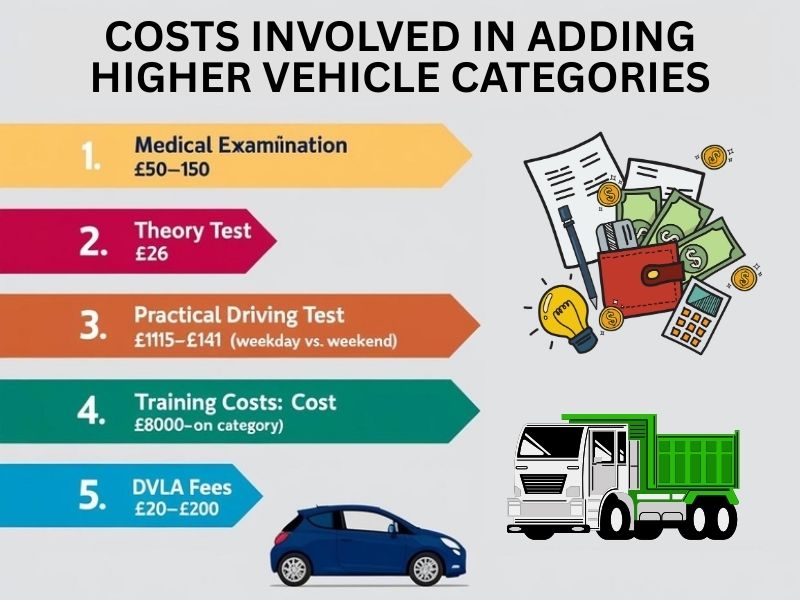
Here’s a breakdown of typical expenses:
- Medical Examination: Expect to pay between £50 to £150, depending on your doctor.
- Theory Test: Around £26 for the multiple-choice and hazard perception tests.
- Practical Driving Test: Fees range from £115 to £141 depending on when you book (weekday or weekend).
- Training Costs: If you take lessons for C1, C, D, or DE, training costs vary between £800 and £2,000.
- DVLA Fees: Applying for your DVLA provisional licence is free, but replacement or updated licences may cost £20.
While it can be a significant investment, gaining new vehicle categories often leads to better-paid driving opportunities.
Provisional Entitlements for Higher Vehicle Categories
Before taking your driving test for a higher category of vehicle, you must secure a DVLA provisional entitlement.
Here’s what happens:
- Apply Early: You should apply for provisional entitlement as soon as your medical is approved.
- Licence Update: The DVLA updates your driving licence to show provisional categories like C1, C, D, or DE.
- Conditions: You can drive larger vehicles only under supervision while holding a provisional.
- Training: You must train with a qualified instructor before attempting the practical driving test.
- Time Limit: Your provisional entitlement typically lasts until your standard licence expiry date unless revoked.
Without a valid DVLA provisional licence for the correct vehicle categories, you legally cannot practice driving the larger vehicles.
Tips for Passing Your Higher Category Driving Test
Securing new vehicle categories is exciting, but the tests can be tough without proper preparation. Here are tips to help you succeed:
- Book professional lessons: Training with qualified instructors familiar with C1, C, D, and DE vehicles are crucial.
- Understand the vehicle: Know the weight, dimensions, and special controls of your chosen category of vehicle.
- Master manoeuvres: Practice reversing, cornering, and coupling/uncoupling trailers where needed.
- Revise theory topics: Focus on load securing, braking distances, and regulations for larger vehicles.
- Use official DVLA resources: Always study from trusted materials when preparing for your driving test.
Confidence comes from practice, and mastering these skills will help you pass and add new vehicle categories to your driving licence.
Conclusion
Adding new vehicle categories to your driving licence opens up exciting opportunities, whether for personal use or a professional career. From medium-sized lorries to large buses, mastering the requirements for each category helps ensure safety on the road.
Follow the steps apply for the correct forms, pass the medical, and complete the driving test to upgrade your skills. While the process involves time, effort, and costs, it’s a valuable investment for those who want to drive bigger vehicles or pursue a career in transport.
Remember, whether you aim to drive a C1E truck or a D bus, the key to success is careful preparation. With the right training and knowledge of vehicle categories, you can obtain the driving licence that meets your needs and gives you new possibilities on the road.
Source / Ref.: Gov.uk Contains public sector information licensed under Open Government Licence v3.0.
Written by [Ketan Borada / British Portal Team] – Founder of British Portal, dedicated to providing accurate and up-to-date information on UK public services and benefits.Related Posts
Previous Post
Next Post





- Business
 5
5 - Cricket5
- Department for Education49
- Departments3
- Driving and Transport
 53
53 - Education45
- Finance6
- Football13
- Golf3
- Government
 108
108 - Guides1
- Health
 5
5 - Health4
- International Politics9
- Law and Justice31
- Money and Tax23
- National Politics4
- News68
- Politics6
- Sports38
- Technology5
- Tennis3
- Transportation4
- Uncategorized4
- Visa
 17
17 - Visas and Immigration
 24
24 - Weather1