Pickleball in the UK is turning heads as it rapidly climbs the ranks of popular sports. Once a niche activity, this paddle-based game is now drawing players from tennis, badminton, and even newcomers who never considered competitive sport before.
With simple rules, social appeal, and low physical strain, pickleball offers a fresh, accessible option for people of all ages. From local parks to national championships, interest is soaring.
So, what is pickleball, and why is it becoming the fastest-growing game in Britain?
Pickleball’s Rapid Growth in the UK
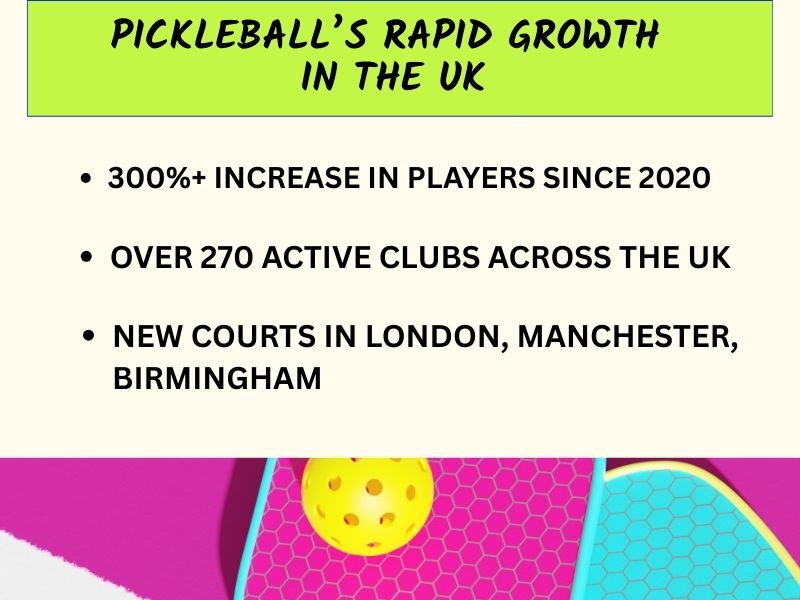
The numbers don’t lie pickleball UK participation has exploded in recent years. According to Pickleball England, the number of active players has more than tripled since 2020. There are now over 270 clubs and thousands of members playing regularly.
In just three years:
- Player growth has exceeded 300%
- Club numbers have more than doubled
- New pickleball courts are being built across cities like London, Manchester, and Birmingham
Much like the game of padel, which found its footing across Europe, pickleball is benefiting from word-of-mouth, community spirit, and easy-to-learn gameplay.
Comparatively, while tennis and badminton remain strong, pickleball’s appeal lies in its modern take on traditional racket sports. With players using lightweight pickleball paddles, smaller courts, and slower balls, the game is both strategic and forgiving.
Key Metrics and Numbers
The rise of pickleball in the UK isn’t just buzz it’s backed by strong numbers. In 2024, Pickleball England reported over 12,000 registered members, with unofficial estimates suggesting 30,000+ regular players nationwide. That’s a sharp climb from under 5,000 players just a few years ago.
Key stats include:
- 270+ active clubs listed on Pickleball England’s directory
- Over 600 indoor and outdoor pickleball courts across the UK
- 200+ events and tournaments hosted in 2023 alone
Interestingly, this growth mirrors the path of the sport padel, which also saw exponential expansion driven by social play and accessible infrastructure.
Breakdown of Players by Age Group:
| Age Group | % of Players |
| Under 25 | 18% |
| 25-45 | 28% |
| 46-65 | 36% |
| Over 65 | 18% |
Pickleball UK participation is evenly spread, reflecting its inclusive appeal. Unlike tennis sport, which can be dominated by younger athletes, pickleball welcomes all generations.
And what about gear?
Pickleball paddles are now widely available at major UK retailers – many of which report increasing demand month-on-month. Searches for “what is pickleball” and “how to play pickleball” have surged on Google UK, signalling not just curiosity, but intent.
Reasons for Popularity and Growth
The surge in pickleball in the UK isn’t a fluke it’s driven by a perfect storm of factors. From lifestyle shifts to smart promotion, here’s why this paddle sport is thriving.
1. Accessibility
Unlike tennis or the game of padel, pickleball is easy to pick up. It’s played on a smaller pickleball court, with lighter pickleball paddles, and slower balls. This means beginners can jump in without lessons, while advanced players still find it strategic.
You don’t need elite fitness or pricey gear to get started, making it more inviting than many traditional sports.
2. Fun and Community
One of the biggest draws of pickleball UK clubs is their social atmosphere. Games are fast-paced, doubles are popular, and you’ll often see mixed ages playing together.
It feels less competitive than badminton or tennis sport, and more focused on fun and connection. Post-game chats are just as important as the match.
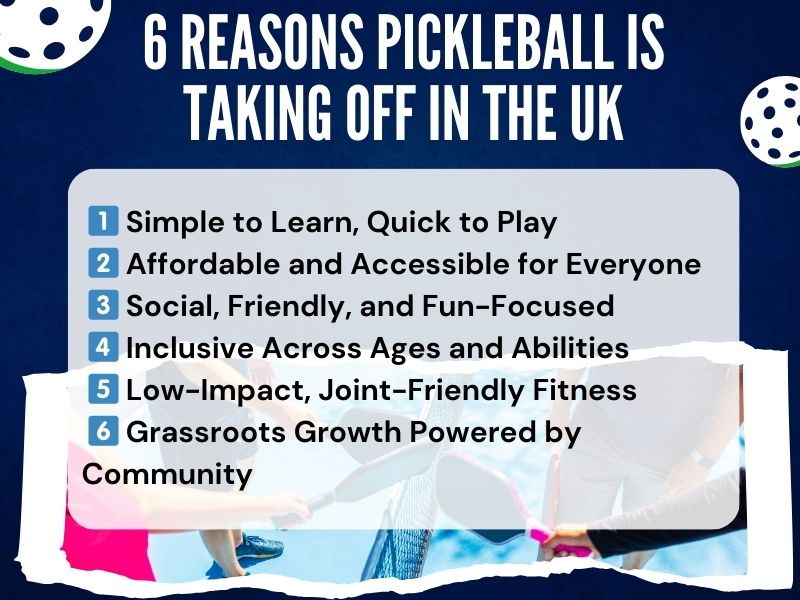
3. Inclusivity
The sport doesn’t discriminate by age, fitness level, or background. Many players in their 60s and 70s are thriving on the court alongside twenty-somethings.
This level of inclusiveness, much like with padel, has made pickleball a rare unifier across generations.
4. Low-Impact Nature
Unlike tennis, pickleball puts less strain on the knees, hips, and shoulders. The game is played at a gentler pace, but still offers a cardio workout.
This is especially appealing to people with joint issues or those recovering from injuries—who want to stay active but avoid intense strain.
5. Organic Growth
What’s unique is how pickleball in the UK has grown without flashy marketing. Most clubs spread the word through local demos, taster sessions, and personal invites.
Pickleball England has supported this by offering free resources, club starter kits, and a directory to find your nearest court.
Demographics and Player Stories
One reason pickleball in the UK is thriving lies in its incredibly diverse player base. Whether you’re 18 or 80, the sport speaks to everyone. And it’s not just numbers—it’s the people and their stories that really show what makes pickleball UK unique.
Who’s Playing?
While the average age globally is around 38, UK participation skews slightly older – especially among new players. Many are:
- Retired or semi-retired adults staying active
- Ex-tennis and badminton players looking for a less intense alternative
- Young professionals discovering the sport through social clubs
- Families and couples enjoying shared court time
Real Player Stories
Margaret, 72, from Surrey, picked up the paddle after her walking group introduced her to a local session. “I hadn’t played a sport in decades. Now I play three times a week,” she says.
Jake and Zoe, 28 and 27, from Manchester, found pickleball on TikTok. “We bought pickleball paddles online, tried it once, and were instantly hooked. We’ve made a bunch of new friends through our club.”
Then there’s Ali, 45, from Birmingham, a former tennis sport player who switched to pickleball after a knee injury. “It saved my love for racket sports,” he explains. “Less pain, more fun.”
These stories are echoed across clubs, courts, and communities – cementing pickleball as more than just a sport. It’s a social lifeline, a fitness gateway, and a passion.
How Pickleball in the UK Compares Internationally
Though pickleball in the UK is growing fast, it’s still playing catch-up to the global scene. In countries like the United States, Canada, and Spain, the sport is already a staple, with massive tournaments, televised finals, and pro sponsorships.
How the UK Compares
- USA: Over 4.8 million players, with hundreds of professional athletes
- Spain: Riding the wave alongside the game of padel, integrating both sports in clubs
- UK: Now pushing past 30,000 regular players, but in early development stages
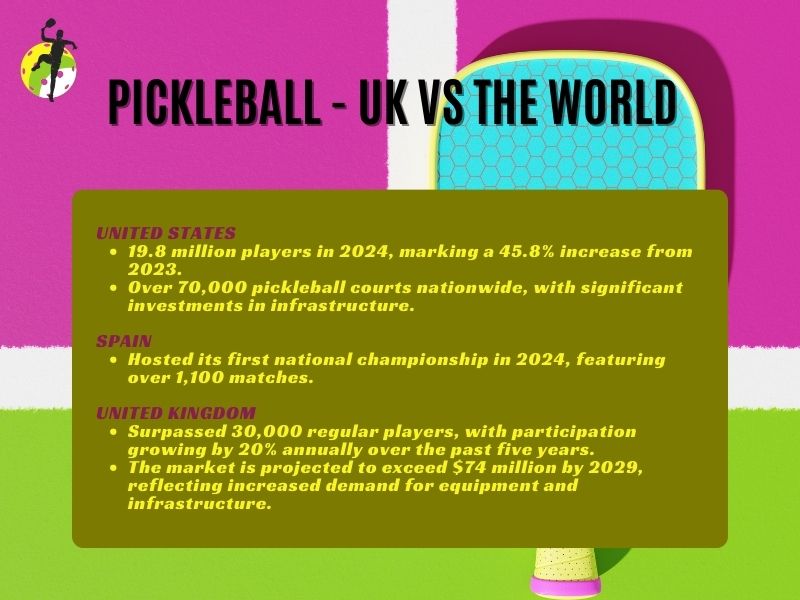
While the US has well-funded leagues and national bodies, Pickleball England is still building out infrastructure and competitive frameworks. However, UK players are already making waves in European championships, showing that talent is not in short supply.
The UK’s edge?
A tight-knit community and a fast-learning curve. Pickleball UK athletes are absorbing best practices quickly, training smart, and fostering grassroots talent that could soon rival international counterparts.
There’s also increasing crossover between pickleball, padel, and tennis players, with clubs offering all three sports under one roof.
Infrastructure and Where to Play
The backbone of pickleball in the UK is its expanding infrastructure. Thanks to increasing demand, more clubs and venues are adapting to this dynamic sport. While once limited to a few leisure centres, today you can find pickleball courts in cities, towns, and even converted village halls.
Where You Can Play
- Dedicated clubs: Locations like Pickleball London and Manchester Pickleball Club now offer daily sessions.
- Community centres: Many multi-sport halls are taping out temporary courts to host weekly games.
- Tennis clubs: Several clubs are repainting or dual-lining their courts to accommodate pickleball UK players.
- Leisure complexes: With the popularity of badminton and tennis sport, these centres are adapting existing spaces to cater to this fast-growing community.
You can find your nearest venue via the Pickleball England website, which lists over 270 locations.
Equipment and Court Design
A pickleball court is smaller than a tennis court – 20×44 feet making it easier to set up indoors or outdoors. The net is lower, and players use lightweight pickleball paddles and plastic perforated balls.
As more players buy personal paddles and portable nets, casual games are popping up in parks, driveways, and school gyms.
Though not quite at the level of sport padel, which now has commercial centres popping up across London, pickleball is clearly heading in that direction with dedicated venues under construction in cities like Leeds and Birmingham.
Competitive Scene and Future Outlook for Pickleball in the UK
As pickleball in the UK matures, the competitive scene is beginning to take shape. While still grassroots in nature, national tournaments and ranking systems are becoming more structured – thanks in large part to Pickleball England.
Tournaments and Leagues
- National Championships: Held annually with growing attendance and sponsorship
- Local leagues: Regions like Kent, Greater Manchester, and the Midlands now have inter-club play
- International representation: UK players are now competing in European Opens and eyeing spots in global events
These competitions bring together players of all ages, from enthusiastic amateurs to ex-tennis and badminton athletes. The friendly, accessible nature of pickleball makes it ideal for inclusive events where fun is valued as much as performance.
The Road Ahead
The future looks bright. Here’s what’s on the horizon for pickleball UK:
- School and university integration: Introducing the sport to younger players
- Corporate partnerships: Similar to those seen in sport padel and traditional racket sports
- Purpose-built venues: More investment into indoor and outdoor dedicated pickleball courts
- Media coverage: With growing attention online and features in UK sport publications
As momentum builds, there’s potential for pickleball in the UK to rival or even surpass early growth patterns seen in the US.
The Spirit of the Game
At its heart, pickleball in the UK thrives not just on rallies or rankings but on the shared values that define it. It’s a game built on sportsmanship, fun, and community.
Why People Stick with It
Even players who once devoted years to tennis, badminton, or even the game of padel often say they find something special in pickleball. There’s a relaxed atmosphere, frequent laughter during games, and a culture of helping new players get up to speed.
That inclusive, “everyone belongs” mentality is part of what makes pickleball UK such a positive space.
The Culture on Court
- Players often call their own faults
- Newcomers are welcomed, not sidelined
- Games end with paddles tapped at the net in mutual respect
- Competitive intensity is balanced with light-hearted fun
Whether at a national tournament or a casual Saturday session, the same principles apply respect, fairness, and enjoyment above all.
That’s why so many stick with it. For some, it’s a social activity. For others, a way to stay fit. And for many, it’s become a lifestyle.
Conclusion – Pickleball in the UK is Here to Stay
Pickleball in the UK has transformed from a niche hobby to a national movement and it’s only gaining speed. With new pickleball courts opening, fresh faces joining daily, and a strong community led by Pickleball England, the sport is fast becoming a fixture in Britain’s athletic landscape.
Its rise is powered by accessibility, inclusivity, and fun not to mention the welcoming spirit that sets it apart from traditional sports like tennis, badminton, or even the game of padel.
Whether you’re 16 or 60, a lifelong athlete or a curious beginner, pickleball UK has a paddle ready for you.
So, if you’ve ever asked yourself “What is pickleball?”, the best way to find out is to pick up a paddle and play. Chances are, you’ll be hooked from the first serve.
FAQs
Pickleball is a fun, fast-paced paddle sport combining elements of tennis, badminton, and table tennis.
Pickleball is played on a smaller court with paddles and a perforated ball, aiming to score by making the ball land in the opponent’s court.
Yes, pickleball is easy to learn and suitable for players of all skill levels.
You can find pickleball courts at community centres, sports clubs, and leisure complexes across the UK.
Yes, you’ll need a pickleball paddle and ball, but the sport requires minimal gear compared to tennis or badminton.
Yes, pickleball is gentle on the joints and offers a great workout without the intensity of other racket sports.
Related Posts



Previous Post
Next Post







- Business
 5
5 - Cricket5
- Department for Education49
- Departments3
- Driving and Transport
 53
53 - Education45
- Finance6
- Football13
- Golf3
- Government
 108
108 - Guides1
- Health
 5
5 - Health4
- International Politics9
- Law and Justice31
- Money and Tax23
- National Politics4
- News68
- Politics6
- Sports38
- Technology5
- Tennis3
- Transportation4
- Uncategorized4
- Visa
 17
17 - Visas and Immigration
 24
24 - Weather1