When a child receives money awarded by a court, perhaps from an injury claim or inheritance, special steps are taken to protect it. Often, this means the money is held securely until the child reaches adulthood. If you look after the child’s interests during the legal case, you might be appointed their “Litigation Friend.” Your responsibilities don’t stop when the court case ends; they change. A key part of your continuing role can involve managing the funds held for the child. This often involves interacting with the Court Funds Office (CFO).
What is a Court Funds Office Account?
So, what is a Court Funds Office account? Put simply, it’s a secure place managed by the government (part of the Ministry of Justice) where money awarded to children by courts in England and Wales is held. The main reason for this is protection. It ensures the money is kept safe and managed responsibly until the child is legally an adult, usually at age 18. This prevents the money from being spent inappropriately and aims to preserve it for the child’s future benefit.
This specific type of account is often called a child court funds office account. It operates under specific rules designed to safeguard the young person’s financial award.
Different Account Types and Interest
The money held by the CFO is usually placed into one of two main types of accounts:
- Special Account: This is the most common type for children’s funds. It pays interest, although the rate can change. Think of it like a standard savings account, aiming to provide some growth while keeping the money safe. If you need to know the specific interest rate, you should look for the official court funds office interest rate information, which is published and updated periodically. The court funds office special account is designed for long-term security.
- Basic Account: This account pays a lower rate of interest, often similar to standard bank deposit rates. It’s generally considered very low risk.
In some specific situations, often involving larger sums and requiring a specific court order, funds might be placed in an investment account like the Equity Index Tracker Fund. This offers the potential for higher growth but also carries investment risk, meaning the value could fall. This option is less common and requires careful consideration and court approval.
It’s also worth noting that interest earned on CFO accounts may be liable for tax, depending on the child’s total income for the tax year.
Your Role as Litigation Friend: After the Court Case
You might have been appointed Litigation Friend primarily to handle the court proceedings. Once the case concludes and the money is paid to the CFO, your role shifts towards overseeing these funds. Your fundamental duty remains the same: to act in the child’s best interests.
Managing the court funds office account for child responsibilities typically includes:
- Understanding the Account: Knowing roughly how much is held and the type of account.
- Applying for Funds (If Necessary): Making applications to access some of the money before the child turns 18, but only for justifiable reasons directly benefiting the child.
- Record Keeping: Keeping track of any applications made and money received.
- Keeping Information Updated: Informing the CFO if your contact details change.
Accessing Funds Before the Child Turns 18
Life brings unexpected needs, and sometimes the child may require access to some of their funds before they turn 18. This is possible, but there’s a strict process designed to protect the main fund.
You cannot simply withdraw money whenever you wish. Accessing funds early requires demonstrating a clear need that directly benefits the child, often related to their health, education, or welfare needs arising from the circumstances of the original award.
The process usually involves two key steps:
- Getting a Court Order: You first need to apply back to the court that originally handled the case (or the relevant local court). You must explain exactly why the money is needed, how much is required, and provide evidence (like quotes for equipment, invoices for therapy, details of educational costs). The judge will decide if releasing the funds is genuinely in the child’s best interests.
- Applying to the CFO: Only after you have a sealed court order approving the payment can you make the formal application for payment out of the court funds office. This is usually done using a specific form, often Form CFO 200. You will need to send this completed form, along with the sealed court order, to the Court Funds Office.
Examples of potential reasons for early access (subject to court approval):
- Specialist equipment is needed due to an injury.
- Modifications to the home to accommodate a disability.
- Specific educational support or tuition fees.
- Therapy or treatment costs are not covered by the NHS.
Remember, the court’s priority is preserving the bulk of the fund for the child’s adulthood. Requests for everyday expenses or items not directly related to the child’s specific needs are unlikely to be approved.
How to Get Money from the Court Funds Office: The Process
So, how to get money from the court funds office before the child is 18? As outlined above, it hinges on getting that court order first.
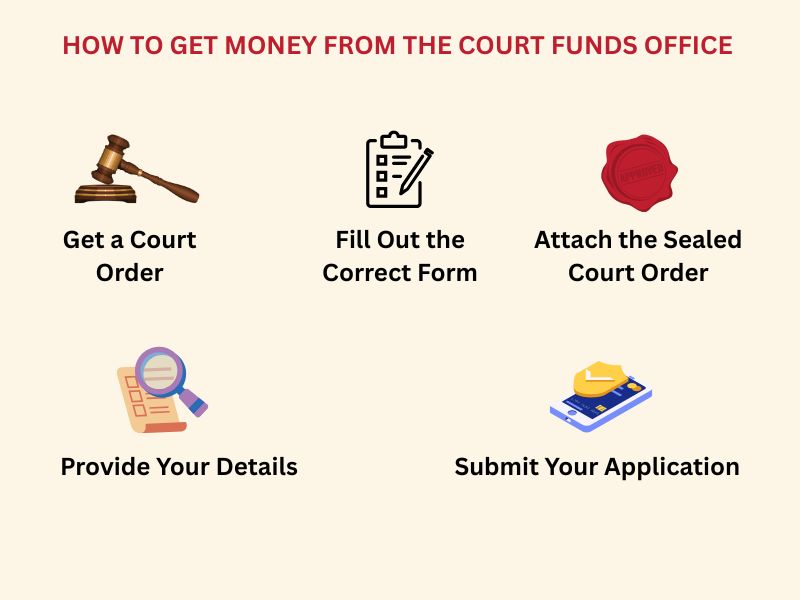
Once you have the order:
- Complete the Correct Form: This is likely Form CFO 200, often referred to implicitly as the court funds office payment request form for these situations. Ensure all details are accurate.
- Attach the Sealed Court Order: This is essential proof that the payment is authorised.
- Provide Your Details: Ensure the CFO knows who you are and how to contact you.
- Submit to the CFO: Send the completed form and order to the Court Funds Office address (check the official GOV.UK website for the current address).
Processing times can vary, so it’s wise to apply well in advance of when the funds are needed.
Best Practices for Litigation Friends Managing CFO Accounts
- Keep Good Records: Maintain a simple file. Keep copies of any court orders authorising payments, copies of application forms sent to the CFO, and statements or letters received from the CFO. If you receive funds, keep receipts showing how the money was spent for the child’s benefit. This protects both you and the child.
- Inform the CFO of Changes: If you move house or change your name, you must inform the Court Funds Office using the correct procedure (often Form CFO 100) so they can maintain contact.
- Review Periodically: Check the official court funds office interest rate annually to understand how the fund might be growing. If you receive statements, review them.
What Happens When the Child Turns 18?
The situation changes significantly when the child reaches the age of majority (usually 18 in England and Wales). At this point, they are entitled to take control of their funds. The process for the court funds office turning 18 is relatively straightforward:
- The Young Person Applies: The responsibility shifts from you (the Litigation Friend) to the young person.
- Proof of Identity: They will need to provide proof of their identity (like a passport or driving licence) and their National Insurance number.
- Bank Details: They need to provide details of the UK bank account where they want the funds transferred.
- Submission: They send the completed form and required ID copies to the Court Funds Office.
Your role here is supportive, helping them understand the process and gather the necessary documents. Once the CFO verifies everything, the funds will be transferred directly to the young person’s bank account, and the CFO’s account will be closed.
What if the young person lacks capacity at 18? If, sadly, the young person is unable to manage their financial affairs when they turn 18 due to a mental impairment, the standard process won’t apply. In these circumstances, someone (potentially you) would usually need to apply to the Court of Protection to be appointed as a ‘Deputy’ to manage their finances going forward. This is a separate legal process.
Finding Official Information
While this overview provides practical context, always refer to the official sources for definitive procedures, forms, and contact details. The primary source is the GOV.UK website. Searching there for “Court Funds Office children” will lead you to the latest official court funds office guidance. The CFO also produces helpful guides like the CFO 403 leaflet.
Key Takeaways for Litigation Friends
Looking after a child’s court funds office account as a Litigation Friend is a big responsibility. Always focus on what is best for the child. Key tasks include knowing how to access money if needed, keeping clear records, and guiding the young person when they turn 18. By doing these things carefully, you help protect the child’s money for their future. The CFO system is set up to keep this money safe. You can handle your duties well with careful attention.
Read more about Role of a Litigation Friend in UK Courts
Frequently Asked Questions
Getting money before 18 takes time. First, you need a court order. Then, you send the right form and the order to the CFO. Processing can take several weeks, so plan.
No. The money must benefit the child directly, often for specific needs like health or education. If applying before age 18, the court must approve the reason first.
You might not get statements often like a bank. You can ask the CFO for one. It’s vital to keep clear records of any money requested or received.
Yes, the money is very secure. The Court Funds Office is part of the UK government, and the funds are well-protected.
No. When the child turns 18, they must apply themselves using Form CFO 203. They’ll need their own ID and bank details. Your role is to help guide them.
Source / Ref.: Gov.uk Contains public sector information licensed under Open Government Licence v3.0.
Written by [Ketan Borada / British Portal Team] – Founder of British Portal, dedicated to providing accurate and up-to-date information on UK public services and benefits.Related Posts



Previous Post
Next Post





- Business
 5
5 - Cricket5
- Department for Education49
- Departments3
- Driving and Transport
 53
53 - Education45
- Finance6
- Football13
- Golf3
- Government
 108
108 - Guides1
- Health
 5
5 - Health4
- International Politics9
- Law and Justice31
- Money and Tax23
- National Politics4
- News68
- Politics6
- Sports38
- Technology5
- Tennis3
- Transportation4
- Uncategorized4
- Visa
 17
17 - Visas and Immigration
 24
24 - Weather1