Forced marriage is a serious issue affecting people across the UK. It happens when someone faces pressure, threats, or abuse to marry against their will. This is not about culture or tradition; it’s about a fundamental lack of consent and is a violation of human rights.
Crucially, forced marriage is illegal in the UK. No one should be forced to marry someone they do not want to marry. This applies whether the pressure comes from family, the community, or anyone else.
What is the Difference Between Arranged Marriage and Forced Marriage?
It’s vital to understand the distinction here, as the terms are often confused.
- Arranged Marriage: In an arranged marriage, families might introduce potential partners, but both individuals have the free choice to decide if and when they want to marry. They give their full and free consent. Arranged marriages are common in many cultures and are perfectly legal.
- Forced Marriage: In a forced marriage, one or both people do not consent to the marriage. They may be pressured through emotional blackmail, threats, physical violence, or other forms of coercion. Sometimes, they might lack the mental capacity to consent (for example, due to learning difficulties). If there is no free choice, it is a forced marriage.
Why Does Forced Marriage Happen?
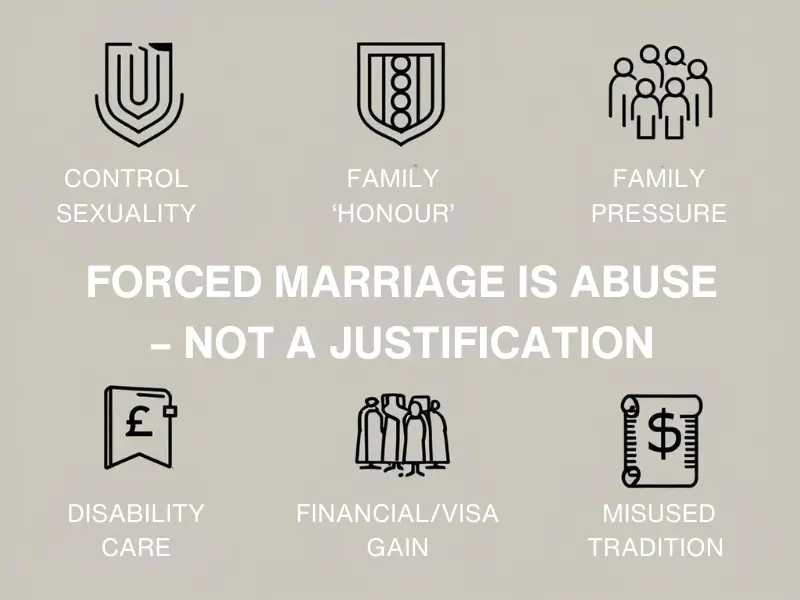
The reasons behind forced marriage are complex and varied. It is never acceptable, but understanding the motivations can help recognise the signs. Some reasons perpetrators give include:
- Controlling unwanted behaviour or sexuality (including LGBTQ+ individuals).
- Responding to perceived ‘shame’ or upholding family ‘honour’.
- Dealing with family disputes or pressure from relatives.
- Believing it provides care for someone with disabilities.
- Securing financial gain or visas.
- Cultural or traditional expectations misused to justify coercion.
It’s important to remember these are reasons given, not valid justifications. Forced marriage is abuse.
Who Does Forced Marriage Affect?
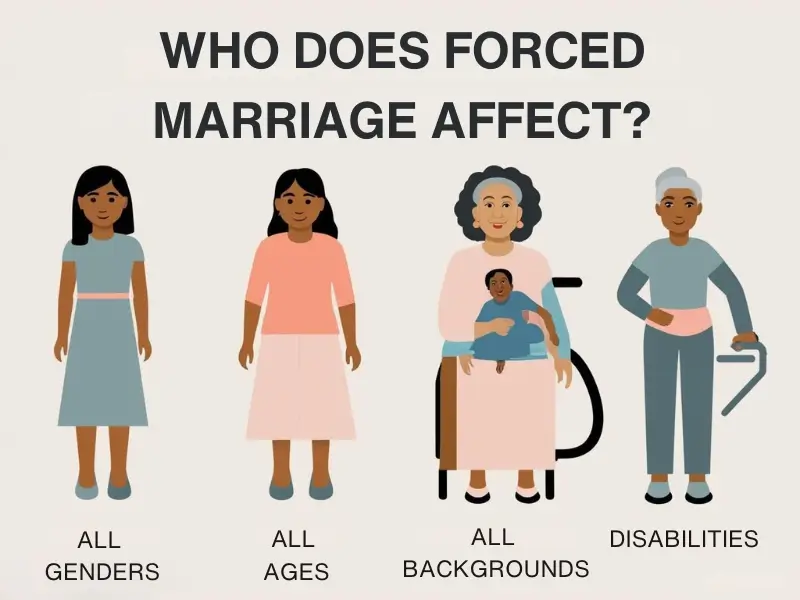
Forced marriage is not confined to one community, gender, or age group. It can affect:
- Men, women, and children.
- People from various national, ethnic, and religious backgrounds.
- Individuals with disabilities or learning difficulties, who may be particularly vulnerable to exploitation (as sadly seen in some UK court cases).
- Members of the LGBTQ+ community may be forced into heterosexual marriages.
Is Forced Marriage Illegal in the UK?
Yes, absolutely. Forcing someone to marry against their will is a serious crime.
- Criminal Law: The Anti-social Behaviour, Crime and Policing Act 2014 made it a specific criminal offence in England and Wales to force someone into marriage. This applies even if the forcing happens outside the UK but involves a UK national or resident. Conviction can lead to significant prison sentences. Breaking a Forced Marriage Protection Order (see below) is also a criminal offence. Similar laws exist in Scotland and Northern Ireland.
- Civil Law: Even before the 2014 Act, protections were available. The Forced Marriage Act 2007 introduced civil orders to protect people.
Protecting Individuals: The Forced Marriage Protection Order (FMPO)
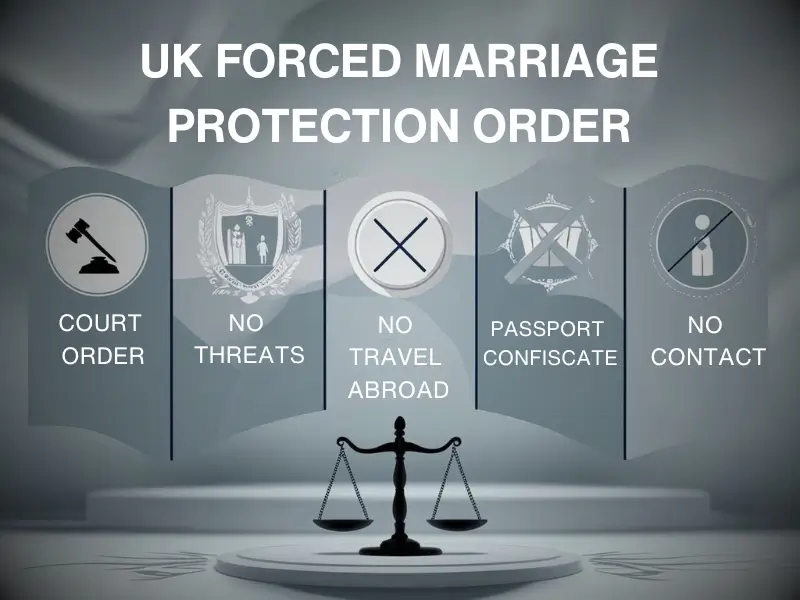
A key tool for safeguarding is the Forced Marriage Protection Order (FMPO). This is a civil court order designed to protect a person who is being forced into marriage or is already in a forced marriage.
- What is it? An FMPO is issued by a court and contains legally binding instructions to stop actions that could lead to a forced marriage.
- Who can apply?
- The person at risk.
- A ‘relevant third party’ (like the police or a local authority) can apply on their behalf.
- Someone else granted permission by the court (e.g., a friend, family member, or support worker).
- What can it do? Orders are tailored to the individual’s situation and can include terms like:
- Stopping intimidation, threats, or violence.
- Preventing someone from being taken abroad for marriage.
- Ordering the return of a passport.
- Stopping contact with certain individuals.
- Requiring someone to reveal the whereabouts of a person.
- What happens if it’s breached? Breaching an FMPO is serious. It can be treated as contempt of court (leading to fines or imprisonment) and is also a criminal offence carrying a potential prison sentence of up to five years. This shows these orders have real legal power.
Getting legal advice is important if considering an FMPO; legal aid may be available.
Recognising the Warning Signs
It can be hard to know if someone is at risk. Some signs might include:
- A person becomes withdrawn, depressed, or anxious.
- Sudden announcement of an engagement without the person seeming happy.
- Being taken out of school or college, or having education restricted.
- Restrictions on movement, communication (phone/internet taken away), or social life.
- Evidence of family disputes, domestic abuse, or talk of ‘honour’.
- Someone expressing fear about an upcoming family holiday abroad, particularly to a country known for forced marriage risk.
- Confiscation of passport or travel documents.
- Surveillance by family members.
If you notice several signs, it’s crucial to reach out for advice.
The Impact on Individuals
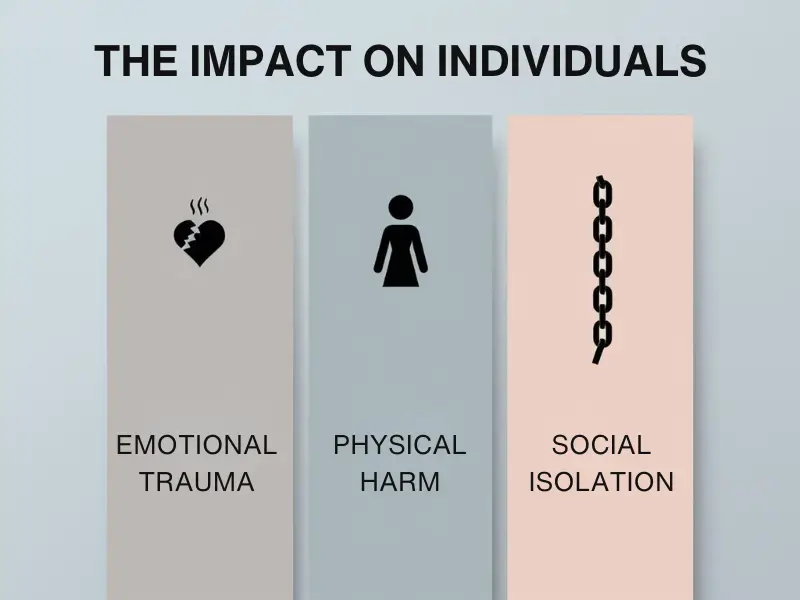
Being forced into marriage is deeply traumatic. The effects can be devastating and long-lasting:
- Emotional & Psychological: Fear, anxiety, depression, low self-esteem, isolation, loss of trust, suicidal thoughts.
- Physical: Potential for physical and sexual abuse within the marriage, neglect.
- Social: Loss of education and career opportunities, disconnection from friends and support networks, and loss of freedom and autonomy.
Where to Find Help and Support in the UK
If you or someone you know is facing forced marriage, please know that help is available. You are not alone, and support exists.
- Immediate Danger:
- If you or someone else is in immediate danger, call 999. The police can provide immediate protection.
- Specialist Government Support: The Forced Marriage Unit (FMU)
- The Forced Marriage Unit is a dedicated joint Foreign, Commonwealth & Development Office and Home Office unit offering confidential advice and support to victims and concerned professionals.
- They can help people in the UK and British nationals overseas.
- They provide safety advice, can explain options like FMPOs, and can assist with repatriation if someone has been taken abroad.
- Contact the FMU:
- Phone (UK): 020 7008 0151 (Monday to Friday, 9 am to 5 pm)
- Phone (Out of hours): 020 7008 5000 (ask for the Global Response Centre)
- Email: fmu@fcdo.gov.uk
- Website: Search “Forced Marriage Unit GOV.UK”
- Police Involvement:
- You can report forced marriage to the police by calling 101 (non-emergency) or visiting a station. Many forces have specially trained officers to handle these sensitive cases confidentially.
- The police can investigate the criminal offence, help ensure safety, and assist in applying for an FMPO.
- Confidential Support Helplines:
- Several charities offer a dedicated forced marriage helpline in the UK and wider support. They provide confidential advice, emotional support, and guidance on options.
How We Can Help Stop Forced Marriage
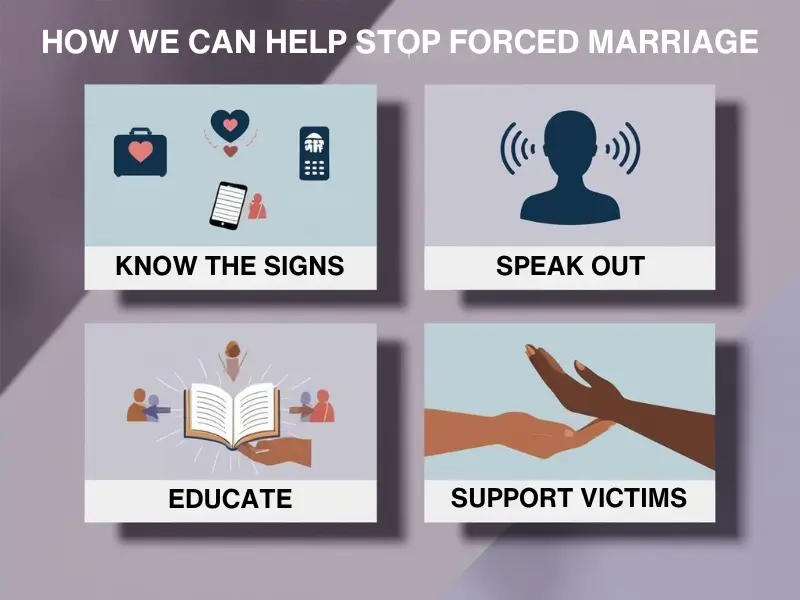
Preventing forced marriage requires awareness and action.
- Know the signs: Be aware of the warning signs listed above.
- Speak out: If you are worried about someone, report your concerns confidentially to the FMU, police, or a support charity. Your call could save someone.
- Educate: Share information about the difference between arranged and forced marriage and the illegality of forcing someone to marry.
- Support Victims: Listen without judgment and signpost them to professional help.
The Scale of the Issue in the UK
While precise numbers are hard to capture due to the hidden nature of the crime, forced marriage statistics in the UK released by the FMU show that they give advice or support in hundreds of cases each year. These figures only represent reported cases, meaning the true scale of forced marriage in the UK is likely much higher. The cases involve diverse communities and highlight that this remains an ongoing challenge.
Your Right to Choose
Everyone has the right to choose whether, when, and whom they marry. Consent must be complete, free, and informed. Forced marriage steals that right and causes immense harm.
If you are facing pressure to marry against your will, or if you are worried about someone else, please reach out. Confidential help and legal protection are available in the UK. Taking that first step to contact the Forced Marriage Unit, the police, or a specialist charity can make all the difference. Remember, you have the right to be safe and to make your own choices about your future.
Read more about Understanding Domestic Abuse Injunctions in the UK
Source / Ref.: Gov.uk Met.police.uk Contains public sector information licensed under Open Government Licence v3.0.
Written by [Ketan Borada / British Portal Team] – Founder of British Portal, dedicated to providing accurate and up-to-date information on UK public services and benefits.Related Posts
Previous Post
Next Post




- Business
 5
5 - Cricket5
- Department for Education49
- Departments3
- Driving and Transport
 53
53 - Education45
- Finance6
- Football13
- Golf3
- Government
 108
108 - Guides1
- Health4
- Health
 5
5 - International Politics9
- Law and Justice31
- Money and Tax23
- National Politics4
- News68
- Politics6
- Sports38
- Technology5
- Tennis3
- Transportation4
- Uncategorized4
- Visa
 17
17 - Visas and Immigration
 24
24 - Weather1