
Being the victim of a violent crime is a difficult and often traumatic experience. Beyond the emotional and physical impact, there can be financial strains, too. If you’ve been injured because of violent crime in England, Scotland, or Wales, there is a government-funded scheme designed to help.
This scheme provides a way to receive financial recognition for the injuries and impact you’ve suffered. It’s not about blame in the way a court case is; it’s about acknowledging what happened to you as a blameless victim.
What is the Criminal Injuries Compensation Scheme?
The Criminal Injuries Compensation Scheme is the formal name for the system set up by the government. Its main purpose is to provide compensation – a sum of money – to people who have been physically or mentally injured because they were the victim of a violent crime.
Think of it as an official acknowledgement of the harm caused. It’s funded by the taxpayer and aims to help victims cope with the consequences of the crime committed against them. This scheme is separate from any money a court might order an offender to pay, which often doesn’t happen or isn’t enough.
Who Decides on Compensation Claims?
The organisation responsible for running this scheme and making decisions on claims is the Criminal Injuries Compensation Authority, usually known simply as CICA.
CICA looks at each application individually based on the rules set out in the official Scheme document. Their job is to assess if you meet the criteria and, if so, how much compensation you should receive based on your injuries and circumstances. They are the official body you (or someone helping you) will deal with when making a claim.
Are You Eligible? Key Things CICA Looks At
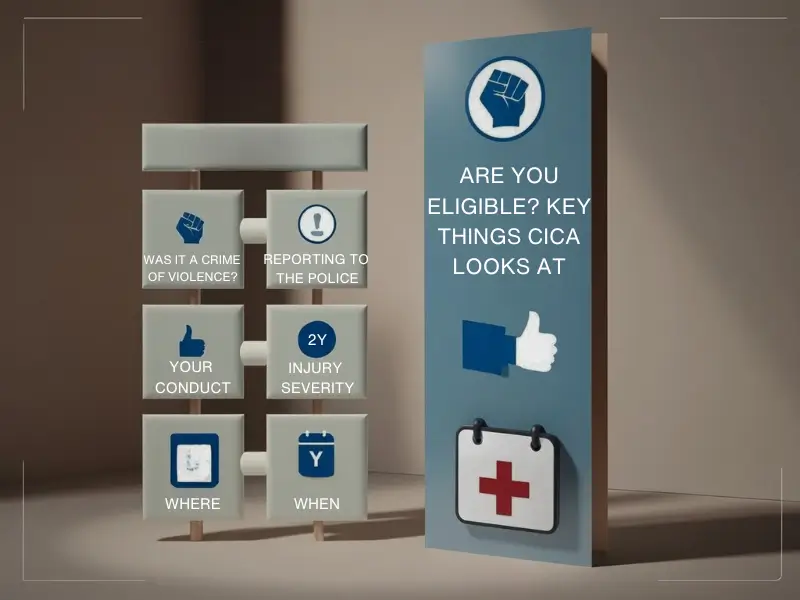
Understanding criminal injuries compensation eligibility is the first crucial step. CICA has specific rules they must follow. While every case is unique, here are the main points they consider:
- Was it a Crime of Violence? The scheme covers injuries caused directly by a violent crime. This includes things like assault, robbery, domestic violence, sexual assault, arson, and injuries caused trying to stop a crime or help the police. It generally doesn’t cover things like theft or property damage unless violence is involved.
- Where and When Did It Happen? The crime must have happened in England, Scotland, or Wales (Great Britain). Northern Ireland has its separate scheme.
- Reporting to the Police: This is very important. You must report the crime to the police as soon as reasonably possible. CICA understands this can be difficult, especially for certain types of crime, but delays need a very good reason. Cooperation with the police investigation is also usually required.
- Time Limit for Applying: You usually have two years from the date of the incident to apply to CICA. There are exceptions for historical abuse that wasn’t reported until later or for those under 18 at the time, but sticking to the two-year limit is safest if possible. Always apply as soon as you feel able.
- Your Conduct: CICA will look at whether your behaviour before, during, or after the incident played a part. They also consider your criminal record, specifically unspent convictions. These factors can sometimes lead to a reduced award or refusal. The aim is to compensate “blameless victims.”
- Injury Severity: The scheme uses a set ‘tariff’ of injuries. Your injury (or injuries) must normally be serious enough to qualify for at least the minimum award level, which is currently £1,000, according to CICA’s assessment. This doesn’t mean your injury only cost £1,000; it refers to how CICA values it under the scheme rules.
Meeting these basic points doesn’t guarantee an award, but failing to meet them usually means a claim won’t succeed.
How Do You Make a Criminal Injury Compensation Claim?
A criminal injury compensation claim is made directly with CICA.
- The Application Form: The main way to apply is through the official online portal on the GOV.UK website. You’ll need to create an account. If you cannot apply online, you should contact CICA directly to discuss alternatives.
- Information Needed: Be prepared to provide:
- Your details.
- Details about the crime (date, location, what happened).
- Which police force do you report it to, and the crime reference number?
- Details of your injuries (physical and mental).
- Information about any medical treatment you received (GP, hospital).
- Details of any time off work or lost earnings, if applicable.
- Gathering Evidence: While CICA will request information from the police and medical professionals, providing anything you already have can be helpful. This might include:
- The police crime reference number.
- Names of officers you dealt with.
- Dates of medical appointments.
- Details of any witnesses, if known.
- What Happens Next:
- After you submit your application, CICA should acknowledge it.
- Your case will be assigned to a claims officer.
- They will gather information, mainly from the police and your doctors (with your consent).
- They assess your eligibility and the value of your claim based on the Scheme rules and the injury tariff.
- You will eventually receive a decision in writing
What Types of Compensation Can You Receive?
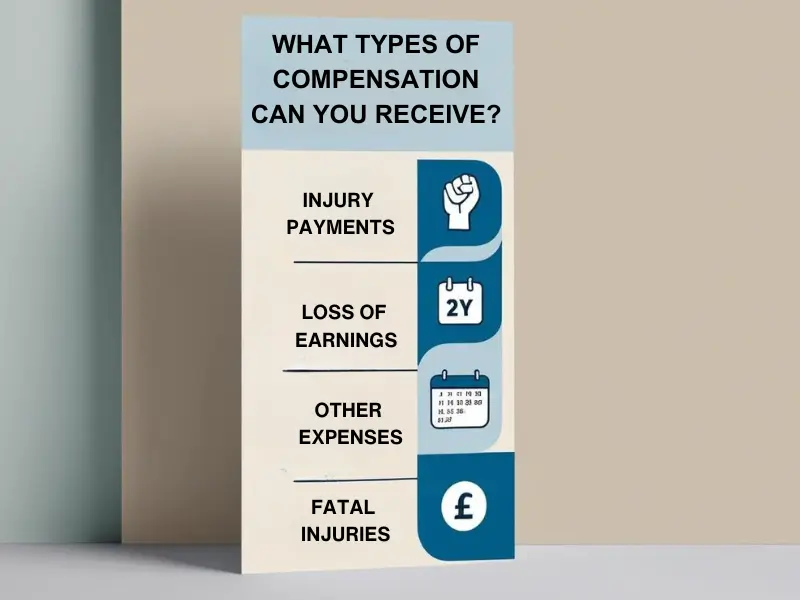
The criminal injury compensation awarded aims to cover different impacts of the crime:
- Injury Payments: Most awards are based on a fixed tariff amount for specific injuries. The CICA Scheme document lists hundreds of injury descriptions, each assigned to a value band. More severe injuries receive higher amounts. If you have multiple injuries, specific rules decide how they are combined.
- Loss of Earnings: If the crime meant you couldn’t work, you might be able to claim for lost earnings or reduced earning capacity in the future. There are strict rules around this, usually requiring significant time off work and proof of your normal income.
- Other Expenses: In some cases, you might be able to claim for specific costs you had only because of the crime, which you couldn’t get covered elsewhere (like by the NHS). This can include things like certain medical expenses, physical aids, or necessary home adaptations. Receipts and proof are essential.
- Fatal Injuries: If a close relative died because of a violent crime, specific family members might be able to claim bereavement payments, dependency payments (if financially reliant on the person who died), and funeral costs.
CICA compensation is primarily based on the injury tariff. Payments for loss of earnings and expenses are less common and have higher evidence requirements.
How Much Criminal Injury Compensation Will I Get?
This is a very common and understandable question. Unfortunately, there’s no simple answer that an online calculator can provide for other types of claims. The answer to “how much criminal injury compensation will I get?” depends entirely on:
- The specific injuries CICA agrees were caused by the crime.
- How those injuries fit into the official CICA Tariff of Injuries (which has set payment bands from £1,000 up to £250,000 for the most severe single injuries, though the total maximum is higher if specific loss of earnings, etc., are added).
- Whether you had multiple injuries and how CICA combines them according to the rules.
- Whether any reductions are applied (e.g., due to your conduct or convictions).
- Whether you qualify for loss of earnings or other specific expenses on top of the injury payment.
It’s important to understand that CICA payments are not the same as damages awarded by a civil court for personal injury. The tariff amounts are fixed and often lower than what a court might award for a similar injury.
How Long Does Criminal Injury Compensation Take?
Another frequent question is, “How long does criminal injury compensation take?” Again, there’s no fixed timeframe. Be prepared for the process to take a significant amount of time.
- Simple Cases: Straightforward claims with clear police reports and easily confirmed injuries might be processed within 12-18 months.
- Complex Cases: More complex cases involving ongoing medical issues, serious injuries, loss of earnings calculations, historical abuse claims, or where eligibility is questioned, can take much longer – potentially several years.
Factors influencing the timescale include:
- How quickly the police provide information to CICA.
- How quickly doctors respond to requests for medical records.
- The complexity of your injuries and financial losses.
- CICA’s current workload.
Patience is often required throughout the process. CICA should keep you updated, but expect significant waiting periods.
What If You Disagree with CICA’s Decision?
If CICA refuses your claim or you disagree with the amount awarded, you don’t have to accept the initial decision.
- Review: You usually have the right to ask CICA to review its decision. You must request this within 56 days of the date of the decision letter. A different claims officer will look at your case again. You can provide more information or explain why you think the decision was wrong.
- Appeal: If you are still unhappy after the review decision, you can appeal to the First-tier Tribunal (Criminal Injuries Compensation). This is an independent body, separate from CICA. You must appeal within 90 days of the review decision date. The Tribunal will look at your case afresh.
Does Criminal Injury Compensation Affect Benefits?
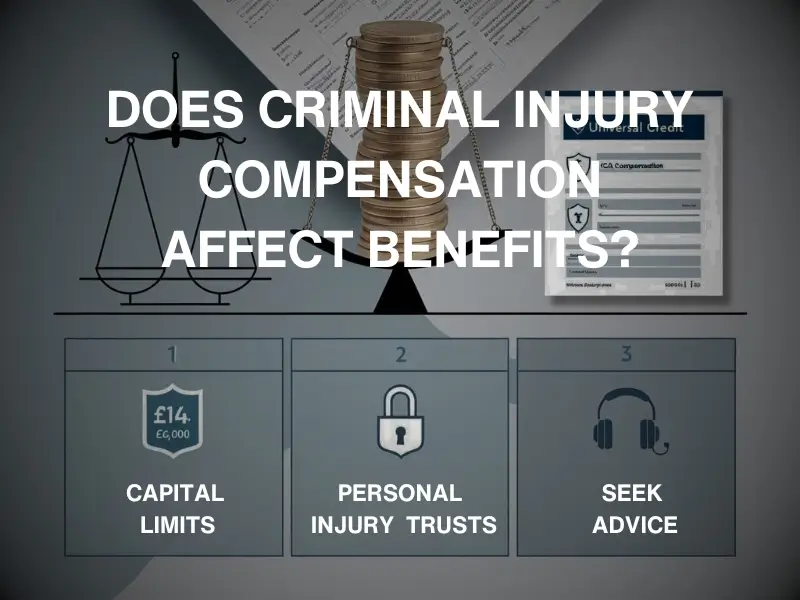
This is a vital question for many people in the UK: “Does criminal injury compensation affect benefits?“
The answer is potentially yes, especially for means-tested benefits like Universal Credit, Housing Benefit, or Income Support.
- Capital Limits: Most means-tested benefits have limits on how much capital (savings and assets) you can have. A CICA payment counts as capital. If the payment pushes your savings over the limit (like £16,000 for Universal Credit), your benefits may be cut or stopped.
- Personal Injury Trusts: One way to protect both your compensation and your benefits is to set up a special bank account called a Personal Injury Trust (or Compensation Protection Trust). If the trust is set up properly, officials usually ignore that money when checking if you can get means-tested benefits.
- Seek Advice: The rules around benefits are complex. If you receive means-tested benefits and are expecting a CICA payment, it is essential to get advice before you receive the money. Contact Citizens Advice, Welfare Rights organisations, or a solicitor experienced in setting up trusts. Do not ignore this – failing to declare the payment or manage it correctly can cause significant problems.
Do You Need a Solicitor?
You do not need a solicitor to apply to CICA. Applicants use the scheme directly, and CICA communicates with them.
However, some people choose to use criminal injury solicitors or claims management companies. When might this be helpful?
- Complex Cases: If your injuries are very severe, involve complex future losses, or if there are significant difficulties with eligibility (e.g., disputed police reports, historical abuse claims).
- Appeals: A solicitor can be particularly helpful if you need to appeal a decision to the Tribunal, as this involves more formal legal processes.
- Time and Stress: Some people prefer to have someone else handle the paperwork and communication, especially if they find the process too stressful or difficult alongside recovering from their injuries.
Things to Consider:
- Cost: Solicitors and claims companies will charge for their services. This is often a percentage of your compensation (a ‘success fee’ under a ‘no win, no fee’ agreement) or fixed fees. Ensure you fully understand the costs before agreeing to anything. CICA does not pay your legal costs.
- Value: Consider whether the potential benefit of using a representative outweighs the cost, especially for straightforward claims based only on the injury tariff.
You always have the right to apply yourself for free.
Moving Forward
The Criminal Injuries Compensation Scheme exists to provide financial support and acknowledgement to those affected by violent crime in Great Britain. While the process requires patience and understanding the rules is key, it can offer valuable help during a difficult time.
Remember to gather information, report the crime promptly if possible, be aware of the time limits, and seek advice on benefits if needed. The official GOV.UK website and the Criminal Injuries Compensation Authority are the definitive sources for the latest rules and application forms.
Read more about How to Suggest a Community Payback Project in the UK
Source / Ref.: Gov.uk Rsvporg.co.uk Contains public sector information licensed under Open Government Licence v3.0.
Written by [Ketan Borada / British Portal Team] – Founder of British Portal, dedicated to providing accurate and up-to-date information on UK public services and benefits.Related Posts


Previous Post
Next Post







- Business
 5
5 - Cricket5
- Department for Education49
- Departments3
- Driving and Transport
 53
53 - Education45
- Finance6
- Football13
- Golf3
- Government
 108
108 - Guides1
- Health
 5
5 - Health4
- International Politics9
- Law and Justice31
- Money and Tax23
- National Politics4
- News68
- Politics6
- Sports38
- Technology5
- Tennis3
- Transportation4
- Uncategorized4
- Visa
 17
17 - Visas and Immigration
 24
24 - Weather1