Have you ever seen people in high-visibility jackets working in your local park, cleaning streets, or decorating a community building? Chances are you might have witnessed community payback in action. This isn’t just random work; it’s part of a sentence given by courts, and importantly, you can have a say in what projects get done in your area.
Many people across the UK can suggest projects that benefit their local neighbourhood, carried out by offenders serving their sentences. It’s a powerful way to ensure that the justice system directly contributes something positive and visible back into our communities.
Understanding Community Payback Orders
So, what exactly is this scheme? When a court decides that an offence doesn’t warrant a prison sentence, they might issue a Community Payback Order (CPO). Think of it as a structured way for an offender to give back to the community through unpaid work.
- What is a Community Payback Order? It’s a formal sentence requiring an offender to complete a set number of unpaid work hours (often ranging from 40 to 300 hours).
- Who Manages It? This community payback scheme is managed and supervised by the Probation Service in England and Wales (and equivalent bodies in other parts of the UK). Trained staff oversee the offenders and the projects.
- What are the Aims? Community Payback has several goals:
- Punishment: It restricts the offender’s free time and requires effort.
- Payback: It provides a tangible way for offenders to make amends to the community they’ve harmed.
- Community Benefit: Local areas get improvements and help they might not otherwise receive.
- Changing Behaviour: The structure and responsibility can help encourage offenders towards a more positive path.
While discussions occur around are community payback orders are effective in the broader sense of reducing reoffending, one clear outcome is the completion of projects that visibly improve local spaces.
Why Your Project Idea Matters
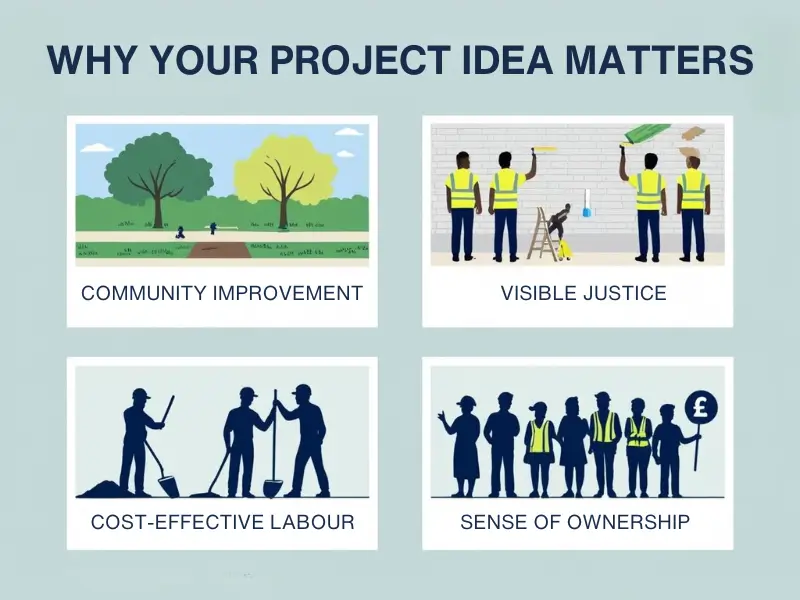
The tasks offenders undertake are incredibly varied, but they often rely on suggestions from people like you. Nominating a project has real benefits:
- Direct Community Improvement: You get to see a direct, positive change in your neighbourhood – cleaner parks, freshly painted community halls, and improved public spaces.
- Visible Justice: It helps communities see that consequences are being delivered and that offenders are contributing back. This visibility was highlighted as important by politicians and local councils.
- Cost-Effective Labour: Needed work gets done without significant cost to local taxpayers or community groups, often just needing materials provided.
- Sense of Ownership: Suggesting a project connects you directly to improving your local area.
What Makes a Good Community Payback Project?
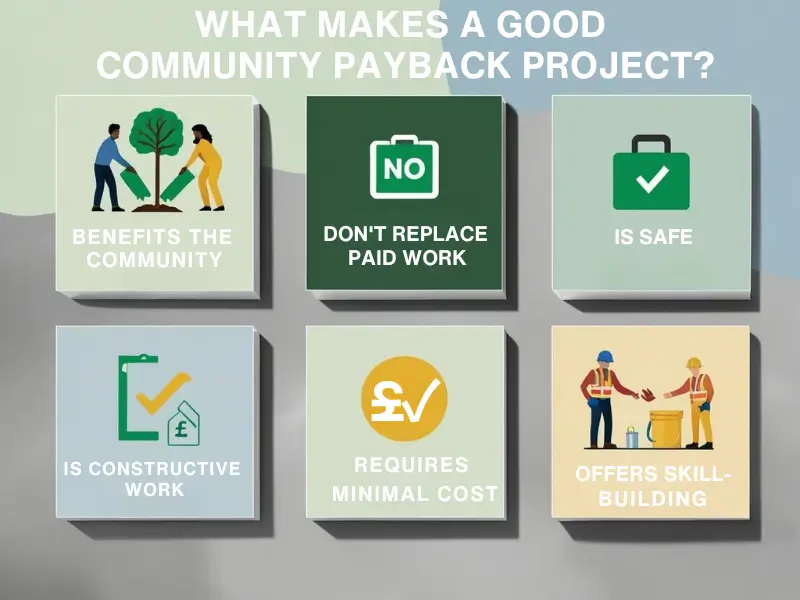
Not every job is suitable. The Probation Service has to consider several factors when deciding which nominated projects to take on. Generally, a good project:
- Benefits the Community: The work should improve the local environment or support a local charity or public service. It must be work that benefits the community as a whole.
- Don’t Replace Paid Work: Offenders should not be doing jobs that would otherwise be done by paid workers. This is a strict rule.
- Is Safe: The project location and tasks must be safe for both the offenders undertaking the work and the general public. Risk assessments are carried out.
- Is Constructive Work: The tasks should be worthwhile and provide a sense of purpose.
- Requires Minimal Cost: While offenders provide the labour for free, projects needing very expensive materials might be less feasible. Often, local councils or community groups provide basic materials.
- (Bonus) Offers Potential Skills: Sometimes, projects can help offenders learn basic skills (like painting, gardening, and teamwork), which can aid their rehabilitation.
Community Payback Examples: What Kind of Work Gets Done?
The range is broad, ensuring there’s always a need for new project ideas. Here are some typical community payback examples:
- Environmental Projects:
- Clearing overgrown areas in parks or along waterways.
- Litter picking and street cleaning.
- Planting trees and gardening in public spaces.
- Conservation work, like maintaining footpaths or restoring habitats.
- Painting and Decorating:
- Refreshing tired community centres, village halls, or youth clubs.
- Painting over graffiti in public areas.
- Maintenance and Upkeep:
- Repairing fences or benches in parks.
- Tidying up churchyards, cemeteries, or memorial gardens.
- Clearing pathways of snow or leaves.
- Working with Charities:
- Sorting donations in charity shops.
- Helping set up local events.
- Maintaining grounds for community organisations.
Think about your local area – is there a rundown playground? A community building needing a lick of paint? An area plagued by litter? These could all be potential projects.
How to Nominate a Project in the UK
Getting your idea considered is straightforward. Here’s how you can generally do it:
- Identify a Need: Look around your local area. What needs doing? Talk to neighbours or local groups.
- Check the Criteria: Does your idea fit the points mentioned above (community benefit, safety, no paid job replacement)?
- Find the Right Contact:
- England and Wales: The UK government has a central webpage where you can nominate a project directly online. Search for “Nominate a Community Payback project UK gov” or visit the relevant section on the GOV.UK website. This is often the most direct route.
- Local Checks: You can also sometimes find nomination forms or contact details on your local council’s website (often under ‘Community Safety’ or similar sections) or the website of your regional Probation Service.
- Scotland: It’s important to note that the system for Community Payback Order Scotland operates under separate legislation and local authority management. If you’re in Scotland, check your council’s or the Scottish Government’s website to see how projects are chosen and suggested. The central UK nomination portal may not apply.
- Submit Your Suggestion: Fill in the online form or contact the relevant body with details about the project:
- What the work involves.
- Where it is located.
- Why it would benefit the community.
- Any potential contacts (like a community group leader).
What Happens After You Nominate?
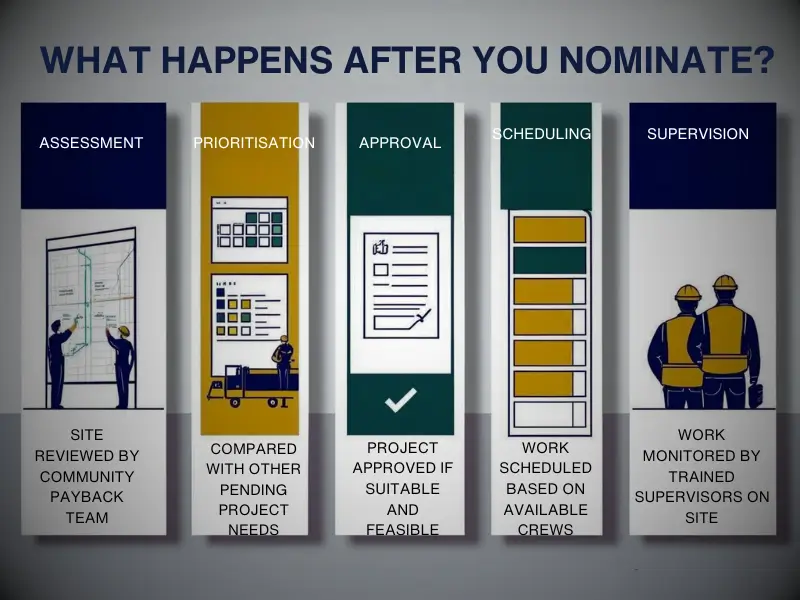
Submitting an idea doesn’t guarantee it will happen immediately, but it starts the process:
- Assessment: The Probation Service will review your suggestion. A community payback supervisor or placement coordinator might visit the site to assess its suitability and safety.
- Prioritisation: They consider factors like the availability of work crews (offenders), the type of work needed, and existing projects.
- Approval: If deemed suitable and resources allow, the project can be scheduled.
- Supervision: Trained staff closely watch the offenders during the project to make sure the work is safe and done right.
Even if they don’t pick your project, your nomination helps the Probation Service learn what the local community needs.
Your Contribution Matters
Nominating a community payback project is a practical way to make a difference. It helps ensure that sentences served in the community provide real, tangible benefits back to neighbourhoods across the UK. It turns the idea of ‘paying back’ into visible improvements, benefiting everyone and reinforcing the link between justice and community wellbeing.
If you see a need in your area, don’t hesitate to put forward your idea. It’s a simple action that can lead to positive changes right on your doorstep.
Read more about How Do UK Community Sentences Work?
Source / Ref.: Cleveland.pcc.police.uk Thurrock.gov.uk Andrewgriffith.uk Contains public sector information licensed under Open Government Licence v3.0.
Written by [Ketan Borada / British Portal Team] – Founder of British Portal, dedicated to providing accurate and up-to-date information on UK public services and benefits.Related Posts

Previous Post
Next Post







- Business
 5
5 - Cricket5
- Department for Education49
- Departments3
- Driving and Transport
 53
53 - Education45
- Finance6
- Football13
- Golf3
- Government
 108
108 - Guides1
- Health
 5
5 - Health4
- International Politics9
- Law and Justice31
- Money and Tax23
- National Politics4
- News68
- Politics6
- Sports38
- Technology5
- Tennis3
- Transportation4
- Uncategorized4
- Visa
 17
17 - Visas and Immigration
 24
24 - Weather1