
Facing debt is stressful, and the thought of bailiffs visiting can add to that worry. Knowing your rights and what bailiffs can and cannot do is essential. This blog explains the process in simple terms, helping you better understand the situation if you’re dealing with bailiffs (now often officially called ‘enforcement agents’) in England and Wales.
What is a Bailiff and Why Might They Visit?
A bailiff is authorized to collect debts owed to creditors (people or companies you owe money to). They might visit your home if you haven’t paid certain debts after receiving warnings and potentially court action.
Common reasons for bailiff action include:
- Council Tax arrears
- County Court Judgments (CCJs)
- High Court Judgments
- Unpaid HMRC debts (like tax or National Insurance)
- Unpaid magistrates’ court fines
- Child Maintenance arrears
- Unpaid parking penalty charge notices
Understanding what a bailiff is and their role is the first step. They are not the same as doorstep debt collectors, who have far fewer powers.
Different Types of Bailiffs Matter
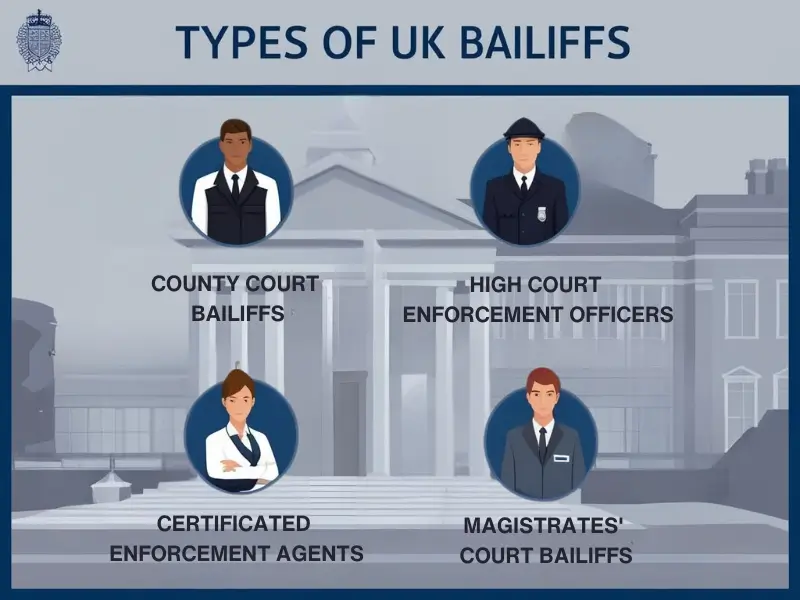
It’s helpful to know there are different types of bailiffs, as their specific powers can vary slightly:
- County Court Bailiffs: Employed by the courts, usually dealing with County Court Judgments (CCJs).
- High Court Enforcement Officers (HCEOs): Often used for larger debts (over £600) that have gone through the High Court. They generally have slightly more extensive high court bailiffs’ powers.
- Certificated Enforcement Agents: These are private bailiffs who must hold a bailiff certificate from the court. They collect debts like Council Tax, business rates, parking fines, and sometimes CCJs or High Court debts under instruction. You might search for bailiff companies to see who they work for.
- Magistrates’ Court Bailiffs: Collect unpaid fines imposed by magistrates’ courts.
Knowing the difference, for example, the bailiff HCEO difference, helps you understand the specific rules that apply. There are also private bailiffs’ powers that are regulated. The role is a formal one; you can even find information on how to become a bailiff through the National Careers Service, detailing bailiff requirements and potential bailiff salary expectations. This shows it’s a regulated profession.
Before a Bailiff Visits: The Notice of Enforcement
You should nearly always receive a warning before a bailiff visits. This usually comes as a letter called a “Notice of Enforcement“.
- This notice gives you at least 7 clear days (excluding Sundays and bank holidays) before a bailiff can visit.
- It tells you the debt amount, who the creditor is, and the bailiff firm involved.
- Crucially: Use this time to contact the bailiff firm or creditor to arrange payment or get debt advice. Acting now is better than waiting for a visit. The bailiff enforcement notice is a critical document.
When the Bailiff Arrives: Checking Identity is Key
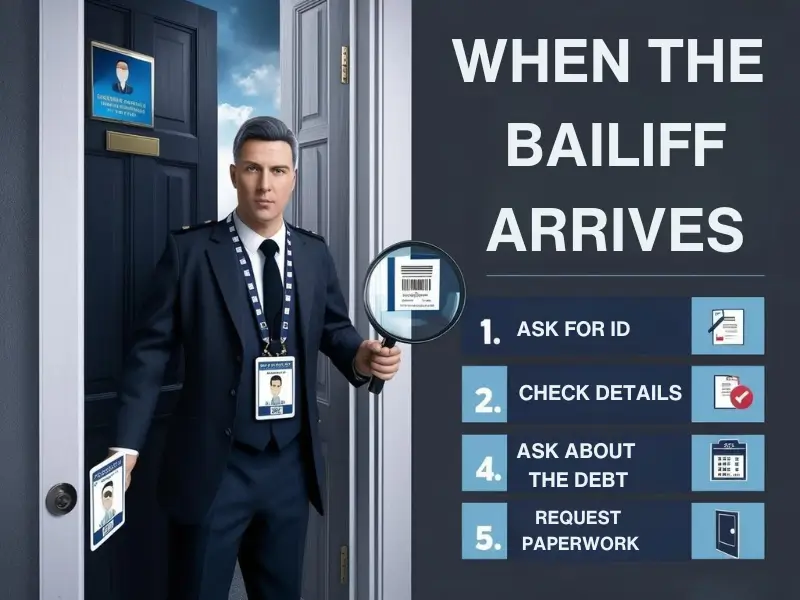
If a bailiff visits your home, the very first thing you should do is check who they are.
- Ask for ID: Ask to see their identification. This could be an ID card, badge (bailiff badge UK), or enforcement agent certificate.
- Check the Details: Look for their name, the company they work for, and potentially their photo. Certificated Enforcement Agents must carry their certificate. Proper bailiff identification is crucial.
- Ask About the Debt: Ask them to confirm which debt they are collecting and who the creditor is. They should have paperwork like a ‘Writ of Control’ (High Court) or ‘Warrant of Control’ (County Court/Magistrates). This paperwork justifies the bailiff court order.
- Don’t Have to Open the Door Immediately: You can ask them to pass ID and paperwork through the letterbox first.
If they cannot provide proper proof of identity and authorization for your debt, do not let them in or deal with them further.
Can a Bailiff Force Entry Into Your Home? Know Your Rights
This is often the biggest worry. The rules depend on the type of debt and the bailiff:
- General Rule (Most Debts): Bailiffs CANNOT force entry. For common debts like Council Tax, CCJs (enforced via County Court), parking fines, or catalog debts, a bailiff cannot force their way past you, push past you, put their foot in the door to stop you from closing it or climb through a window. They can come in if you invite them or through an unlocked door (this is called ‘peaceful entry’). Therefore, keeping doors locked is vital.
- High Court Writs & HMRC Debts: High Court Enforcement Officers (HCEOs) collecting High Court debts, or bailiffs collecting certain HMRC debts, may have the power to force entry, but usually only as a last resort and often requiring separate court permission to use a locksmith. They still cannot use violence against you. This specific high court bailiff’s powers of entry are limited.
- Magistrates’ Court Fines (Criminal): Bailiffs collecting unpaid criminal fines from a magistrates’ court can potentially force entry, but again, specific rules apply.
- Previous Peaceful Entry: If a bailiff has previously been inside your home peacefully (because you let them in or they found an unlocked door) and listed goods under a Controlled Goods Agreement (see below), they can then use reasonable force to re-enter later if you don’t pay as agreed.
So, the answer to “Can a bailiff force entry?” is usually NO for most common debts on a first visit, provided your doors are locked. Understanding bailiff power of entry versus bailiff breaking entry (which is rare and highly regulated) is important. A standard bailiff doorstep visit does not automatically grant them entry.
What Can Bailiffs Do Inside Your Home?
If a bailiff does gain legal entry (either peacefully or, rarely, by force for specific debts), their main power is to ‘take control’ of your belongings to cover the debt value plus their fees.
- Taking Control: This doesn’t always mean removing goods immediately. Often, they will make a list of valuable items in your home that could be sold if the debt isn’t paid.
- Controlled Goods Agreement (CGA): They may ask you to sign a bailiff-controlled goods agreement. This lists the items they’ve taken control of. ‘ You promise to make payments, and the goods remain in your home as long as you stick to the agreement. If you break the CGA, the bailiff can return to remove the goods listed, potentially using force to re-enter. Carefully read and understand any CGA before signing. The bailiff’s list of goods is important.
- What Can Bailiffs Take? They generally look for high-value items like TVs, game consoles, jewelry (non-sentimental), or cars parked at your property (bailiff vehicle, bailiff car on the driveway).
- What Bailiffs CANNOT Take (Exempt Goods): The law protects essential items. Bailiffs cannot take:
- Things needed for basic domestic needs (clothes, bedding, cooker, microwave, fridge, washing machine, essential furniture).
- Bailiff tools of trade or equipment necessary for your job, study, or business, up to a certain value (currently £1,350).
- Someone else’s belongings (bailiff third-party goods). You’ll need proof they belong to someone else (receipts, agreements).
- Pets (bailiff taking pets is generally not allowed).
- A vehicle is crucial for basic needs (e.g., displaying a valid Blue Badge or potentially essential work vehicle under the £1,350 limit). Rules around cars on finance (bailiff car finance) are complex; seek advice.
Understanding bailiff powers is crucial. This includes county court bailiff powers, council tax bailiff powers, and CCJ bailiff powers, all governed by regulations.
Bailiff Charges: What You Need to Know
Bailiffs charge fees set by law, which are added to your debt. There’s usually a three-stage structure:
- Compliance Stage (£75): Charged when the Notice of Enforcement is sent. You pay this even if you pay the debt before they visit.
- Enforcement Stage (£235 + 7.5% of debt over £1,500): Charged on the first visit where the bailiff attempts to take control of goods.
- Sale Stage (£110 + 7.5% of debt over £1,500): Charged if goods are removed and prepared for sale. Plus, auction costs.
- Always ask for a breakdown of fees.
- You can challenge bailiff fees if you think they are wrong or excessive. Resources like Citizens’ Advice can help. Understanding bailiff charges and bailiff enforcement fees, including specific high court enforcement fees, is important.
Paying the Debt or Negotiating
The best way to stop bailiffs is usually to deal with the debt.
- Pay the Creditor Directly: If possible, try to pay the original creditor before the bailiff visits. Keep proof of payment.
- Negotiate with the Bailiff: If you can’t pay in full, offer a realistic bailiff payment plan. Get any agreement in writing. Be aware that they might initially insist on bailiffs demanding full payment, but negotiation is often possible.
- Seek Debt Advice: If you cannot afford to pay, contact a free debt advice charity immediately (see below). They can help negotiate or explore other options.
Vulnerable Situations: Special Rules Apply
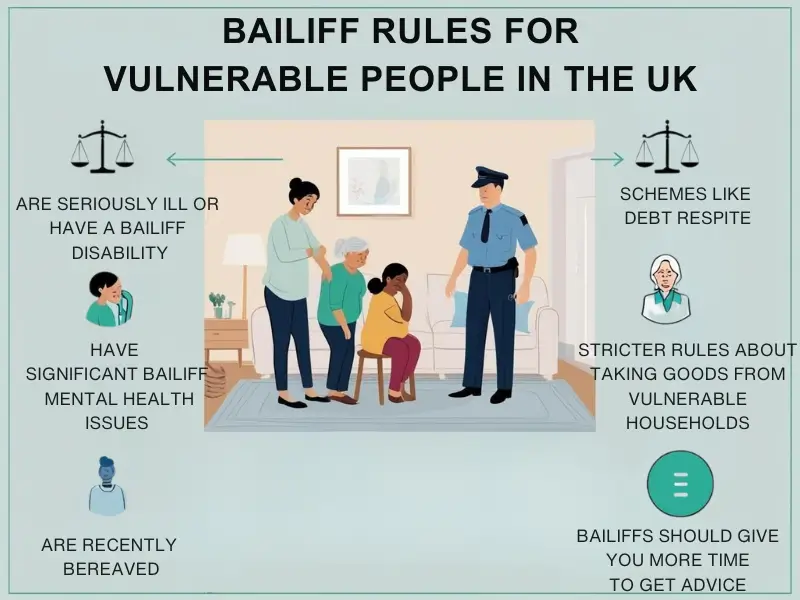
There are special rules if you are considered ‘vulnerable’. This might include if you:
- Are seriously ill or have a bailiff disability
- Have significant bailiff mental health issues
- Are recently bereaved
- Are pregnant or have very young children
- Have severe difficulty understanding or communicating.
If you are vulnerable:
- Tell the bailiff and the creditor immediately. Provide evidence if possible (e.g., doctor’s note).
- Bailiffs should give you more time to get advice and make arrangements.
- There are stricter rules about taking goods from vulnerable households.
- Schemes like Debt Respite (bailiff breathing space) can pause enforcement action while you get advice.
Knowing about vulnerable person bailiff rules is vital for extra protection.
Making a Complaint
If you believe a bailiff has acted incorrectly, broken the rules, or treated you unfairly (e.g., bailiff harassment, trying to take exempt goods, charging wrong fees), you can complain.
- Complain to the Bailiff Firm First: Use their official complaints procedure.
- Complain to the Creditor: The organization the bailiff is collecting for is also responsible.
- Escalate: If unhappy with the response, you can escalate:
- To a professional body like CIVEA (Civil Enforcement Association) or HCEOA (High Court Enforcement Officers Association), if the firm is a member.
- To the court (for Certificated Enforcement Agents).
- To an Ombudsman (e.g., Local Government & Social Care Ombudsman for council tax issues, Financial Ombudsman for some consumer credit debts). The bailiff ombudsman route depends on the debt type.
Bailiffs must follow a strict bailiff code of practice and regulations.
Where to Get Free Help and Advice
Dealing with bailiffs can be daunting, but you don’t have to face it alone. Free, impartial advice is available:
- Citizens Advice: This offers comprehensive bailiff advice online, by phone, or face-to-face.
- StepChange Debt Charity: Provides expert debt advice and solutions.
- National Debtline: This offers free debt advice over the phone and online tools.
These organizations offer bailiff debt help and can negotiate with creditors/bailiffs on your behalf. Look for bailiff advice online or a bailiff advice helpline.
Takeaway
Understanding the basics – who bailiffs are, what notice you should get (bailiff enforcement notice), your rights regarding entry (can a bailiff force entry), what they can take (what can bailiffs take), and the fee structure (bailiff charges) – empowers you. Always check identification, know the rules about entry, be aware of exempt goods, and never hesitate to seek free debt advice if you are struggling. Knowing your rights is the best way to navigate a difficult situation.
Read more about Probation in the UK: Understanding Sentences, Rules & Your Rights
Source / Ref.: Gov.uk Commonslibrary.parliament.uk Contains public sector information licensed under Open Government Licence v3.0.
Written by [Ketan Borada / British Portal Team] – Founder of British Portal, dedicated to providing accurate and up-to-date information on UK public services and benefits.Related Posts

Previous Post
Next Post







- Business
 5
5 - Cricket5
- Department for Education49
- Departments3
- Driving and Transport
 53
53 - Education45
- Finance6
- Football13
- Golf3
- Government
 108
108 - Guides1
- Health4
- Health
 5
5 - International Politics9
- Law and Justice31
- Money and Tax23
- National Politics4
- News68
- Politics6
- Sports38
- Technology5
- Tennis3
- Transportation4
- Uncategorized4
- Visa
 17
17 - Visas and Immigration
 24
24 - Weather1