
Ever bought something that broke almost immediately? Or paid for a service that just wasn’t up to scratch? It’s frustrating, but the good news is, when you spend your hard-earned money in the UK, you have powerful protections. Understanding your consumer rights is the first step to ensuring you get what you pay for and knowing what to do when things go wrong.
The cornerstone of these protections is the Consumer Rights Act 2015. This important piece of consumer rights legislation applies across the UK and sets out the minimum standards you can expect for goods, services, and even digital content. Forget jargon; let’s break down what the Consumer Rights Act 2015 means for you.
Your Rights When Buying Goods: More Than Just Hope
When you buy goods – anything from a kettle or clothes to a sofa or smartphone – the law says they must meet certain standards. Think of these as basic promises the seller makes to you:
- Satisfactory Quality: This is a key concept in British consumer law. Goods shouldn’t be faulty or damaged when you receive them. They should be of a standard that a reasonable person would consider satisfactory, considering the price, description, and any other relevant factors. This includes aspects like:
- Appearance and finish
- Freedom from minor defects (unless pointed out)
- Safety
- Durability (how long they should last)
- Fit for Purpose: The item must be fit for purpose. This means it should do the job it’s meant to do. If you ask a retailer if a specific printer works with your computer model, and they say yes, it should. If an item has only one obvious use (like a waterproof coat), it must perform that function.
- As Described: Goods must match the description given to you by the trader (whether verbally, on packaging, or in an advert). If you buy based on a sample or model you saw, the actual goods must match. If a product is not as described, you have rights.
What about how long things should last?
The Consumer Rights Act 2015 states that goods must last a reasonable time. There’s no exact definition of ‘reasonable’ as it depends on the item. A £500 washing machine should last much longer than a £10 T-shirt. This right can extend beyond a manufacturer’s guarantee – sometimes even up to 6 years in England, Wales, and Northern Ireland (5 years in Scotland) for bringing a claim, although proving fault becomes harder over time.
If you believe an item hasn’t lasted a reasonable length of time, even after a year or two, you may still have rights.
Problem with Your Purchase? Getting Faulty Goods Sorted
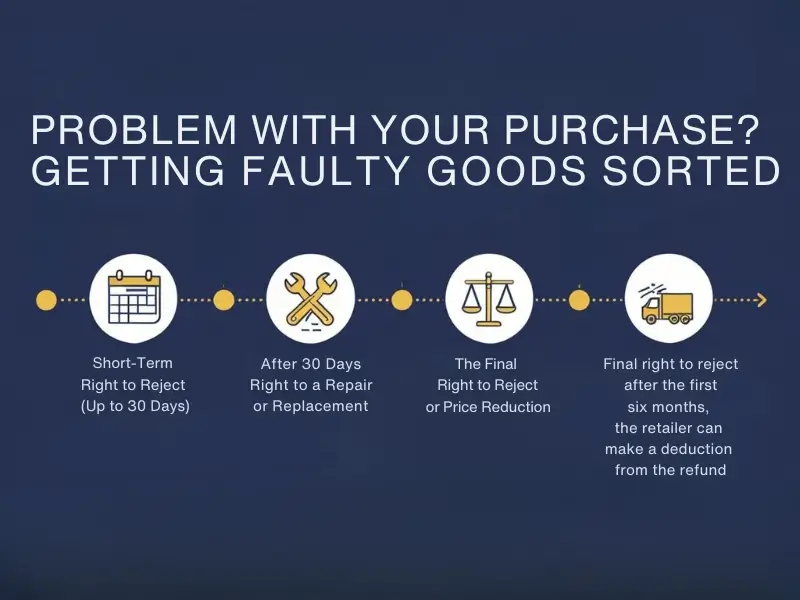
So, what happens if the goods you bought are faulty, not fit for purpose, or not as described? The Consumer Rights Act 2015 gives you clear remedies. The key is how long ago you made the purchase.
The Short-Term Right to Reject (Up to 30 Days)
- If goods are faulty within 30 days of you taking ownership, you have the right to reject them and get a full consumer rights refund.
- This is often the simplest route. You need to make it clear to the retailer that you are rejecting the item under the Consumer Rights Act 2015 refund rules.
- The retailer is responsible for arranging the return of the faulty goods, though you need to make them available.
After 30 Days: Right to a Repair or Replacement
- If a fault appears after 30 days (but generally within the first six months), you must give the retailer one opportunity to repair or replace it.
- You can state your preference, but the retailer can choose the option that is cheaper or easier for them, as long as it doesn’t significantly inconvenience you.
- The repair or replacement must be done:
- Within a reasonable time.
- Without significant inconvenience to you.
- Free of charge.
If you need to pursue consumer rights by returning faulty goods for repair, the retailer often covers reasonable postage costs.
The Final Right to Reject or Price Reduction
You gain the final right to reject (and get a refund) or ask for a price reduction (if you want to keep the item) in these situations:
- The repair or replacement attempt fails.
- A repair or replacement is impossible.
- A repair or replacement would cause significant inconvenience.
- The repair or replacement would take an unreasonably long time.
Important Note: If you exercise the final right to reject after the first six months, the retailer can make a deduction from the refund to account for the use you’ve had of the goods. This doesn’t apply if the goods are rejected within the first six months.
The Crucial 6-Month Rule
For the first six months after purchase, if a fault appears, the law assumes the fault was present when you bought it (unless the retailer can prove otherwise). This makes claiming a repair or replacement easier. After six months, the burden of proof shifts to you to show the fault was there at the time of purchase – this can be harder, sometimes requiring an expert report.
Your Rights for Digital Content
The Consumer Rights Act 2015 was the first major consumer rights legislation to give specific rights for digital content – things like apps, music downloads, ebooks, games, or software.
- Digital content must be:
- Of Satisfactory Quality.
- Fit for Purpose.
- As Described.
- If your digital content doesn’t meet these standards, your remedy is usually a repair or replacement.
- If a repair/replacement isn’t possible or successful, you can seek a price reduction.
- Crucially, if the digital content you’ve downloaded damages your device or other digital content (e.g., due to a virus), and the trader didn’t use reasonable care and skill, they may have to repair the damage or compensate you.
Your Rights When Paying for Services
Consumer rights aren’t just about physical goods. When you pay someone to perform a service – like a builder, decorator, dry cleaner, hairdresser, or garage repair person – the Act provides protection, too.
- The service must be carried out with Reasonable Care and Skill. This means the work should be done to a proper standard, similar to what a competent trader in that field would provide. If you experience poor service, this right may have been breached.
- Information provided (written or verbal) is binding. If a trader tells you a specific kitchen fitting UK job will take three days, that becomes part of the contract.
- If the price wasn’t agreed beforehand, the service must be provided for a Reasonable Price.
- If a timeframe wasn’t agreed upon, the service must be completed within a Reasonable Time.
What if a service isn’t up to scratch?
- Your primary remedy is the right to repeat performance. The trader should redo the service (or the faulty part of it) correctly, free of charge, and within a reasonable time, without causing significant inconvenience.
- If repeat performance isn’t possible or can’t be done reasonably quickly, you have the right to a price reduction. This could be up to 100% of the cost, depending on how bad the service was.
Online Shopping, Phone & Mail Order Rights (Distance Selling)
Buying online, over the phone, or via mail order gives you extra protection under the Consumer Contracts Regulations (often working alongside the Consumer Rights Act).
- 14-Day Cooling-Off Period: For many purchases (not all – exceptions include perishable items and personalized goods), you have 14 days after receiving your goods to change your mind and get a full refund. This is your consumer rights cooling off period. You usually have to pay the return postage.
- Information Requirements: Retailers must provide clear information before they buy.
- Delivery: Unless agreed otherwise, the retailer must deliver goods within 30 days. They are responsible for the goods until they are in your possession. If you experience delayed delivery or non-delivery, you have rights, potentially including canceling the order if delivery was essential by a certain date or unduly delayed. Dealing with undelivered goods is a common issue where consumer rights distance selling rules apply.
Common Situations & Questions Answered
- Used Cars (from a Trader): Yes, the Consumer Rights Act 2015 used car provisions mean second-hand cars bought from traders must be of satisfactory quality, fit for purpose, and as described. However, ‘satisfactory quality’ takes into account the car’s age and mileage. A fault on a 10-year-old car might be acceptable wear and tear, but not on a nearly new one. Consumers’ rights to second-hand car purchases from private sellers have far fewer protections. Check the Consumer Rights Act 2015 used car-specific guides for details on rejection.
- Proof of Purchase: You don’t always need a receipt. A bank statement, credit card slip, or loyalty card record can work. If you have consumer rights and no receipt, provide any evidence you can.
- Gifts: The person who received the gift generally needs proof of purchase from the buyer to exercise their rights.
- Sale Items: Your statutory consumer rights still apply unless the specific fault you’re complaining about was pointed out at the time of sale (e.g., a label saying ‘sold as seen due to scratch’).
- Warranties & Guarantees: These are offered by manufacturers or retailers and are in addition to your statutory rights; they don’t replace them. Sometimes a warranty offers more (like accidental damage cover), but often your consumer rights warranty protection under the Act is stronger, especially regarding how long goods should last.
- Electrical Goods: Items like TVs, washing machines, and laptops must meet the usual standards. Questions like consumer rights and how long a TV should last depend on ‘reasonable time’. Look into consumer rights for electrical goods specifics if needed.
- Unfair Contract Terms: The Consumer Rights Act 2015 protects you from unfair contract terms, including high cancellation fees and clauses that eliminate your basic rights.
Taking Action: How to Assert Your Consumer Rights
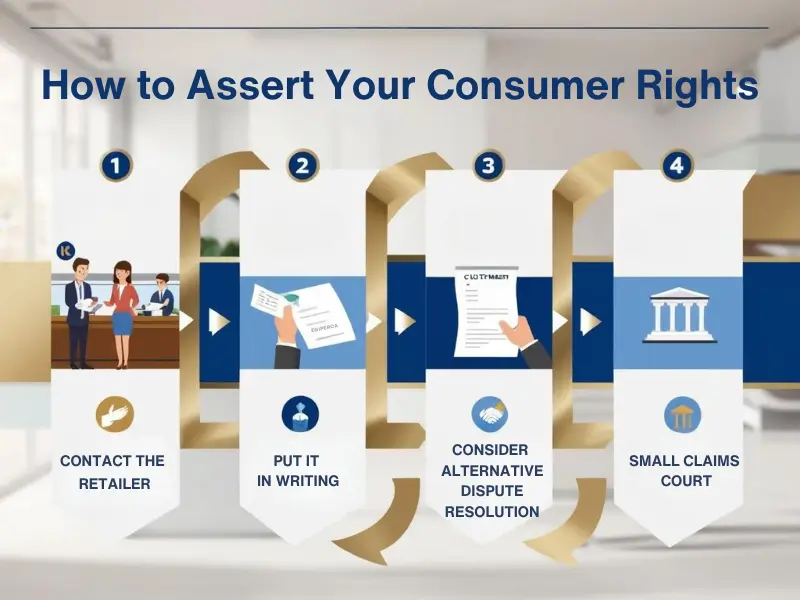
Knowing your rights is one thing; using them is another. Here’s a step-by-step approach:
- Contact the Retailer/Trader First: This is always the initial step. Contact the business you bought from (not the manufacturer initially). Explain the problem clearly and calmly. State what you want (a refund, repair, replacement, etc.). Mentioning the Consumer Rights Act 2015 shows you know your position. Keep records of communication.
- Put it in Writing: If a conversation doesn’t resolve it, follow up with a formal letter or email. Clearly outline the issue, reference your consumer rights complaint, state the remedy you seek under the Act, and give them a deadline to respond (e.g., 14 days). You can often find a consumer rights letter template online. Searching for a Consumer Rights Act 2015 sample complaint letter might help.
- Consider Alternative Dispute Resolution (ADR): If the trader won’t help or you’re in dispute, ADR is an option. This involves an independent third party helping resolve the issue without going to court. Many sectors have ombudsman schemes (e.g., energy, financial services). Seeking help from the consumer rights ombudsman relevant to your issue can be effective.
- Small Claims Court: As a last resort for claims up to £10,000 in England & Wales (£5,000 in Scotland, £3,000 in NI), you can take the trader to the Small Claims Court. It’s designed to be simpler and less formal than regular court proceedings.
Where to Get Help:

- Citizens Advice: Offers free, impartial advice on consumer rights. They have a website, phone line, and local centers. They are a primary resource for citizens’ advice on consumer rights.
- Trading Standards: Enforces consumer protection laws. While they don’t usually take on individual cases, reporting issues helps them build intelligence against rogue traders. Contact them via Citizens’ Advice. (Trading standards consumer rights focus is enforcement).
- Which? Consumer Rights: The Which? The website provides excellent guides (often answering consumer rights questions directly).
- MoneySavingExpert (MSE): Offers practical guides and template letters. Searches like Martin Lewis’s consumer rights often lead here.
- Consumer Rights Solicitors: For complex or high-value disputes, you might consult consumer rights solicitors, though this involves costs. Check for reviews and specialisms. Some may offer consumer rights no win no fee arrangements, but understand the terms.
Understanding your UK consumer rights empowers you. The Consumer Rights Act 2015 provides strong protection when things go wrong with goods, services, or digital content. By knowing the basics – satisfactory quality, fit for purpose, as described, and your rights to refunds, repairs, or replacements – you can approach issues confidently and ensure you get a fair deal.
Don’t hesitate to seek help from organizations like Citizens’ Advice if you need further guidance. Know your consumer rights and use them!
FAQs
1. Do I absolutely need the original receipt to return faulty goods?
Not necessarily. While a receipt is the easiest proof of purchase, it’s not the only way. Other evidence, like a bank statement, credit card slip showing the transaction, or even a loyalty card record, can be acceptable. You just need to prove that you bought the item from that specific retailer and when.
2. Are my consumer rights different if I bought an item in a sale?
Generally, no. Your core rights under the Consumer Rights Act 2015 (that goods must be of satisfactory quality, fit for purpose, and as described) still apply fully to sale items. The only exception is if the specific fault you’re complaining about was clearly pointed out to you before you bought it (e.g., a label saying ‘sold cheap due to cosmetic scratch’).
3. What’s the difference between a warranty/guarantee and my statutory consumer rights?
Your statutory rights are the minimum legal protections guaranteed by the Consumer Rights Act 2015. A warranty or guarantee is an additional promise offered by the retailer or manufacturer. Sometimes, these offer extra benefits (like accidental damage cover), but your statutory rights often provide longer or broader protection (especially regarding how long an item should reasonably last) and exist regardless of any warranty. You can rely on your statutory rights even if the warranty has expired.
4. Who is responsible for dealing with my complaint – the shop or the manufacturer?
You should keep records of all income, expenses, sales and purchases, personal pension contributions, charitable donations, and any other information relevant to your tax return. These records should be kept for at least 5 years after the submission deadline.
5. The faulty item was a gift. Can the recipient return it?
Yes, but it’s usually simplest if the original buyer handles the return, as they hold the contract and proof of purchase. If you received the gift, you will ideally need the original receipt or other proof of purchase from the buyer to assert the consumer rights associated with that item. Without it, the retailer may refuse the return.
Source / Ref.: Iclg.com Which.co.uk Contains public sector information licensed under Open Government Licence v3.0.
Written by [Ketan Borada / British Portal Team] – Founder of British Portal, dedicated to providing accurate and up-to-date information on UK public services and benefits.Related Posts


Previous Post
Next Post







- Business
 5
5 - Cricket5
- Department for Education49
- Departments3
- Driving and Transport
 53
53 - Education45
- Finance6
- Football13
- Golf3
- Government
 108
108 - Guides1
- Health4
- Health
 5
5 - International Politics9
- Law and Justice31
- Money and Tax23
- National Politics4
- News68
- Politics6
- Sports38
- Technology5
- Tennis3
- Transportation4
- Uncategorized4
- Visa
 17
17 - Visas and Immigration
 24
24 - Weather1